
For a decade, the home robot has been a fixture of keynote reels and crowdfunding pages — a thing that folds a towel on stage, then vanishes before anyone checks whether it can do the second towel. That gap between demo and driveway is finally narrowing. Weave Robotics has launched Isaac 1, a home robot pitched squarely at chores, with a price tag, a delivery window, and a preorder button. It is a small but telling signal that consumer robotics is trying to graduate from spectacle to shipping product. The question worth asking is not whether the machine impresses — plenty do — but whether the moment is real, and whether it means anything at all in a market like India.
The product
Isaac 1 is a privacy-first mobile home robot built around household chores — the launch materials lead with folding laundry, the most stubbornly manual task in most homes. One caveat worth keeping in view: at this stage the folding is not fully autonomous. Like most home robots shipping today, Isaac 1 leans on remote human operators (teleoperation) for the trickiest manipulation, with on-device autonomy handling the repeatable parts. According to The Neuron, citing Weave Robotics, the machine has a collapsible torso and swappable fabric shells, a design choice that reads as much about living-room aesthetics as engineering: a robot people will tolerate in the corner of a home has to look less like a warehouse arm and more like furniture.
The commercial model is the more interesting part. Weave is offering Isaac 1 through a $250 preorder deposit, then either a $449-per-month subscription or a $7,999 upfront purchase, with deliveries planned for this fall. That pricing tells you who the early buyer is — an affluent, time-poor household in a high-labour-cost country — and it frames the robot as a service rather than an appliance. The subscription framing matters: it lowers the psychological barrier of a five-figure outlay and lets Weave push software and capability updates over time, the way a laptop-sized robot arguably needs to be sold.

Why now
The timing is not an accident. The launch, as The Neuron frames it, reflects consumer robotics moving from demos toward shipping products, enabled by advances in physical AI. The past few years have produced rapid progress in the models that let a machine perceive a cluttered scene, predict how objects behave when touched, and plan a sequence of movements — the so-called world models and physical-AI systems that turn a static camera feed into something a robot can act on. Manipulation, long the hard ceiling of home robotics, has become tractable enough to attempt laundry rather than just avoid the coffee table.
Chores are also a shrewd choice of first battlefield. They are concrete, repetitive, and universally disliked — a high-value use case that needs no persuasion. Nobody has to be sold on the appeal of never folding laundry again. And the subscription model lowers the entry price to something a certain kind of household can rationalise against the cost of hired help or the value of reclaimed hours. Cheaper compute, better sensors, and maturing manipulation software have collectively pulled the home robot from research lab to preorder page. That is the genuine shift; the rest is execution.
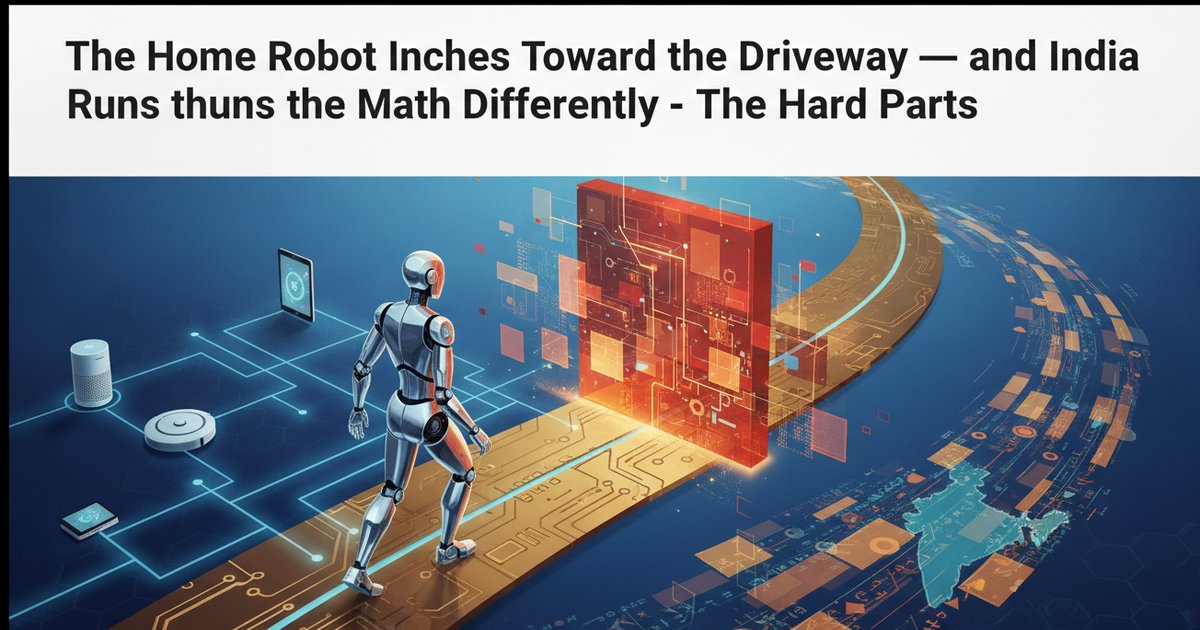
The hard parts
Execution is where the enthusiasm should cool. Reliability in a real home is a brutal problem. A demo happens in a controlled space with known objects and good lighting. A home is a chaos of variables — a sock tangled in a bedsheet, a toddler underfoot, a pet, a chair moved six inches since yesterday. The edge cases are not edges at all; they are the everyday. A robot that folds laundry beautifully nine times and dumps the tenth load on the floor is not a labour-saving device — it is a chore that supervises another chore.
Safety compounds the difficulty. A mobile machine with actuators strong enough to manipulate objects is, by definition, strong enough to hurt someone if it misjudges a situation. Weave’s collapsible, soft-shelled design nods at this, but trust in a home robot is earned over thousands of uneventful hours, not marketing copy. The Neuron is right to flag reliability, cost and safety as the key hurdles that remain.
Then there is the value equation. At $449 a month, the robot competes directly with human labour and with the buyer’s own time, and it has to win decisively on a narrow set of tasks to justify itself. A device that does one chore well is a gadget; a device that does several chores adequately is a platform. Which of those Isaac 1 turns out to be will decide whether it is a milestone or a curiosity.
Finally, privacy. A robot that navigates your home is a mobile sensor package — cameras, microphones, a map of your floor plan and, implicitly, your routines. Weave’s decision to lead with a privacy-first positioning is a recognition that the household is the most sensitive surveillance surface a company can ask to enter. Whether processing stays on-device, what leaves the home, and who can access the map are not footnotes; for many buyers they will be the deciding factor.
The India read
Transplant this product to India and the economics invert almost entirely. The core value proposition of a $449-a-month robot is that human domestic help is scarce and expensive. In most Indian cities, it is neither. Domestic labour is comparatively inexpensive and widely available, which means a household robot is not competing against a costly hire — it is competing against a far cheaper one, plus the social and practical fabric that surrounds it. At current pricing, Isaac 1 is not a rational purchase for the vast majority of Indian homes; it is an imported luxury.
That does not mean home robots have no future here — it means their first wins will look different. The most compelling early cases are not about outsourcing chores but about capability and dignity: accessibility for people with limited mobility, and eldercare in a country whose ageing population is growing while family structures scatter across cities and continents. A robot that helps an elderly parent live independently, or assists a person with a disability with tasks that no amount of cheap labour reliably solves, addresses a need that price alone does not capture. That is where the value math tips.
There is also a manufacturing and pricing story worth watching. India’s cost structures, engineering talent and domestic-market scale could eventually produce cheaper, purpose-built machines rather than premium generalists — robots designed down to a price the market will actually bear. But that is a long road. Mainstream adoption of the general-purpose home robot in India will lag the West by years, gated by cost, reliability and the simple fact that the problem it solves is already solved, imperfectly and affordably, by human hands.
The honest read on Isaac 1, then, is that it is a real product marking a real inflection — automation is genuinely creeping from the demo stage into homes — without yet being the moment. For India, the lesson is sharper still: the same machine can be a plausible luxury in one market and an economic non-starter in another, and the interesting future here begins not with laundry, but with care.
