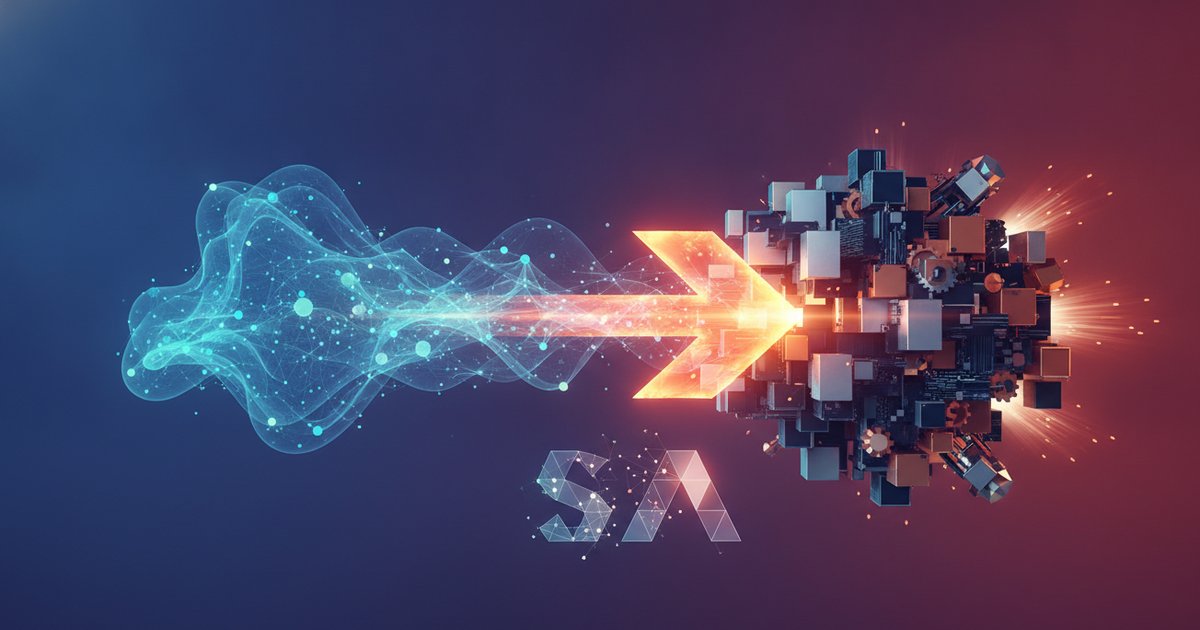
For two decades, the smart money chased bits. Software was cheap to build, infinitely copyable at near-zero marginal cost, and quick to scale — the ideal venture asset. That logic is now inverting in real time. Generative AI has made writing software faster and cheaper than ever, which sounds like a tailwind until you follow it to its conclusion: if anyone can spin up a competent app in an afternoon, the app itself stops being a moat. Capital is responding the way capital always does — it is moving toward the things that remain hard to replicate. Increasingly, that means atoms, not bits.
The rotation
The clearest framing of this shift comes from reporting by TechStartups, citing the Wall Street Journal (June 1, 2026), which argued that AI is making software easier to build and harder to defend — and that this is pushing venture money toward chips, robotics, energy and defence, where replication is genuinely costly. It is a simple thesis with sharp implications: when the barrier to producing a working product collapses, the value migrates to whatever the AI cannot trivially reproduce. A foundry. A robotics supply chain. A grid-scale battery. A defence-grade sensor that took a decade and a regulator’s blessing to certify.
The numbers attached to this rotation are starting to look serious. Per the same reporting, the portfolio of a single hard-tech-focused firm — backed by Eclipse — raised roughly $14 billion in 2026, a haul that included a Cerebras IPO. Whatever caveats one wants to apply to a single firm’s tally, a $14 billion year concentrated in companies that build physical, capital-intensive systems is a loud signal. It tells founders and limited partners alike that the appetite for ‘hard tech’ is no longer a niche thesis recited at deep-tech conferences; it is where some of the biggest cheques are now being written.
The phrase doing the heavy lifting here is ‘software easy to build, hard to defend.’ For most of the SaaS era, the defensibility conversation centred on distribution, data network effects and switching costs. AI does not eliminate those moats, but it weakens the foundational one — the assumption that building a comparable product was itself expensive and slow. Strip that away, and a lot of venture-backed software starts to look like a feature waiting to be cloned. Atoms don’t have that problem.
Why atoms are defensible
The defensibility of hard tech is, paradoxically, its cost. The very capital intensity that made investors nervous about chips, robotics and energy for years is now the moat. You cannot vibe-code a semiconductor fab into existence. You cannot prompt your way past the billions of dollars, specialised talent and multi-year lead times required to manufacture advanced silicon, build a robotics production line, or stand up an energy-storage plant. The barrier that scares away tourists is precisely what protects the company that clears it.
Three structural advantages stack up here:
- Capital intensity as a moat. When a credible competitor needs hundreds of millions just to reach a first prototype at scale, the field of rivals thins dramatically. The cost of entry does the defending for you.
- Regulatory and manufacturing barriers. Defence, energy, medical robotics and space operate inside dense webs of certification, compliance and security clearance. These gates are slow and expensive to pass — but once passed, they keep newcomers out for years. Manufacturing know-how, yield optimisation and supply-chain relationships compound the same way.
- Longer commercialisation clocks. A hardware company that takes seven years to reach product-market fit has also spent seven years building institutional knowledge, tooling and trust that a fast-follower cannot shortcut. Time-to-replicate becomes a defensive asset rather than a liability.
In a world where AI compresses software development to weeks, the businesses that take years to build — and years to copy — start to look like the safer bet, not the riskier one.
The risks
None of this makes atoms a free lunch. The same characteristics that create defensibility also create danger, and founders romanticising hard tech should be clear-eyed about the trade.
First, patience and burn. Hardware businesses consume capital for far longer before they generate revenue, and the gap between funding rounds can be existential. A software startup that misjudges the market can pivot in a quarter; a robotics or chip company that misjudges it may have already sunk years and a factory’s worth of money into the wrong direction. The longer commercialisation clock cuts both ways — it protects you from competitors and punishes you for mistakes.
Second, execution and physical-world complexity. Atoms are unforgiving. Supply chains break, materials behave unexpectedly, manufacturing yields disappoint, and physics does not accept feature flags. The operational sophistication required to ship hardware at scale is a different discipline from shipping code, and many brilliant software founders will find the transition brutal.
Third, binary outcomes. Deep-tech bets tend toward the extremes. The certification either comes through or it doesn’t; the chip either hits its performance target or it’s scrap; the rocket either reaches orbit or it doesn’t. This binary quality is part of why these companies can produce outsized returns — and part of why they can produce total losses. For founders, that means the downside is rarely a graceful wind-down; it is more often a cliff.
The India read
For Indian founders, this global rotation lands at a peculiarly opportune moment. India has spent years building software for the world; the deep-tech conversation here is younger but accelerating, and policy is finally catching up to ambition. The government’s push toward a dedicated Research, Development and Innovation (RDI) Fund — aimed at channelling patient, long-horizon capital into deep tech — signals an institutional recognition that the next wave of Indian value creation may come from atoms rather than apps.
The early bets are telling. A cohort of Indian startups is forming around marine technology, space, defence and climate — domains that are capital-intensive, regulation-heavy and strategically important, exactly the profile of defensible hard tech. India’s space ecosystem, already proven at the public-sector level, is spawning private launch and satellite companies. Defence is opening to startups under indigenisation mandates. Climate and energy storage are drawing founders who see both a national imperative and a global market.
But there is a hard truth beneath the optimism: building atoms in a capital-scarce market is genuinely difficult. Indian deep-tech founders face longer fundraising journeys, fewer specialised investors comfortable with seven-year horizons, and a manufacturing and components ecosystem that is still maturing. The $14 billion portfolio years happen in San Francisco, not yet in Bengaluru. Closing that gap will require not just the RDI Fund but a deeper bench of patient domestic capital, sovereign and strategic investors willing to absorb binary risk, and policy stability that lets a robotics or chip company plan a decade ahead.
The opportunity, though, is real and arguably larger for India than for incumbents. If software defensibility is eroding everywhere, the playing field tilts toward whoever can execute in the physical world — and India’s engineering talent, manufacturing aspirations and frugal-innovation instincts are well-suited to that fight. The founders who internalise the shift early, and build in domains where capital intensity and regulation become moats rather than obstacles, may find themselves on the right side of the rotation.
The lesson for anyone deciding what to build next is not ‘abandon software.’ AI-native software will create enormous companies. The lesson is sharper: ask what protects your business once the cost of building it falls toward zero. If the honest answer is ‘nothing,’ the smart money has already moved on — toward the things that are expensive to replicate. Toward atoms.
