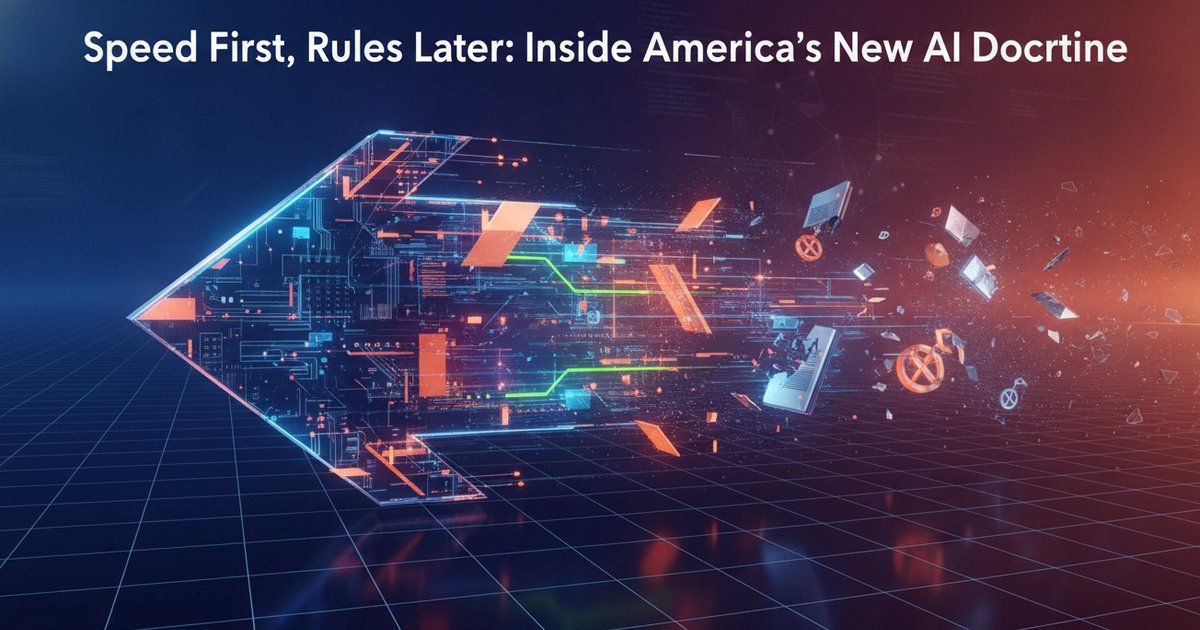
For two years the global argument about artificial intelligence has been framed as a choice between two extremes: move fast and risk harm, or regulate hard and risk irrelevance. With its June 2026 executive order, the United States has stopped pretending the choice is hard. Titled Promoting Advanced Artificial Intelligence Innovation and Security, the order, published by The White House on June 2, 2026, reads as a doctrine rather than a rulebook. It pairs aggressive deregulation with a sharpened national-security posture, and it places a single word at the centre of American strategy: dominance.
This is worth taking seriously on its own terms — not as a partisan artefact, but as a coherent theory of how a great power thinks AI leadership is won. Below is a fair-minded look at what the order actually does, the bet it represents, the risks that bet carries, and what it means for everyone watching from outside the US, India included.
What the order does
Strip away the framing and three concrete moves stand out.
First, the order directs the creation of an AI cybersecurity clearinghouse — a coordinating body that, per the White House text, would bring together agencies such as Treasury, the NSA, and CISA to share intelligence on AI-related vulnerabilities and align scanning and patching efforts with industry and critical-infrastructure operators. The idea is a standing channel where a flaw discovered in a widely deployed model or AI system can be triaged and remediated across the public and private sectors at speed, rather than being handled piecemeal.
Second, it pushes to harden federal and national-security systems. As AI tooling spreads through government — from administrative automation to defence applications — the attack surface widens. The order treats the security of these systems as a priority, with federal grants directed at AI vulnerability detection and a clear expectation that agencies adopting AI also raise their own defensive baseline.
Third, it foregrounds the protection of US intellectual property from adversaries. The concern here is twofold: the theft of model weights, training data, and proprietary techniques, and the broader competitive risk of foundational American research leaking to strategic rivals. The order signals that IP protection is now framed as a national-security matter, not merely a commercial one.
Taken together, these are defensive and coordinating mechanisms. None of them, notably, is a binding constraint on how companies build or deploy AI.

The doctrine
That absence is the point. The order’s animating logic is that the surest route to safety is American leadership, and the surest route to leadership is fewer obstacles in the way of builders.
The deregulatory thread runs throughout. Rather than impose new compliance regimes, the order doubles down on an industry-collaborative model: a voluntary clearinghouse, federal grants for vulnerability detection, and partnership over prescription. Security, in this telling, is achieved by getting the best engineers in government and industry into the same room — not by writing rules that those engineers must then spend their time interpreting.
The framing is explicit about the prize. “Global AI dominance” is treated as a strategic objective, the way naval supremacy or nuclear parity once were. The implicit argument is that whoever sets the technological frontier also sets the de facto standards the rest of the world adopts, and that ceding the frontier in the name of caution would be a strategic error of the first order.
It is a defensible position. There is genuine evidence that heavy-handed, ex-ante regulation can slow deployment without measurably improving outcomes, and that fast iteration surfaces real-world problems faster than committee-room foresight. The doctrine bets that speed and security are complements, not opposites.

The risks and the debate
The bet has obvious failure modes, and intellectual honesty requires naming them.
The most fundamental is the speed-versus-safety trade-off. Deregulation accelerates the helpful and the harmful alike. The same fluid environment that lets a startup ship a breakthrough also lets a poorly tested system reach critical infrastructure or financial markets. A clearinghouse that coordinates patching after vulnerabilities emerge is valuable — but it is, by design, reactive. It assumes problems will be caught and fixed, not prevented from shipping in the first place.
The second is the question of voluntary collaboration versus enforceable rules. Voluntary frameworks work beautifully right up until incentives diverge. When a company faces a choice between disclosing a costly vulnerability and shipping a product on schedule, a clearinghouse with no teeth relies on goodwill. History with cybersecurity disclosure suggests goodwill is real but uneven. Critics will argue that the order has chosen the most optimistic assumption about corporate behaviour and built policy on top of it.
The third, and most distinctively American, is the state-law tension. A federal posture of deregulation does not erase the patchwork of state-level AI and data laws, and in some cases sharpens the conflict. Companies could find themselves caught between a federal government urging speed and individual states legislating caution. The result may be less the clean deregulatory landscape the order envisions and more a fragmented compliance map — the very outcome a national doctrine is supposed to avoid.
The debate, then, is not really about whether security matters. Everyone agrees it does. It is about whether security is best produced by collaboration and incentives or by mandates and liability — and the order has placed a large, clear bet on the former.
The India read
For New Delhi, and for Indian founders and operators, this is the more consequential story than the domestic American politics.
The world now has two visible poles. On one side sits the US doctrine: deregulatory, industry-collaborative, dominance-oriented. On the other sits the European Union’s rules-first model, built on binding obligations, risk tiers, and ex-ante compliance. The contrast that the White House itself draws — voluntary clearinghouse and grants versus mandated requirements — is precisely the fault line along which global AI governance is now splitting.
India has, so far, charted a third and pragmatic course: light-touch, pro-innovation, but with a growing scaffolding of data protection and accountability through measures already in motion. In a bipolar regulatory world, that positioning is an asset. A light-touch India is naturally closer in spirit to the American approach than the European one, which creates room for deeper cooperation on research, compute, and security coordination. If a US-led clearinghouse model becomes the template for allied nations, India will want a seat at that table rather than a notification after the fact.
But there are sharper edges for Indian exporters and AI firms to watch.
- The IP-protection push cuts both ways. A US increasingly focused on shielding its intellectual property from “adversaries” may tighten the flow of advanced models, weights, and tooling. Indian firms that depend on access to frontier American systems should plan for a world where access is more conditional and more security-screened.
- Compliance divergence is now a product decision. An Indian SaaS or AI company selling globally must build for both a deregulated US and a rules-bound EU. That is a real cost, and a real opportunity for those who treat compliance flexibility as a feature.
- Security expectations will travel. Even without mandates, US critical-infrastructure operators participating in a clearinghouse will push security expectations down their supply chains. Indian vendors serving those clients should expect the security bar to rise informally, through procurement, well before any law requires it.
- Alignment is leverage. India’s closeness to the US model gives it negotiating room on compute access, talent mobility, and joint security efforts — leverage worth using deliberately rather than drifting into.
The honest assessment is that America has made a clear and aggressive bet. It may be right that dominance buys safety, or it may discover that reactive coordination is a thin shield against fast-moving harm. Either way, the doctrine is set, the poles are drawn, and the countries that thrive will be the ones — India among them — that read the landscape clearly and position themselves to trade with both worlds while bending to neither.
