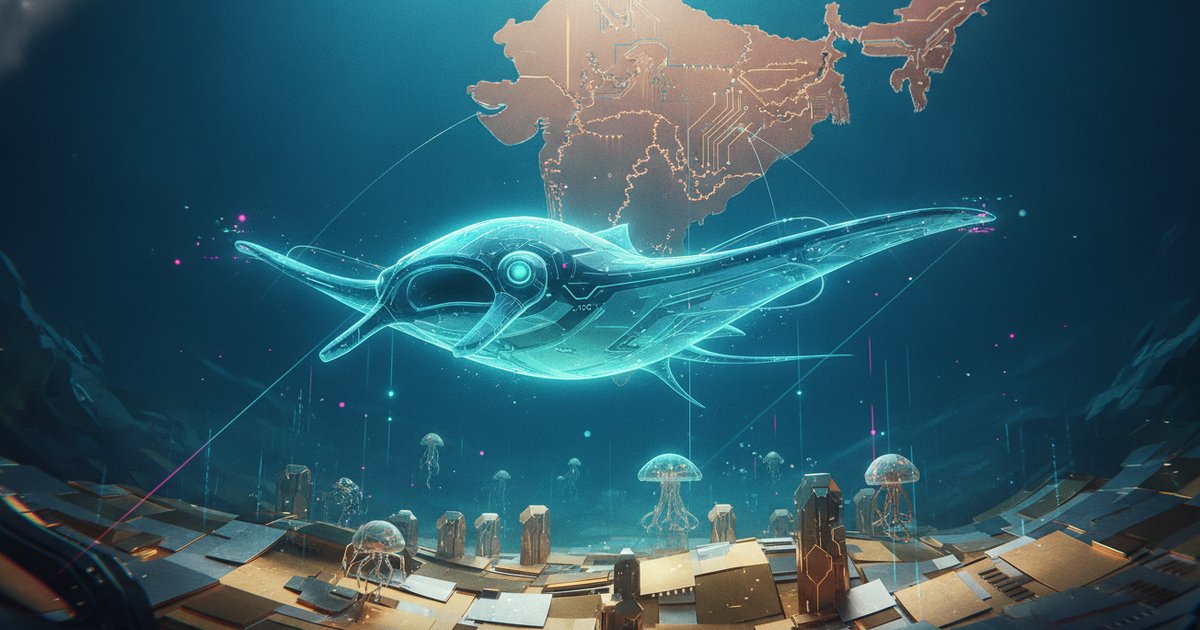
For a country with a 7,500-kilometre coastline, a fast-modernising navy, and a booming software talent pool, India has been curiously quiet on one frontier: the robots that operate on and under the sea. While drones in the air and rovers on land have captured the imagination of founders and funders alike, the ocean — vast, unforgiving, and strategically vital — has stayed largely the domain of governments and legacy shipbuilders.
Bengaluru’s Rekise Marine wants to change that. The deeptech startup, which builds autonomous surface vessels and underwater platforms, recently closed a seed round of roughly $9.7 million led by Accel and NKSquared, per reporting from ScoopEarth (figures pending verification against the company’s own announcement). It is a meaningful cheque for hard tech in India, and a signal that investor appetite is broadening well beyond SaaS dashboards. We spoke with the company’s founders and studied its trajectory to understand why marine robotics may be India’s most under-appreciated deeptech bet — and what it actually takes to build it here.
The origin
Rekise Marine begins, as many durable deeptech stories do, with two people who saw the same gap from opposite ends of a career. Maitrai Maka, a naval architect by training, understood the physics and engineering of vessels — how hulls behave, how sensors fail in saltwater, how a platform survives a sea state that would humble most consumer hardware. Rear Admiral Shekhar Mital (Retd) brought the other half: decades inside the institutions that buy, deploy, and depend on marine systems, and a first-hand view of where existing capabilities fall short.
The gap they identified was autonomy. Globally, autonomous marine systems have matured rapidly — uncrewed surface vessels for surveillance, underwater platforms for inspection and survey, swarms for persistent monitoring. India, despite its maritime stakes, has largely imported or improvised. That dependency is a strategic vulnerability and a commercial opportunity at once.
Why now? Several currents are converging. The cost of sensors, compute, and edge AI has fallen sharply, making sophisticated autonomy economically viable on platforms that would have been prohibitively expensive a decade ago. India’s deeptech ecosystem is maturing, with capital finally flowing toward hardware-heavy bets. Reporting from SquaredTech noted that a single mid-June 2026 window saw Indian startups raise across more than ten sectors — including deeptech, marine, and space-adjacent hardware — a sign that investors are looking beyond pure software. And the geopolitical backdrop, with heightened focus on maritime domain awareness and indigenous defence manufacturing, gives a homegrown marine-robotics company both a market and a mission.
The build
At its core, Rekise Marine is building two families of robots: autonomous surface vessels — think uncrewed boats that can navigate, sense, and make decisions at sea — and underwater platforms that operate in the far harder subsea environment. The company frames its work as dual-use, a deliberate posture that widens the addressable market while keeping the technology grounded in real demand.
That dual-use thesis spans three broad arenas:
- Commercial: port operations, offshore inspection, hydrographic survey, and monitoring of assets like cables, pipelines, and wind infrastructure — work that is currently slow, manual, and expensive.
- Defence: maritime domain awareness, surveillance, and persistent presence in waters where keeping crewed vessels on station is costly and risky.
- Subsea: the underwater frontier, where GPS doesn’t reach, communication is constrained, and pressure and corrosion punish every component.
The engineering challenge is genuinely two-sided. On the hardware front, a marine platform must survive an environment designed to destroy it — salt, pressure, biofouling, sea states that toss equipment for days. Reliability isn’t a feature; it’s the product. On the autonomy front, the software must perceive and decide with degraded or absent inputs: no GPS underwater, limited bandwidth, unpredictable currents, and the constant risk that a sensor reading is wrong. Building either is hard. Building both, integrated, so a vessel can plan a mission, adapt to conditions, and return safely without a human at the helm, is the kind of full-stack problem that resists shortcuts.
This is precisely why marine robotics has stayed a thin field. You cannot fake your way through a sea trial. The ocean is the ultimate adversarial test environment, and it does not grade on a curve.
Why marine robotics is hard (and defensible)
The flip side of difficulty is defensibility. The same factors that make marine robotics punishing also make it a moat — provided you survive long enough to build one.
Long timelines and capital intensity. Unlike a software product that can ship an MVP in weeks, a marine platform demands fabrication, testing, sea trials, iteration, and certification. Each cycle costs real money and real time. A $9.7 million seed round, generous by Indian standards, is not a war chest in a field where a single prototype and its trials can consume a meaningful share of the budget. Founders here are signing up for a multi-year build before the business looks anything like a business.
Regulatory and trust barriers. Autonomous vessels operate in shared, regulated waters. Maritime law, defence procurement norms, and safety certification are all slow-moving and conservative — and rightly so, given the stakes. Selling into defence and critical infrastructure means clearing trust hurdles that no amount of clever code shortcuts. Customers want to see the platform perform, repeatedly, in conditions that matter. This is where Rear Admiral Mital’s institutional fluency becomes a genuine asset: knowing how these buyers think, evaluate, and decide is itself a form of intellectual property.
Domain expertise as a moat. The deepest defensibility in marine robotics is knowing the domain. Naval architecture, hydrodynamics, subsea systems, maritime operations — this is hard-won knowledge that doesn’t transfer from a generic robotics or AI background. A team that pairs a naval architect with a career naval officer has a head start that capital alone cannot buy. In a field where the learning curve is measured in years and the failures are expensive, that accumulated expertise compounds into an advantage that latecomers struggle to replicate.
Lessons for deeptech founders
Rekise Marine’s path offers a useful template for anyone building capital-intensive hardware in India, where the playbook differs meaningfully from Silicon Valley’s.
The first lesson is that India’s cost structure is a strategic weapon. Building hard tech here means engineering, fabrication, and skilled labour at a fraction of US or European burn rates. A capability that might require $50 million to develop in the Bay Area can plausibly be built for a fraction of that in Bengaluru. For deeptech — where you need runway measured in years, not quarters — that lower burn isn’t just a cost saving; it’s what makes the entire venture survivable. Indian deeptech founders can stretch a dollar further than almost anyone, and in a field with long timelines, runway is everything.
The second lesson is talent. India’s marine-robotics opportunity sits at the intersection of two deep talent pools: the engineering rigour coming out of the IITs and IISc, and the operational and domain expertise resident in the navy and the broader maritime sector. The IIT/IISc pipeline produces world-class talent in control systems, perception, embedded software, and mechanical engineering. The navy and India’s shipbuilding ecosystem supply the domain context. A startup that can bridge those worlds — speaking both the language of autonomy software and the language of sea operations — has access to a workforce that few geographies can match for the price.
The third lesson is about sequencing and patience. Hardware deeptech rewards founders who resist the temptation to over-promise and instead build credibility one validated milestone at a time. The metrics that matter early aren’t vanity revenue numbers; they’re successful sea trials, reliability data, and pilot deployments with serious customers. Investors who back this kind of company — and Accel’s lead here is notable — are signalling a willingness to underwrite longer arcs than the typical software bet.
What’s next
The road ahead for Rekise Marine runs through deployment. Demonstrations and prototypes earn attention; sustained, reliable performance in real operating conditions earns contracts. The near-term challenge is moving from validated capability to fielded platforms — getting autonomous vessels and underwater systems into the hands of commercial operators and defence customers, and proving they hold up.
Partnerships will be the multiplier. In a field this regulated and trust-dependent, the fastest route to scale runs through alliances — with shipyards that can manufacture at volume, with defence and government bodies that can validate and procure, and with commercial operators in ports, offshore energy, and survey who feel the pain that autonomy solves. The fresh capital buys runway to build these relationships and to harden the product across more demanding missions.
Scale, in marine robotics, is not about hockey-stick user growth. It’s about expanding the fleet of deployed platforms, broadening the mission set each platform can handle, and steadily lowering the cost and risk of autonomous operations at sea. If Rekise Marine executes, it won’t just build a company — it will help establish India as a credible builder of marine autonomy, reducing import dependence and creating a domestic ecosystem where none meaningfully existed.
That is the larger story here, and the reason marine robotics deserves to be called India’s quiet frontier. The hard-tech bets that matter most are rarely the loudest. They are the ones that take years, demand deep expertise, and survive the brutal test of the real world. The ocean offers no shortcuts — which is precisely why the companies that conquer it will be very hard to displace.
