
There is a tidy story circulating about the future of work in 2026, and it goes like this: artificial intelligence is eliminating jobs, so industry and government are stepping up to retrain the people affected. The story is reassuring because it suggests the system is correcting itself. It deserves scrutiny precisely because it is reassuring. The same companies building the tools that automate work are now bankrolling the programs meant to help workers survive that automation — and the evidence that such programs actually move people into safer jobs is far weaker than the press releases imply. This is not a reason to panic. It is a reason to read the fine print.
The numbers behind the alarm
An analysis cited in June 2026 attributed roughly 88,000 US job cuts this year to AI — reportedly more than all prior years combined, according to figures circulated by Build Fast with AI (June 30, 2026), drawing on Metaintro, the IMF, the Rockefeller Foundation and Axios. The figure is worth treating with care: “linked to AI” is a slippery category that can fold in layoffs a company would have made anyway and merely chose to label as efficiency. But even with that caveat, the direction of travel is consistent across sources.
More telling than the headline number is where the cuts concentrate. The roles most exposed are entry-level knowledge jobs: customer support, content production, and administrative work. These are the tasks that large language models handle most convincingly — bounded, text-heavy, and repetitive enough to template. The IMF’s chief has warned specifically about an AI shock to entry-level positions, and that warning matters because it strikes at the bottom rung of the career ladder. When the first job disappears, so does the path that leads to the second and third.
That is the real structural worry. A 50-year-old manager whose role is automated has options, savings, and a network. A 23-year-old whose first analyst or support job never materializes has none of those things yet — and no obvious way to build them.

What RAISE US is
Into this gap steps RAISE US, a new initiative reported at somewhere between $500 million and $1 billion that unites employers and US state governors around worker retraining. According to the reporting, an AI lab has joined national labor efforts as part of the coalition, and a labor union has been given a seat on the board. The framing is engagement over opposition: rather than fight automation through legislation or litigation, the participants are choosing to fund the adaptation.
On its face this is a meaningful shift. The presence of an AI lab inside a labor initiative signals that the technology’s builders have accepted some responsibility for the disruption — at least rhetorically. The union board seat matters too, because it means workers’ representatives have a formal voice rather than a press statement. Coalitions of this kind have, in the past, produced more durable programs than government-only efforts, simply because employers know which skills they will actually hire for.
But the structure of the deal is exactly what should give us pause, and that brings us to the paradox at the centre of the whole arrangement.
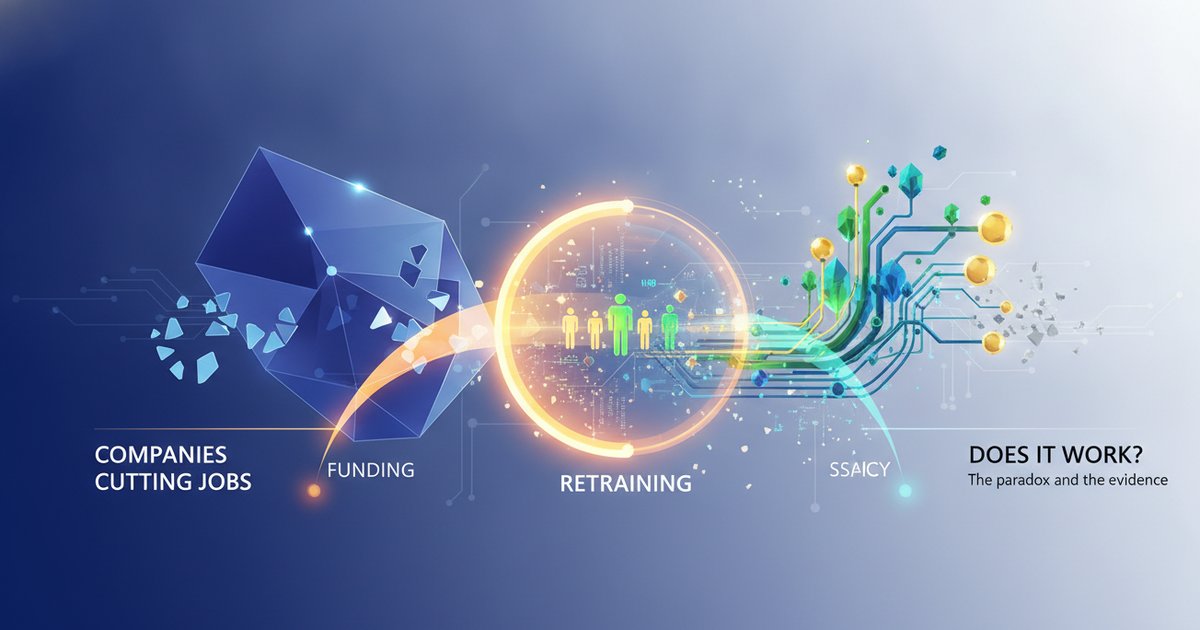
The paradox and the evidence
The tension is not ideological; it is structural. The companies funding the retraining are the same ones building the technology that makes retraining necessary. That is not automatically cynical — you could argue it is the most responsible thing they could do with their profits. But it does create an incentive problem. A funder building automation tools has no reason to retrain people away from the products it sells; if anything, it benefits from steering workers toward roles that use, support, or supervise its own systems. “Reskill into AI-adjacent work” can be both genuinely helpful advice and a customer-acquisition strategy. Both can be true at once.
The harder problem is whether retraining works at all. Build Fast with AI’s June 30 report points to a study of 23 million participants in US federal workforce programs which found that retraining rarely placed workers into jobs that were genuinely less exposed to automation. (The underlying study deserves verification against its primary source — but the finding aligns with decades of evaluations of government job-training schemes, which have consistently produced modest results.) People completed programs; they often found work; but the work was frequently as vulnerable as what they left.
This is the part “just reskill” optimists tend to skip. Reskilling assumes three things that are not always true:
- That a durable destination job exists. If the target role is itself automatable within a few years, the training is a treadmill.
- That adults can acquire genuinely new skills fast enough to compete with fresh graduates and the technology simultaneously. Mid-career retraining into a different domain is slow and uncertain.
- That employers will actually hire the retrained. A certificate is not a job; many programs measure completions, not durable placements.
None of this means retraining is worthless. It means the metric that matters is not how many people were trained, but how many ended up in roles that are still standing five years later — and that is the number these programs are least eager to publish.
The India read
For India, this is not an abstract American debate. The country sits on one of the world’s largest concentrations of exactly the work most exposed: entry-level IT, BPO, and support roles. The first-job ladder that the IMF worries about is, in India, an entire economic engine — the route by which millions of young people enter the formal economy and the middle class.
If a US-style retraining response arrives here, the lesson from the 23-million-participant finding should travel with it: design backwards from durable roles, not forwards from available courses. Reskilling that targets genuinely resilient work — roles requiring physical presence, regulated judgment, complex stakeholder management, or the kind of domain trust that takes years to build — is worth funding. Reskilling that simply moves a support agent into an adjacent role automatable by the next model release is a more expensive way of delaying the same outcome.
India also has a structural advantage worth naming: a young workforce can be trained into durable skills from the start, rather than retrained out of obsolete ones mid-career. Curriculum and apprenticeship design done now is cheaper and more effective than remediation later. That window is open, but it is not permanent.
The final point is the one most easily lost in the panic. Exposure is not destiny. The studies measure associations — which jobs tend to be affected — not verdicts on individuals. A worker’s agency, the quality of the program, the honesty of its placement data, and the design of the target roles all change the outcome. RAISE US, or any Indian equivalent, will be judged not by its budget or its board seats but by a single unglamorous question: did the people it trained land somewhere that lasts? Until that number is published and independently checked, the right posture is neither alarm nor applause — it is the patience to ask for the evidence.
