
India is buying more sneakers, more protein, more gym memberships and more athleisure than at any point in its history. But the buying experience remains fragmented: a D2C brand here, a marketplace listing there, a mall store for footwear, a separate app for supplements. Someone, eventually, has to aggregate all of it into a coherent place to shop. PlayBlue thinks it can be that someone.
The Bengaluru-founded startup, built by Satyam Trivedi and Jayam Vora, is positioning itself as an omnichannel, multi-brand sports retail platform — part curated store, part ecommerce operation, and a wager that Indian fitness spending has reached the scale where a dedicated aggregator makes sense. Here’s a look at the raise, the model, and whether the economics hold up.
The raise
PlayBlue has closed a $2.7 million seed round co-led by Centre Court Capital and MIXI Global, with participation from WEH Ventures, according to a YourStory daily roundup. The capital is earmarked for a dual push: opening physical retail stores, starting in Bengaluru, and deepening the company’s ecommerce presence.
The investor mix is telling. Centre Court Capital’s involvement signals a thesis around sports and consumer as an emerging category, while MIXI Global brings an international lens to a domestic play. WEH Ventures, an early-stage backer with a track record in consumer and internet businesses, rounds out a cap table that skews toward operators who understand both the digital and the physical sides of retail.
For a seed round, $2.7 million is meaningful but not lavish — and that matters, because physical retail eats cash. Fitouts, inventory, rent and staffing are all front-loaded costs that come due long before a store turns profitable. The size of the raise suggests PlayBlue intends to prove out a small number of stores and its online engine before scaling aggressively, rather than blitzing the market with dozens of locations at once.

The model
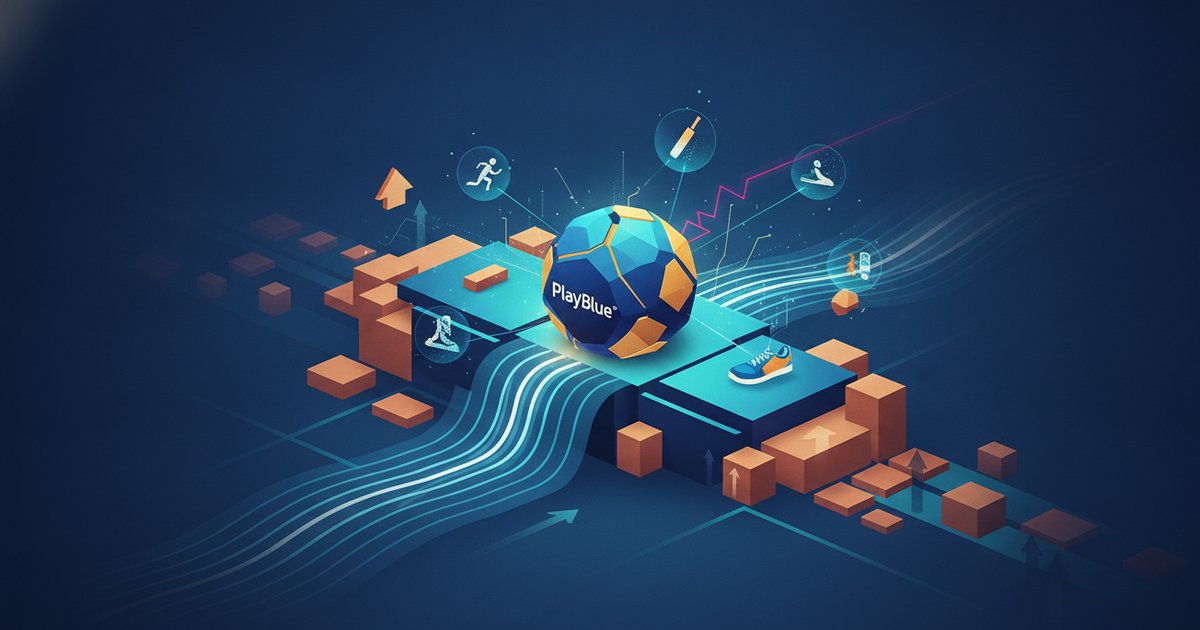
The core of PlayBlue’s pitch is aggregation. The platform brings together more than 100 global and homegrown brands across four categories — athleisure, footwear, equipment and nutrition — betting on rising Indian sports and fitness consumption via an omnichannel model, per YourStory’s reporting.
That breadth is the whole point. A single D2C brand can sell you leggings or a protein tub; PlayBlue wants to sell you the outfit, the shoes, the resistance bands and the recovery supplements in one trip or one cart. The multi-brand structure lets it capture the customer who is category-loyal to fitness but not loyal to any one label — arguably the majority of buyers.
The omnichannel layer is where the ambition sits. PlayBlue plans to open physical stores in Bengaluru first, followed by Mumbai and Delhi-NCR, while running ecommerce in parallel. The logic is that these two channels reinforce each other: stores let customers touch, try and trust the products; online captures the repeat purchases and long-tail demand that don’t justify a trip to the mall. Done well, a store becomes both a sales point and a marketing asset, and the website becomes both a catalogue and a fulfilment engine.
What PlayBlue is really selling, then, is curation and experience. In a market crowded with individual brands and undifferentiated marketplace listings, the value it promises is editorial — a considered selection of gear across price points and use cases, presented in a way that helps a customer decide. If that curation is good, it earns trust. If it’s just a shelf of everything, it competes with Amazon on Amazon’s terms, which is a losing game.
The opportunity and risks
The tailwind is real. India’s spending on fitness, sports and active lifestyles has been climbing steadily, driven by younger consumers, rising disposable incomes in metros and Tier-1 cities, and a cultural shift that treats gym-going and running as aspirational rather than niche. Athleisure has blurred the line between workout wear and everyday wear, expanding the addressable market well beyond serious athletes. That structural shift is the thesis underwriting the entire bet.
But the risks are equally structural, and they cluster around three hard problems.
- Inventory. Carrying 100-plus brands across footwear, apparel, equipment and nutrition means managing an enormous SKU count with wildly different shelf lives, size curves and demand patterns. Overstock ties up cash; understock loses sales. Multi-brand retail lives or dies on inventory discipline.
- Margins. Multi-brand retailers typically earn thinner margins than vertically integrated D2C brands, because they don’t own the product and must share economics with suppliers. Physical stores add rent and staff on top. The path to healthy unit economics runs through private labels, scale-driven buying power, or high-margin categories like nutrition — and PlayBlue will need at least one of those levers.
- Retail execution. Opening and running physical stores profitably is a specialist discipline. Store location, footfall, conversion, staff training and shrinkage are all operational grind that software cannot abstract away.
Then there’s competition. On one flank sit the D2C brands themselves, many of which are opening their own experience stores and would rather own the customer directly. On the other sit the marketplaces — Amazon, Flipkart, Myntra and the quick-commerce players — with unbeatable selection, logistics and pricing power. PlayBlue has to carve a defensible position between a brand’s depth and a marketplace’s breadth, and that middle ground has swallowed plenty of retailers before.
The India read
The bigger story here is India’s athleisure and sports-consumption boom, and what kind of retail architecture wins it. The demand is not in question; the question is who captures it and how.
PlayBlue’s clearest strategic asset is offline experience as a differentiator. In categories like footwear and equipment, fit and feel matter enormously, and the returns-and-friction cost of buying blind online is high. A well-run physical store solves a genuine customer problem — and, in the process, becomes a moat that pure-play ecommerce and marketplace listings struggle to replicate. This is the same insight that has pushed successful digital brands offline worldwide: the store is where trust is built and where category-defining experiences happen.
The harder part is scaling omnichannel in India specifically. Real estate in prime metro locations is expensive and scarce. Consumer density that supports premium sports retail is concentrated in a handful of cities, which is precisely why the Bengaluru–Mumbai–Delhi-NCR sequence makes sense as a starting map. Logistics for the online side must knit together store inventory and warehouse stock without the two cannibalising each other. And the whole system has to work across a wide price spectrum, from mass-market to premium imported brands.
If PlayBlue can make a store profitable, use it to lower customer acquisition costs online, and turn its curation into genuine brand equity, it has a shot at becoming the default destination for fitness shoppers in urban India. That is a large prize — and a demanding execution challenge. The $2.7 million seed round buys the company a chance to prove the model in a few locations. Whether the omnichordan math scales from there is the real experiment, and it is one worth watching closely as India’s fitness wallet keeps growing.
