Every glossy AI demo — the agent that files your expenses, the bot that reconciles invoices, the assistant that reads a stack of KYC forms — rests on a deeply unglamorous foundation: turning pixels of paper into structured, machine-readable text. That layer is optical character recognition, and it rarely gets a headline. So when France’s Mistral shipped OCR 4, adding bounding boxes, block classification, confidence scores, 170-language support and self-hosting at aggressive prices, it’s worth pausing. This is the kind of infrastructure release that quietly changes what’s economically viable to automate — especially in a paperwork-heavy, multi-script country like India.
What’s new
According to The Neuron’s July 2, 2026 digest (which we’d flag to verify against Mistral’s own documentation), OCR 4 is less about a single flashy feature and more about hardening the output into something automation pipelines can actually trust.
- Bounding boxes and block classification: Instead of returning a flat wall of text, OCR 4 hands back the spatial coordinates of each element and labels what kind of block it is — heading, paragraph, table, signature line. That structure is what lets downstream systems know where on a form a value sits, not just that it exists.
- Confidence scores: Every extraction now comes with a machine-readable measure of how sure the model is. This sounds mundane; it’s actually the difference between blind automation and a workflow that can route low-confidence fields to a human for review.
- 170-language support: Broad multilingual coverage moves OCR out of the English-and-a-few-European-languages comfort zone and into the messy reality of global documents.
- Self-hosting: You can run the model inside your own infrastructure rather than shipping sensitive documents to someone else’s cloud.
- Pricing: The Neuron reports API pricing at $4 per 1,000 pages, or roughly $2 per 1,000 pages through the batch API — cheap enough to change the math on large backlogs.
Individually, none of these is revolutionary. Together, they turn OCR from a lossy first step into a dependable component you can build on.

Why OCR is the backbone
Document extraction underpins most enterprise automation. Before an AI agent can “understand” a contract, an invoice, or an onboarding form, something has to read the document and hand over clean structured data. Industry analysis in 2026 makes the same point we’d argue from the trenches: cheap, multilingual, self-hostable OCR lowers both the cost and the compliance barriers to automating paperwork-heavy workflows. Get this layer wrong and everything above it inherits the error.
Three of OCR 4’s additions map directly onto what real automation needs. Accuracy is table stakes — a misread digit in an amount field is a downstream disaster. Layout, delivered through bounding boxes and block classification, is what lets a system reliably extract “the total in the bottom-right box” across thousands of slightly different invoice templates. And confidence scores are what make partial automation safe: you set a threshold, auto-process everything above it, and escalate the rest. Without that signal, you’re forced to either trust everything (risky) or review everything (pointless).
Then there’s self-hosting, which matters for reasons that have nothing to do with model quality. Regulated industries — banking, insurance, healthcare, government — often cannot send raw customer documents to an external API. Being able to run extraction inside a private environment addresses data-residency and compliance requirements head-on, and removes one of the biggest reasons enterprise automation projects stall before they start.
The competitive angle
What’s striking here is the shape of the competition. A European lab is pricing aggressively at a layer long dominated by big cloud providers’ proprietary document-AI services. Closed cloud OCR has generally meant per-page fees, per-region availability, and your documents leaving your walls. An open, self-hostable alternative changes the negotiating position for buyers who’d rather not be locked into a single vendor’s cloud.
The self-hostable-versus-closed distinction is the real story. Closed cloud OCR is convenient and often excellent, but it forces a trade-off between capability and control. When a credible model can run on your own hardware, that trade-off softens: you can prototype on the API, then bring the workload in-house for sensitive volumes without re-architecting.
Multilingual reach is the other differentiator. Support for 170 languages is not a vanity metric — it’s a wedge into markets where English-centric OCR has always underperformed. For a European lab looking to matter globally, being demonstrably good at scripts that incumbents treat as afterthoughts is a smart place to compete. And undercutting on price while doing it makes the pitch harder to ignore for cost-conscious teams.
A caveat worth stating plainly: benchmark claims and language counts should be validated against your own documents before you commit. “Supports” a language and “reads your specific messy scanned form” in that language are not the same thing. Run a pilot on your worst real-world samples.
The India read
India is where this release gets genuinely interesting. The country runs on paper and PDFs across a bewildering range of scripts — Devanagari, Bengali, Tamil, Telugu, Kannada, Malayalam, Gurmukhi, Gujarati, Odia, and more, often mixed with English on the same page. Every KYC packet, land record, ration document, school certificate, utility bill and handwritten form is a candidate for automation, and the multi-script reality has long been the thing that broke English-first OCR pipelines.
Broad language support directly attacks that problem. If OCR 4 can reliably read vernacular documents — the ones that make up an enormous share of real-world Indian paperwork — it opens automation to processes that were previously stuck with manual data entry because no affordable tool could parse the source. That’s the difference between digitising the English-medium slice of your documents and digitising all of them.
Self-hosting lands especially well against India’s tightening data-localisation expectations. Financial services, government workflows and healthcare all face pressure to keep sensitive personal data within controlled environments. An extraction model you can run on-premises or in a domestic cloud region sidesteps the awkward question of whether customer documents can legally leave the building — a question that has quietly killed plenty of otherwise sensible automation projects.
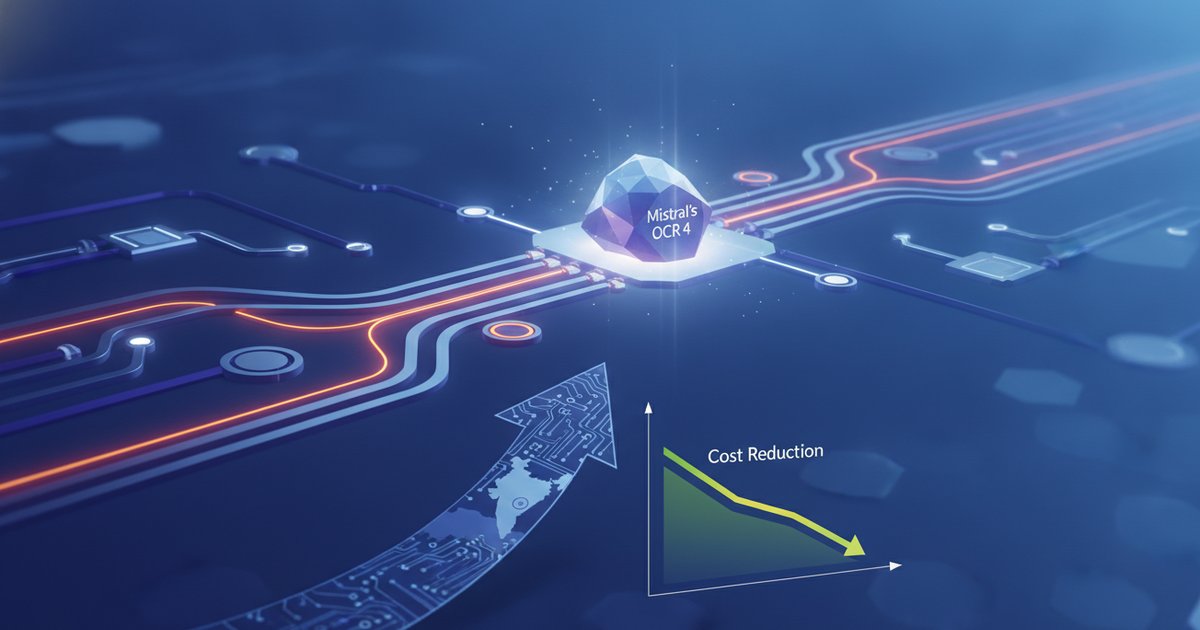
And then there’s price. At roughly $4 per 1,000 pages, or $2 via batch, the economics of digitising a large backlog change. For a lending startup processing KYC at scale, a BPO clearing millions of forms, or a state department migrating decades of records, per-page cost is not a rounding error — it’s the line item that decides whether the project happens. Cheap OCR is what makes vernacular document automation move from pilot deck to production.
None of this is a silver bullet. Handwriting, faded stamps, skewed scans and inconsistent regional formats will still trip up any model, and confidence scores are useful precisely because failure is expected. But the direction is clear. The boring plumbing under enterprise AI just got cheaper, more multilingual, and more compliant to deploy — and in a market defined by paper and many scripts, that unglamorous layer may matter more than the flashier stuff built on top of it.
