What marketing automation is (and isn’t)
Marketing automation is software that does marketing work for you the moment a customer earns it — without you touching a keyboard. You define the rules once (“when this happens, do that”), and the system watches every contact around the clock and acts on your behalf. That’s the whole idea: your best follow-up, sent to the right person, at the right moment, whether it’s 2 p.m. on a Tuesday or 3 a.m. on a holiday.
Meet GlowKit, a small direct-to-consumer skincare brand we’ll use throughout this course. GlowKit sells online, mixes one-time purchases with a replenishment subscription, and lives or dies on whether buyers come back. Right now the founder does everything by hand: she notices an abandoned cart in the dashboard and maybe emails the shopper a day later, she thanks big customers when she remembers, and she wins back lapsed buyers only when she has a spare afternoon. Most of the time, she doesn’t. This lesson is about turning that manual scramble into a system that runs itself.
This is Lesson 1 of the full marketing automation course. By the end of it you’ll be able to explain the core model — trigger, condition, action — and name the pieces of a working automation stack. That’s the mental model everything else in the series builds on.
First, clear up what marketing automation isn’t. It isn’t “set it and forget it” spam — a good system sends fewer, more relevant messages, not more. It isn’t just email; the same logic drives SMS, ads, and in-app nudges. It isn’t only for big companies with big budgets — GlowKit is a two-person operation. And it isn’t artificial intelligence, though AI increasingly rides on top of it. At its core, marketing automation is plumbing: reliable rules that move the right message to the right person automatically.
Why bother? Because manual follow-up doesn’t scale and it doesn’t sleep. Roughly 70% of online shopping carts are abandoned before checkout — that’s the single biggest leak in GlowKit’s funnel, and no human can chase every one of them in the narrow window when the shopper still cares. Automation can. That’s the difference between a reminder that recovers a sale and one that never gets sent.
The core model: trigger, condition, action
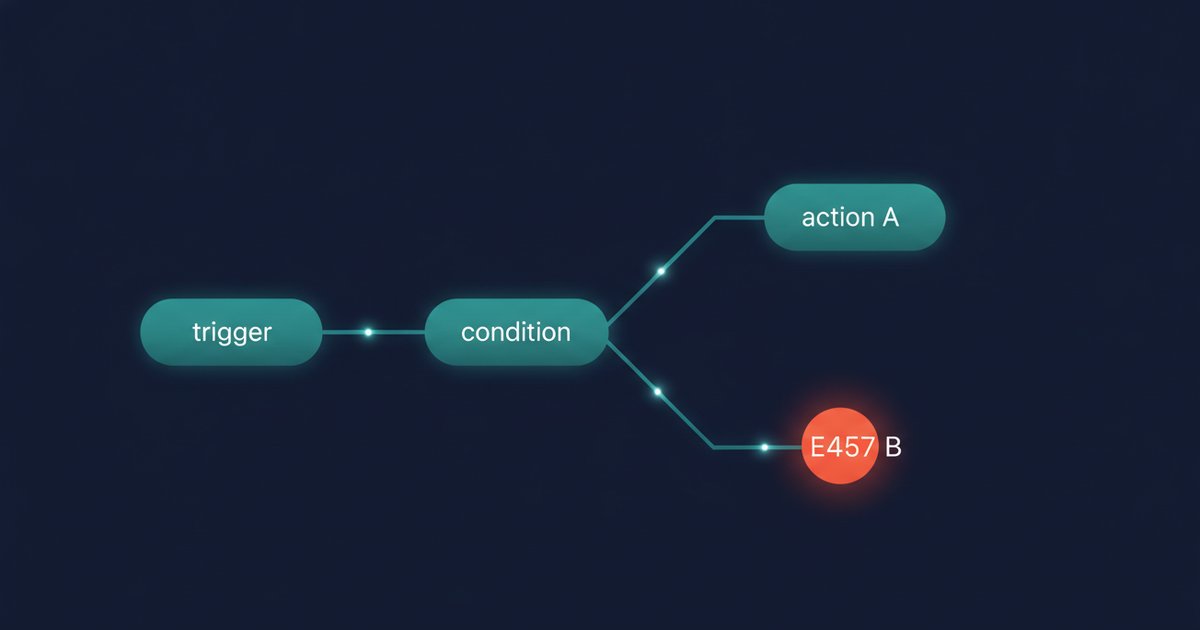
Strip away the jargon and every automation — from the simplest reminder to the most elaborate lifecycle program — is built from three parts:
- Trigger — the event that starts the automation. Something a person does (or fails to do): signs up, adds to cart, buys, clicks, goes quiet for 60 days.
- Condition — a check that decides whether and how to proceed. A yes/no filter or a fork in the road: has this person bought before? Is the cart over $50? Are they subscribed to SMS?
- Action — what the system actually does: send an email or text, wait three hours, add a discount, tag the contact, notify you.
Read it as one sentence: when [trigger], if [condition], then [action]. That’s the atom of marketing automation. Master it and you can read, build, or debug any workflow you’ll ever meet.
The same model, on GlowKit
Take GlowKit’s worst leak — abandoned carts — and run it through the model:
- Trigger: a shopper adds the vitamin-C serum to their cart but doesn’t check out within one hour.
- Condition: is this a first-time visitor, or a known customer? Is the cart worth more than $40?
- Action: after a one-hour wait, send an email — “Still thinking it over?” If they still haven’t bought after 24 hours, send a follow-up with free shipping.
Nobody sat at a desk to send that. The founder wrote the rule once; the system now recovers carts every hour of every day. This matters because those messages punch far above their weight: automated flows generate roughly 37% of ecommerce email revenue from just 2% of email volume. A single well-built cart flow can be one of the most profitable things a small brand ever ships.
Notice how conditions add intelligence. Without them, every abandoner gets the same message. With them, a loyal VIP who abandons a cart gets a gentle nudge, while a first-time visitor gets the free-shipping offer that actually converts strangers. Same trigger, different action — because the condition told the system who it was talking to.
Your turn
Write out one automation for your own business in the “when / if / then” format. Pick your most obvious leak — an abandoned cart, a signup that never buys, a customer who hasn’t returned. Name the trigger, one condition, and one action. If you can write that single sentence clearly, you already understand the engine that powers this entire course.
The pieces of a stack
Triggers, conditions, and actions describe the logic. But logic needs machinery to run on. Your stack is the set of tools that captures data, decides, and acts. You don’t need all of it on day one, but you should be able to name the parts:
- Data / customer store. The memory. Every profile, purchase, and behavior lives here — often a customer data platform (CDP) or the database inside your marketing tool. Without reliable data, every condition downstream is guessing. GlowKit’s store knows who bought the serum, when, and how often.
- Triggers & events. The senses. This is how the system knows something happened — a Shopify-style store firing an “order placed” event, a form capturing a new subscriber, a link click, a page view.
- The automation engine. The brain. This is where you draw workflows — the if/then logic, the waits, the branches. Tools like Klaviyo, Mailchimp, or HubSpot are essentially engines wrapped in a friendly builder.
- Channels. The mouth. Where actions actually reach the customer: email, SMS, push notifications, retargeting ads, in-app messages. GlowKit leans on email and SMS.
- Analytics. The scoreboard. What happened, and what did it earn? Revenue per flow, conversion rate, unsubscribes. Without it you’re automating blind — we devote a whole lesson to it later.
Here’s the honest version for a small brand: for many D2C businesses, a single all-in-one platform quietly covers the data store, the engine, and email plus SMS channels in one login. You bolt on extra tools only when you outgrow the built-in ones. Choosing among those platforms is a real decision, so we dedicate a whole lesson to it — see choosing your automation stack when you’re ready to buy.
How the pieces talk on GlowKit
Follow one cart recovery through the whole stack. The store (data) records that a known subscriber added a serum. The event “checkout started, not completed” fires an hour later (trigger & events). The engine checks a condition — first-timer or repeat buyer? — and picks a branch. It fires an action down the email channel. A day later, analytics shows the email recovered $340 in orders. Five parts, one smooth handoff. When people say “marketing automation,” this coordinated relay is what they mean.
Your turn
Audit your own tools against the five parts. Write each layer — data, events, engine, channels, analytics — and note which tool covers it today. Blanks aren’t failures; they’re your shopping list. Most small brands find one platform already covers three or four layers, which is exactly why you don’t need to buy much to start.
Where it fits in the funnel
Automation isn’t one email; it’s a program that carries someone through their whole relationship with you. Throughout this course we’ll use GlowKit’s lifecycle stages as the map:
Visitor → Subscriber → First-time buyer → Repeat buyer → VIP / Loyal → Lapsed / At-risk
Every stage has a natural trigger and a job automation can do:
- Visitor → Subscriber: a signup form triggers a welcome series that introduces the brand and earns the first order.
- Subscriber → First-time buyer: browsing or an abandoned cart triggers reminders and gentle proof (reviews, a first-order offer).
- First-time buyer → Repeat buyer: a purchase triggers a thank-you, then a well-timed replenishment nudge before the serum runs out.
- Repeat buyer → VIP: hitting a spend or order threshold triggers early access and rewards.
- Any stage → Lapsed: going quiet for 60–90 days triggers a win-back sequence before the customer is gone for good.
This is where automation earns its keep. GlowKit’s founder was doing acquisition by hand and ignoring almost everything after the first sale — which is backwards, because that’s where the money is. Classic Bain & Company research popularized in Harvard Business Review found that a 5% lift in customer retention can raise profits by 25% to 95%. For a brand that lives on repeat purchase, the post-purchase and win-back stages aren’t nice-to-haves; they’re the business. Automation is simply the only practical way to work all six stages at once without hiring a team.
Your turn
Sketch your own lifecycle stages — even three or four is fine. Beside each, jot the one automation you wish were running there. You’ll almost certainly find, like GlowKit did, that the back half of the journey is wide open. That gap is your biggest opportunity, and the next lesson turns this sketch into a real map.
Your turn
You now have the whole mental model. Marketing automation is software that runs your best marketing on autopilot, built from a simple atom — when a trigger fires, if a condition is met, then an action runs — executed by a stack of five parts: data, events, an engine, channels, and analytics, working across every stage of the customer journey.
Before the next lesson, do these three things. One: write your single most valuable automation in when/if/then form. Two: audit your current tools against the five stack layers and mark the gaps. Three: list your lifecycle stages and spot where automation is missing. Keep those notes — you’ll build directly on them.
Next we turn that rough sketch into a real customer-journey map, so you automate the right moments instead of guessing.
zoho.social is an independent media platform and is not affiliated with, endorsed by, or associated with Zoho Corporation. All product names and brands are the property of their respective owners.
