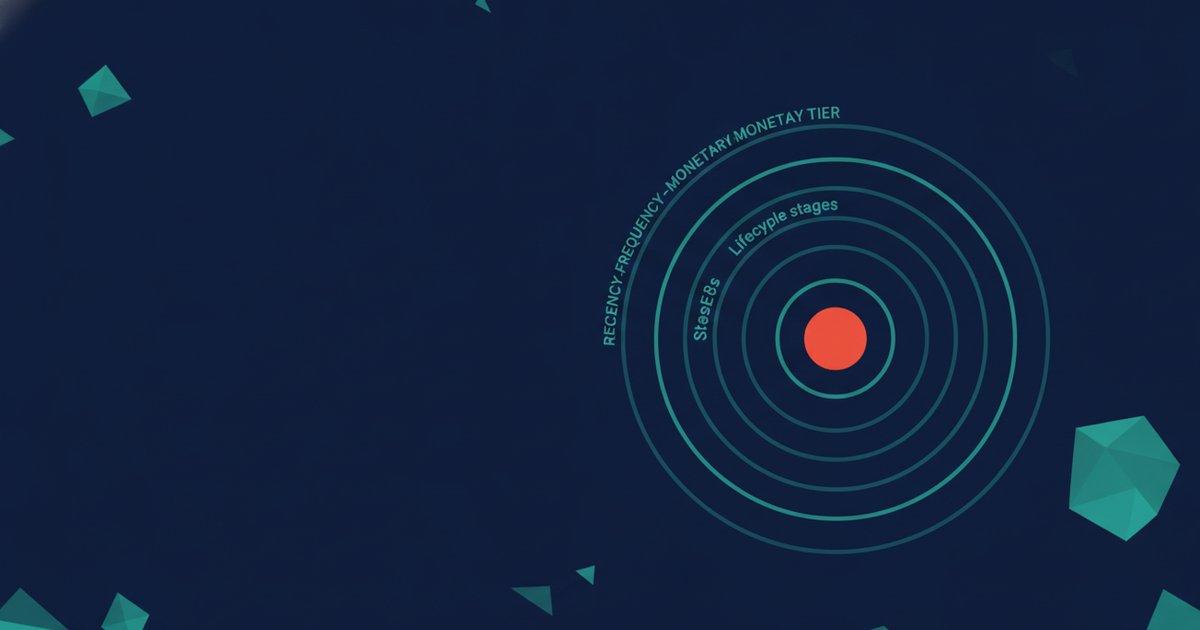
Why segmentation beats batch-and-blast
Batch-and-blast is the habit of sending the same message to your entire list on the same day. It feels efficient — one email, everyone gets it — but it quietly punishes you. A first-time buyer and a five-time VIP have almost nothing in common, yet they receive an identical “15% off your next order” blast. You just discounted a customer who would have paid full price, and bored a newcomer who needed reassurance, not a coupon.
Segmentation is the fix: you group people by what they’ve actually done, then send each group the message that fits. The payoff is not marginal. According to the DMA, marketers have reported a 760% increase in email revenue from segmented campaigns versus undifferentiated sends. This lesson shows you a simple, durable way to build those segments — RFM — and then wire them to move customers through their lifecycle automatically.
There’s a quieter cost to blasting, too. Every irrelevant email trains a subscriber to ignore you, and a stretch of ignored sends teaches inbox providers that your mail isn’t wanted — which drags down deliverability for the messages that do matter. Segmentation protects the asset. When people mostly receive mail that’s relevant to them, they keep opening, and your sender reputation stays healthy. Batch-and-blast slowly burns that reputation to reach people who were never going to convert on that message anyway.
If you’ve already worked through mapping your customer journey, you have the six GlowKit lifecycle stages in hand: Visitor → Subscriber → First-time buyer → Repeat buyer → VIP / Loyal → Lapsed / At-risk. Segmentation is how you decide, from real purchase behavior, which stage each person is in right now — and lifecycle automation is how you move them to the next one without doing it by hand.
RFM basics
RFM is the most useful segmentation model for a repeat-purchase business, and it’s built from data you already own. It scores every customer on three questions:
- Recency — how long since their last order? Recent buyers are far likelier to buy again.
- Frequency — how many orders have they placed? Frequency signals habit and loyalty.
- Monetary — how much have they spent in total (or on average)? This separates your revenue drivers from your bargain-hunters.
The mechanic is simple. For each dimension you rank your customers and split them into five tiers, scoring 1 (worst) to 5 (best). A customer who bought last week gets an R of 5; someone who last bought fourteen months ago gets a 1. Do the same for frequency and monetary value, and everyone ends up with three digits — a score like 5-5-4 or 2-1-1.
Why does this beat guessing? Because value is wildly concentrated. In a typical ecommerce book, the “Champions” segment — your highest R, F and M scores — is roughly 10–15% of customers but contributes on the order of 35–45% of revenue. If you treat that group the same as everyone else, you’re leaving your most reliable money undefended and un-nurtured.
A quick GlowKit worked example makes the digits concrete. Take three customers. Priya bought the Vitamin-C serum last week, has ordered six times this year, and is your top spender — she scores 5-5-5. Marcus bought once, eleven days ago, and hasn’t returned: 5-1-2. Dana was a loyal every-eight-weeks buyer who has now gone silent for five months: her recency has collapsed to a 2 while her old frequency and monetary scores were strong. Three customers, three completely different right moves — reward Priya, convert Marcus, and win Dana back — and RFM told you which is which without you reading a single order by hand.
You don’t need all 125 possible combinations. In practice you collapse the score grid into a handful of named segments that map cleanly onto GlowKit’s lifecycle stages — which is exactly what we’ll do next.
Building segments
Let’s score GlowKit’s buyers and turn the numbers into segments you can actually market to. Here’s a working translation from RFM scores to named segments and lifecycle stages:
| Segment | RFM signal | GlowKit example | Lifecycle stage |
|---|---|---|---|
| Champions / VIP | High R, high F, high M (e.g. 5-5-5, 5-4-5) | Bought the Vitamin-C serum 3× this year, on the replenishment plan, top spender | VIP / Loyal |
| Loyal / Growing | High F, mid M, recent-ish | Reorders cleanser reliably but spends moderately | Repeat buyer |
| Promising newcomers | High R, low F (e.g. 5-1-2) | First order shipped two weeks ago, no second order yet | First-time buyer |
| At-risk | Falling R, previously good F/M | Used to order every 8 weeks, now 4 months silent | Lapsed / At-risk |
| Lost / Dormant | Low R, low F, low M (e.g. 1-1-1) | One order a year ago, never returned | Lapsed / At-risk |
A few practical notes for building these in whatever platform you use (Klaviyo, Mailchimp, HubSpot, Shopify’s native segments, or a CDP):
- Set recency thresholds from your own purchase cycle, not a generic rule. GlowKit’s hero serum lasts about eight weeks, so “recent” might mean the last 60 days and “at-risk” might trigger at 90–120 days of silence. A brand selling annual gift sets would use completely different windows.
- Make segments dynamic, not static lists. The whole point is that a customer’s segment updates automatically as they buy (or stop buying). A one-time exported spreadsheet is stale within a week.
- Start with five or six segments, not twenty. More segments mean more messages to write and maintain. Begin with the segments that map to a clear action, and split further only when the data justifies it.
If you sell across email and SMS, keep the segment definitions in one place and let both channels read from them — the same VIP segment should drive your SMS and conversational flows as well as email, so a customer never gets contradictory treatment across channels.
Automating stage transitions
Segments are only half the system. The other half is the automation that moves people between segments — from First-time buyer to Repeat buyer, from Repeat buyer to VIP, and from any stage into (and back out of) Lapsed. This is where segmentation stops being a report and starts being revenue.
The reason to automate it: triggered, behavior-based sends punch far above their weight. Omnisend’s 2024 ecommerce data found that automated emails drove about 37% of all email sales from just 2% of email sends. A well-designed segment feeding a trigger is the most efficient thing in your whole marketing stack.
Here’s how the key GlowKit transitions work as automations:
Newcomer → Repeat buyer (the second-purchase push)
When a customer’s RFM shows a single order and enough time has passed to have tried the product, trigger a “how’s it going?” flow: a usage tip, a review request, and a gentle nudge toward the natural next item (or the replenishment plan). The goal is the second order, because that’s the moment a First-time buyer becomes a Repeat buyer and their lifetime value roughly doubles.
Repeat buyer → VIP (the promotion)
When a customer crosses your VIP threshold — say, a third order or a monetary score of 5 — enrolment into the VIP segment should auto-trigger perks: early access to new drops, a surprise bonus in their next shipment, or a members-only bundle. Notice this is a reward, not a discount. You’re protecting margin on customers who’ve proven they’ll pay full price.
Any stage → Lapsed, and back (the winback)
When recency crosses your at-risk line, the customer drops into the Lapsed / At-risk segment and a winback flow fires: a “we miss you” message, then a reason to return (restock reminder, a modest incentive, or a new product they haven’t seen). The moment they buy, RFM re-scores them and the automation pulls them back into an active segment — and, crucially, suppresses the winback so they don’t keep getting “we miss you” emails after they’ve returned.
That suppression detail is what separates a real lifecycle system from a pile of disconnected campaigns. Every automation should have an exit condition tied to the behavior it’s trying to cause. Enter the winback on inactivity; exit it on purchase. Enter the second-purchase flow on one order; exit on two.
One more layer ties it all together: use segment membership to suppress as much as to send. When GlowKit runs a broad promotion, exclude the VIP segment from the discount — they don’t need it — and exclude anyone already inside an active flow so they’re not hit twice in a day. Suppression is the unglamorous half of segmentation, and it’s where a lot of the margin protection actually lives. The best-run programs send fewer emails to any given person, not more; each one just lands at a moment that matches where that customer is in their lifecycle.
Rule of thumb: for every segment, name the entry trigger, the action, and the exit condition. If you can’t state the exit, the automation will eventually annoy someone.
Your turn
Pull your last 12 months of order data and run a first-pass RFM scoring. You don’t need a data team — a spreadsheet with order dates and totals per customer is enough to rank people into five tiers on each dimension.
- Score each customer on Recency, Frequency and Monetary value (1–5 each).
- Collapse the scores into five named segments and map each to one of GlowKit’s six lifecycle stages.
- Attach one automated action to each segment — and write down its exit condition.
Free download: GlowKit RFM / Segmentation Worksheet — score customers on recency, frequency and monetary value, map them to segments, and attach an automated action to each so your list starts working the way this lesson describes.
Once your segments are live and driving triggers, the next question is whether it’s all actually paying off. That’s the job of the next lesson: measuring the ROI of your automation, flow by flow.
zoho.social is an independent media platform and is not affiliated with, endorsed by, or associated with Zoho Corporation. All product names and brands are the property of their respective owners.
