
Every few years, a government somewhere decides it is time to settle the question of how much of your digital life it can reach. It never gets settled. The fight over lawful access — the state’s ability to compel data and communications from companies and citizens — is the oldest argument in technology, and it is back again. This time the trigger is Canada, where a Lawful Access Act was advanced to the Senate after a fast-tracked vote and a committee session that, by accounts from BetaKit (June 18, 2026), stretched past midnight. The substance matters. So does the speed. And the questions it raises are precisely the ones India has been wrestling with for years over encryption and message traceability.
This is an opinion piece, but the goal is not to tell you which side to pick. It is to lay out both honestly, because the people most affected — founders building messaging and fintech products, marketers handling user data, and ordinary users who never read a privacy policy — deserve more than a slogan.
What Canada is doing
According to reporting from BetaKit, Canada’s Lawful Access Act cleared a key parliamentary hurdle and moved to the Senate following a fast-tracked vote, after a committee session that ran past midnight. The bill expands the state’s ability to obtain data and communications, the perennial centerpiece of lawful-access legislation. (As always, the precise scope is a matter of the bill text and the parliamentary record, which readers and reporters should verify against the final language rather than the summaries circulating in real time.)
Two things are worth separating here: the what and the how. The what — broader, more streamlined state access to digital information — is a policy choice governments around the world have been inching toward for two decades. Reasonable people disagree about it, and we will get to those arguments.
The how is harder to defend regardless of where you stand on the substance. A bill that materially changes the relationship between the state and private communications is exactly the kind of law that benefits from daylight: extended committee scrutiny, expert testimony, civil-society input, and unhurried public debate. A vote advanced quickly, on the back of a session that ran into the early hours, invites the suspicion that the process was designed to outrun opposition rather than absorb it. Even supporters of expanded access should want this kind of law to be bulletproof in its legitimacy. Speed is the enemy of that.

The case for
Start with the strongest version of the argument for, because it is a serious one. Crime has moved online, and so has the evidence of it. Investigators working cases involving child exploitation, organized fraud, human trafficking, and terrorism routinely hit walls where a suspect’s communications and data sit beyond practical reach. When a platform cannot or will not produce information even under a valid court order, public-safety officials argue, the law has effectively created a zone where serious harm can be coordinated with impunity.
The case for lawful access rests on a few defensible pillars:
- Access should be warranted and lawful, not arbitrary. The strongest proponents are not asking for a free-for-all; they want a clear, judicially supervised mechanism to obtain specific data tied to specific investigations.
- Online spaces should not be evidence-free zones. A phone call could always be wiretapped under a warrant; the argument is that a messaging thread used to plan the same crime should not be categorically untouchable simply because the medium changed.
- Speed matters in real cases. When a child is at risk or money is moving, investigators argue the current patchwork of cross-border requests and platform discretion is too slow to be useful.
Framed this way, lawful access is not surveillance for its own sake. It is the digital extension of investigative powers societies have long accepted, subject to courts and warrants. That is a coherent position, and dismissing it as authoritarianism does the debate no favors.
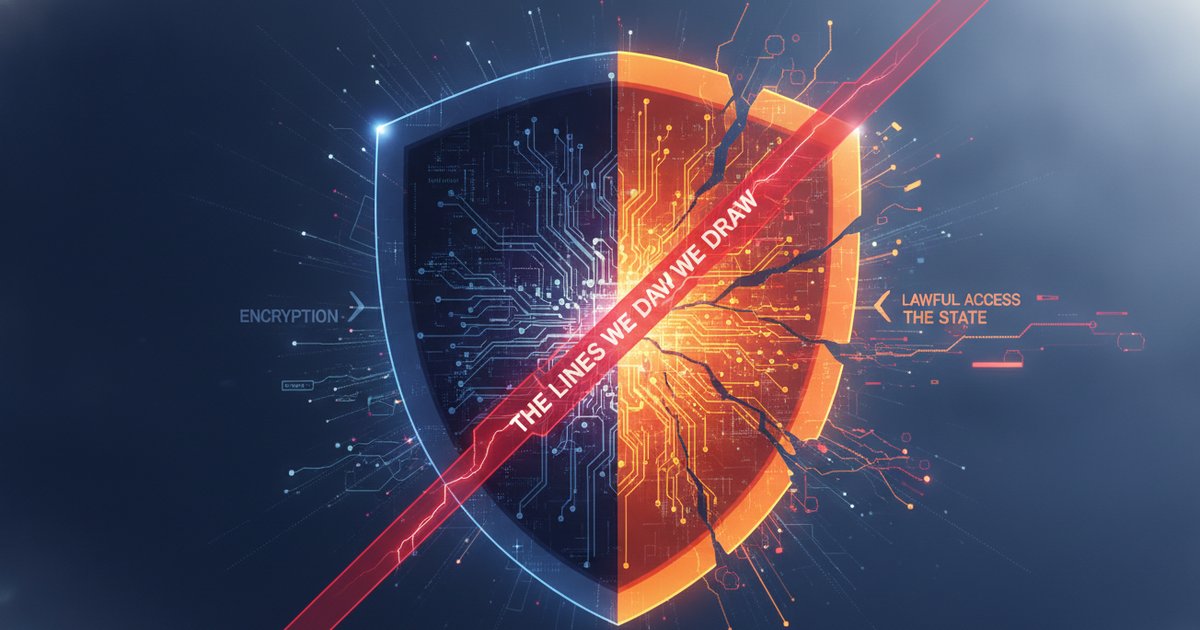
The case against
The case against is equally serious, and it begins with a technical reality that policy language often glosses over: you cannot build a backdoor that only the good guys can walk through. Any mechanism that weakens encryption to grant lawful access creates a vulnerability that hostile states, criminals, and abusive insiders can also exploit. End-to-end encryption protects journalists, dissidents, abuse survivors, businesses, and ordinary people precisely because it has no privileged exception. Punch a hole in it, and the hole is there for everyone.
Beyond the cryptography, critics point to the chilling effect. When people suspect their messages may be accessible to the state, they self-censor — they say less, organize less, dissent less. That is a cost to a free society even if the power is never abused. And powers are rarely never abused; they are written for the worst crimes and, over time, applied to far more ordinary ones.
The strongest objections cluster around three failures of design:
- Overreach risk. Broad definitions and vague triggers let access creep well beyond the serious crimes used to justify it.
- Weak oversight. Without independent, well-resourced review and meaningful transparency reporting, warrants become rubber stamps.
- Eroded due process. Fast-tracked legislation, gag orders, and secret requests strip away the adversarial scrutiny that keeps state power honest.
The midnight passage is itself an exhibit for this side of the argument: if the case for access is so strong, why not make it in full view?
The India read
For Indian readers, none of this is abstract. India has been having a version of this debate for years, and the contours are strikingly familiar. The flashpoints have been message traceability — the demand that platforms be able to identify the originator of a message — and the broader tension between lawful access and end-to-end encryption. Industry and policy reporting through 2026 describes a standoff that has not resolved: platforms, regulators, and privacy advocates remain at odds, each holding a position that is internally consistent and mutually irreconcilable.
The traceability fight is instructive because it exposes the same engineering problem Canada now faces. Platforms argue that identifying a message’s originator at scale cannot be done without re-architecting encryption in ways that degrade it for everyone. The state argues that the inability to trace viral misinformation, mob-inciting forwards, and coordinated criminal activity is an unacceptable blind spot. Both are describing the same trade-off from opposite ends.
Caught in the middle, as always, are two groups. The first is users, whose trust is the entire product. People in India adopted encrypted messaging at massive scale partly because it felt private; legislation that quietly changes that bargain risks the very trust the digital economy runs on. The second is founders. An Indian startup building a messaging app, a fintech wallet, or any product handling sensitive communications now has to design for a compliance regime that is unsettled, jurisdiction-dependent, and politically charged. Building in traceability or access hooks can alienate privacy-conscious users and create security liabilities; refusing can mean regulatory conflict, blocked features, or worse. There is no neutral default. Every architectural choice is now a political one.
That is the real lesson Canada’s late-night vote offers India and everyone watching. The substance of lawful access deserves a genuine, good-faith debate — public safety is not a fig leaf, and privacy is not a luxury. But the way these laws are passed tells you how much the framers trust their own arguments. A rule that reshapes the boundary between the state and the individual should be able to survive the daylight. When it is advanced past midnight, the process becomes the message — and that message is rarely reassuring.
