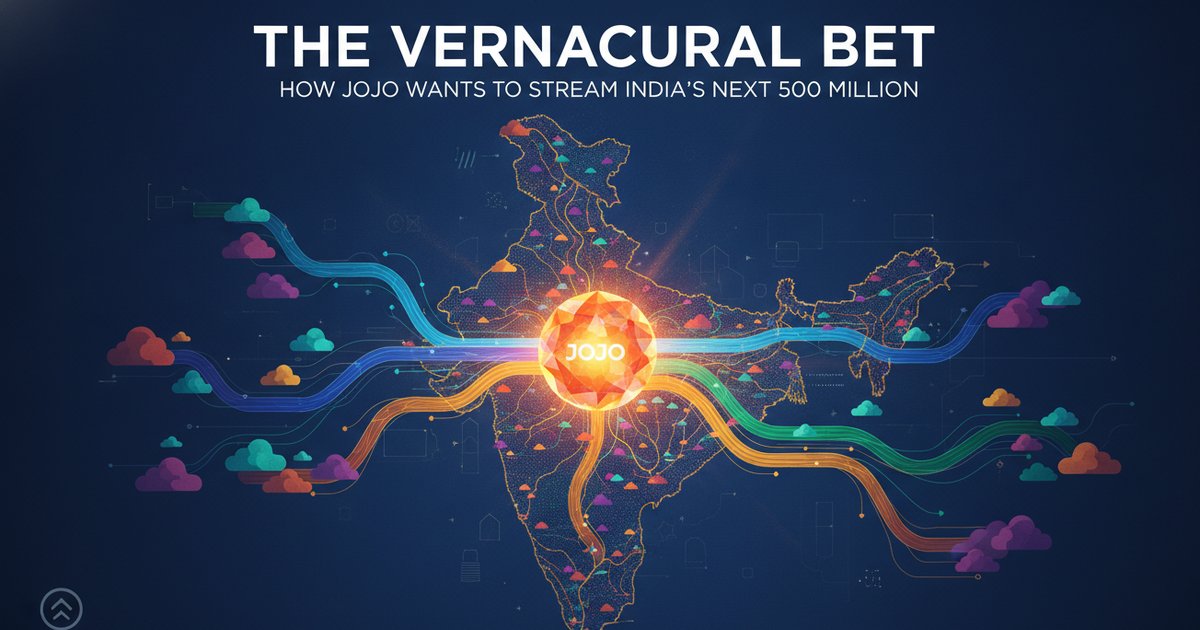
India’s streaming story is usually told from the metros, in English, with subtitles for everyone else. But the centre of gravity is shifting. The audiences powering the next phase of online video are not in Bandra or Indiranagar — they’re in Tier-2 and Tier-3 towns, watching in Gujarati, Bhojpuri, Tamil, Marathi and a dozen other languages. Ahmedabad-based JOJO is building its entire thesis on that premise: that the future of Indian OTT is vernacular, regional and representation-first. It’s a bet against the metro-default instincts of the global giants — and, if the demographics hold, a sensible one.
The bet
JOJO is building an OTT streaming platform focused on high-quality regional storytelling and representation, according to IndianStartupNews (June 2026). The pitch is deceptively simple: instead of treating regional-language content as a translation afterthought or a cheap library filler, treat it as the headline product. The platform positions vernacular content not as a niche to be served but as the growth frontier of Indian streaming itself.
That framing matters. Most large platforms still programme metro-first — commissioning premium originals in Hindi or English, then dubbing or licensing regional titles to widen the funnel. JOJO inverts the logic. Representation isn’t a diversity checkbox here; it’s the core value proposition. Stories rooted in specific cultures, dialects and lived realities — told by people who know them — are the differentiator a Mumbai-led commissioning desk struggles to replicate at scale.
There’s also a quiet geographic signal in JOJO being Ahmedabad-led rather than Mumbai- or Bengaluru-headquartered. A challenger built outside the established media-tech corridors is naturally closer to the audiences and creator communities it wants to serve. Whether that proximity converts into a durable advantage is the open question — but the instinct is sound. (We’d flag that JOJO’s specific traction numbers remain to be independently verified; the thesis is clearer than the metrics at this stage.)
Why regional wins
The market rationale is straightforward, and increasingly hard to argue with. Industry analysis in 2026 points to India’s streaming growth being driven less by English-speaking metro subscribers and more by non-English, regional-language audiences — the cohort from which the bulk of the next wave of online viewers will come. India’s next 500 million viewers, in other words, won’t watch in English. They’ll watch in their mother tongue, on a budget Android phone, over an increasingly cheap data connection.
For a platform, several structural advantages follow:
- Lower content costs. Regional productions can be made at a fraction of the budget of a tentpole Hindi or English original, which changes the unit economics of building a library and lowers the cost of experimentation.
- Deeper loyalty. Content in a viewer’s own language, reflecting their own world, earns a stickiness that polished but culturally distant programming rarely does. Representation builds retention.
- Local IP and creators. Regional ecosystems are full of writers, performers and local franchises that the big platforms underexploit. A regional-first player can build proprietary IP and creator relationships before incumbents bother to.
The combination — cheaper to make, harder to churn, and IP you actually own — is exactly the kind of asymmetry a focused challenger needs against deeper-pocketed rivals.
The hard part
None of this is easy, and the obstacles are precisely the ones that have humbled bigger players.
Monetisation in price-sensitive markets. The next-half-billion viewers are, almost by definition, the most cost-conscious. They are reluctant to pay metro-level subscription fees, and many won’t pay at all. That pushes platforms toward advertising, micro-subscriptions, telco bundles and other low-friction models — none of which generate the per-user revenue that funds prestige content. Building a sustainable business on price-sensitive audiences is the central commercial challenge, and it’s unsolved across the industry, not just at JOJO.
Content quality and discovery. ‘High-quality regional storytelling’ is a promise that’s hard to keep consistently. Regional production talent is real but unevenly distributed, and audiences who have grown up on slick global content will not accept low production values simply because the dialogue is in their language. Then there’s discovery: a library is worthless if viewers can’t find the one show that will hook them. Recommendation in low-data, multilingual contexts is genuinely difficult — and it’s where scale and engineering muscle favour the incumbents.
Competing with the giants’ regional pushes. The flaw in the regional thesis is that the giants know it too. Netflix, Prime Video, JioHotstar and others are all expanding regional-language slates and dubbing aggressively. A focused challenger’s window is the gap between the incumbents’ awareness of the opportunity and their willingness to truly localise — to commission from within communities rather than from a central desk. That gap is real, but it won’t stay open forever. JOJO’s bet is essentially a race: build depth, ownership and loyalty in regional ecosystems faster than the giants can bolt it on.
The creator-economy angle
This is where the story stops being only about OTT and becomes a creator-economy story. A regional-first platform’s supply chain isn’t studios — it’s creators. The vernacular YouTubers, short-video stars, regional comedians and local storytellers who already command loyal language-specific audiences are the natural feedstock for longer-form regional content. They arrive with built-in audiences, cultural fluency and a production sensibility tuned to exactly the viewers JOJO wants. The platform that turns these creators into a structured supply pipeline — funding them, formatting them, giving them ownership — has a content engine the giants can’t easily buy.
On monetisation, the realistic answer is hybrid. A pure subscription wall won’t work for price-sensitive viewers; a pure ad model caps revenue and depends on scale. The workable path is layered: ad-supported tiers to build reach, low-cost or micro-subscriptions for committed fans, creator-led commerce and sponsorships, and brand-funded content where a marketer underwrites a regional show in exchange for authentic placement. The economics of regional content — cheap to produce, loyal to consume — make these blended models far more viable than they are for premium English originals.
And there’s a lesson here for brands, which is arguably the sharpest takeaway. Marketers in India still over-index on English and Hindi metro campaigns while the audience moves to vernacular video. The brands that learn to show up authentically in regional languages — backing regional creators, sponsoring regional storytelling, speaking to viewers in their own tongue rather than a translated afterthought — will reach the next-half-billion before their competitors do. Representation isn’t just a content strategy; it’s a marketing one.
Whether JOJO specifically becomes the platform that cracks this is unknowable today, and worth watching with appropriate scepticism about early traction. But the underlying wager is hard to fault. India’s online video future is being written in languages the metro-first playbook never prioritised. The companies — and creators, and brands — that internalise that first will own the next decade of the Indian creator economy.
