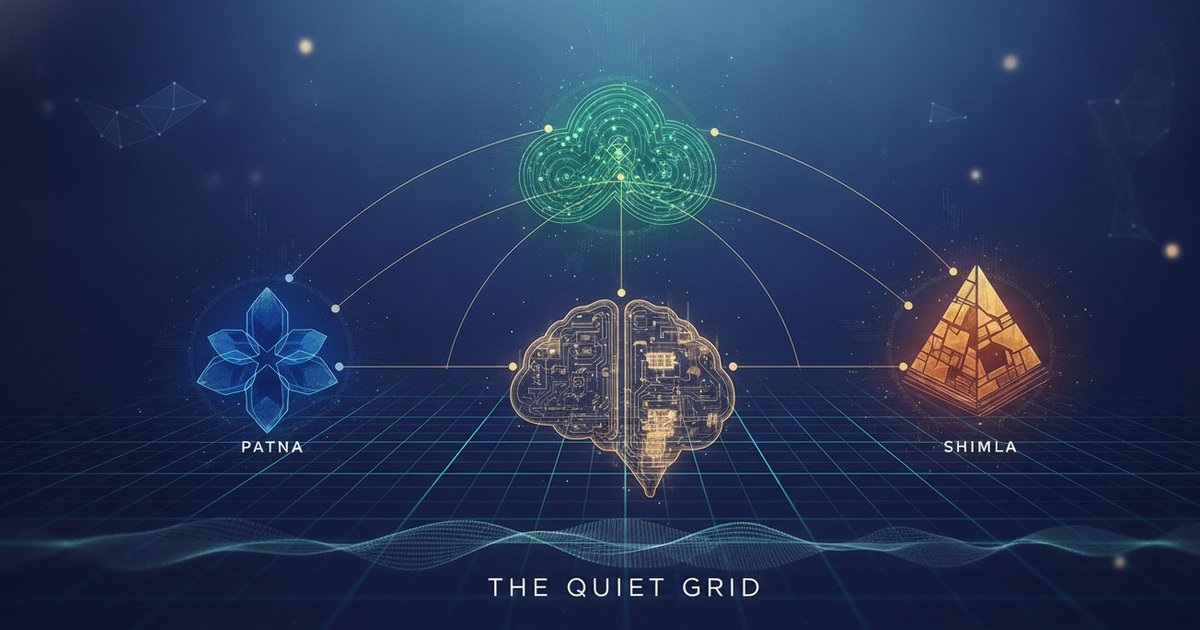
Most of the conversation about India’s AI ambitions happens at the top of the stack: how many GPUs the country can secure, which sovereign foundation model will arrive first, what the compute subsidy bill looks like. It is a story told in megawatts and crores. But the part of the IndiaAI Mission most likely to shape who actually participates in this economy is being built far from the data-centre press releases — in classrooms in Patna, Gorakhpur, Muzaffarpur and Shimla.
This is the grassroots layer: a network of AI and data labs spreading across tier-2 and tier-3 cities, teaching the unglamorous fundamentals of data work. It will not trend. It may, in the long run, matter more than any single model launch.
What’s being built
The IndiaAI Mission’s Data Labs Network is rolling out dozens of AI and data labs in partnership with NIELIT, the National Institute of Electronics and Information Technology, across smaller cities — Patna, Lucknow, Muzaffarpur, Gorakhpur, Buxar, Aurangabad and Shimla among them, according to an IMPRI policy note citing IndiaAI and PIB material. The curriculum is deliberately foundational: ethical and responsible AI basics, data annotation, and Python-based data curation.
None of that is the kind of thing that wins demo-day applause. Annotation — labelling images, tagging speech, marking up text so a model can learn from it — is the plumbing of machine learning. Curation, the work of cleaning, structuring and quality-checking datasets, is one rung up. Responsible-AI literacy, understanding bias, consent and data provenance, is the conceptual glue. Taught together, in places that have historically been on the consuming end of technology rather than the building end, they form a bridge across India’s twin gaps: a shortage of applied AI skills, and a shortage of the infrastructure to teach them.
That bridge matters because the alternative is a familiar pattern, in which capability concentrates in a handful of metros and everyone else waits for the trickle-down. By putting physical labs with curriculum and trainers into district towns, the programme is attempting something more structural than another online course catalogue.
It sits inside a much larger effort. The IndiaAI Mission, with an outlay of roughly ₹10,371.92 crore, spans seven pillars — compute, foundation models, datasets, applications, safety and trust, startup financing, and skilling. On the talent side, the mission has spoken of supporting 500 PhD fellows, 5,000 postgraduate and 8,000 undergraduate students. The Data Labs Network is the part of that skilling pillar reaching furthest down the urban hierarchy.

Why it matters
The first reason is simple geography. India’s AI talent narrative has been written almost entirely in Bengaluru, Hyderabad, Pune, the NCR and a few campus towns. But the demographic weight of the country — and a large share of its untapped technical aptitude — sits in the cities the labs are targeting. If AI capability is going to be broad rather than boutique, the on-ramps have to exist where the people are. A young graduate in Buxar or Gorakhpur who can annotate and curate data competently has a foothold in the industry that simply did not exist before.
The second reason is more specific to the kind of AI India needs. Indian-language AI — models that work in Hindi, Bhojpuri, Maithili, Marathi, Pahari and dozens of other languages and dialects — cannot be built on scraped English-heavy web data. It depends on human-generated, human-labelled, human-checked datasets, often produced by people who speak those languages natively. The data-work layer is not a stepping stone to the ‘real’ AI work; for multilingual India, it is foundational AI work. The annotators and curators trained in these labs are precisely the workforce that high-quality Indian-language systems require.
The third reason is narrative, and it is bigger than India. The Global South has spent years cast as the place where AI’s invisible data labour happens — low-paid, low-recognition, exported to whoever needs cheap labels. A skilling grid that pairs annotation with responsible-AI literacy and a path upward is an attempt to flip that script: to build domestic capability and dignity into the data layer rather than renting it out. Whether the programme lives up to that ambition is an open question, but the framing itself is a meaningful departure.

The open questions
Optimism here should be measured, because the hard part is not opening labs — it is what happens after.
The first question is quality and job outcomes. Building rooms with computers and a syllabus is the easy, fundable step. Producing graduates who can actually find paid work, and tracking whether they do, is harder and far less visible. Without published placement data, completion rates and employer feedback, a lab network risks becoming a certificate factory that looks good in a press release and changes little on the ground. The metric that matters is not seats filled but careers started.
The second question is the ceiling. Annotation and basic curation are entry points, and entry points can become traps if there is no ladder. The genuine prize is helping people move from labelling data to higher-value roles — dataset design, model evaluation, prompt and pipeline engineering, AI quality assurance, applied product work. That requires advanced tracks, mentorship, and connective tissue to actual employers, none of which is guaranteed by a foundational curriculum alone. A grid that leaves everyone stuck at the bottom rung will have democratised access to the least durable jobs in the stack.
The third question is durability. Government-funded skilling programmes have a recurring failure mode: an enthusiastic launch, a few cohorts, and then quiet decay as funding shifts and curricula age. AI moves fast; a syllabus written for 2026 tooling will look dated quickly. Keeping these labs funded, staffed with current trainers and aligned to what employers actually need is an ongoing operational commitment, not a one-time capital expense. Relevance has to be maintained, not assumed.
The bigger picture
The right way to read the Data Labs Network is as one leg of a three-legged stool. Compute, models and skills are not separate initiatives competing for headlines; they are a single stack. GPUs without trained people are expensive heaters. Foundation models without curated, well-labelled Indian datasets are brittle and biased. The skilling layer is what turns hardware and models into something a country can actually use — and the data-work layer specifically is what feeds the datasets pillar that everything else depends on.
There is also a market logic that employers and investors should not miss. Tier-2 and tier-3 cities are not just a supply of labour; they are the next demand base. As AI tools spread into local commerce, agriculture, government services, healthcare and education, the people who understand both the technology and the regional context — language, behaviour, ground realities — will be disproportionately valuable. A workforce trained where that demand is emerging is a strategic asset, not a cost centre.
For employers, a few things are worth watching closely. First, the output: are these labs producing candidates who can do real work, and is anyone measuring it credibly? Second, the upgrade path: companies that build apprenticeship and progression routes into this talent pool early will lock in an advantage as it matures. Third, the language angle: any firm serious about Indian-language AI should be paying attention to where the multilingual data workforce is being trained, because that is where its supply chain begins.
The GPU headlines will keep coming, and they should — compute is a genuine bottleneck. But a decade from now, the more interesting question may be whether India managed to build AI capability that reached beyond a dozen rich districts. The answer is being written, quietly, in labs in Patna and Shimla. It deserves more attention than it gets, and more scrutiny too.
