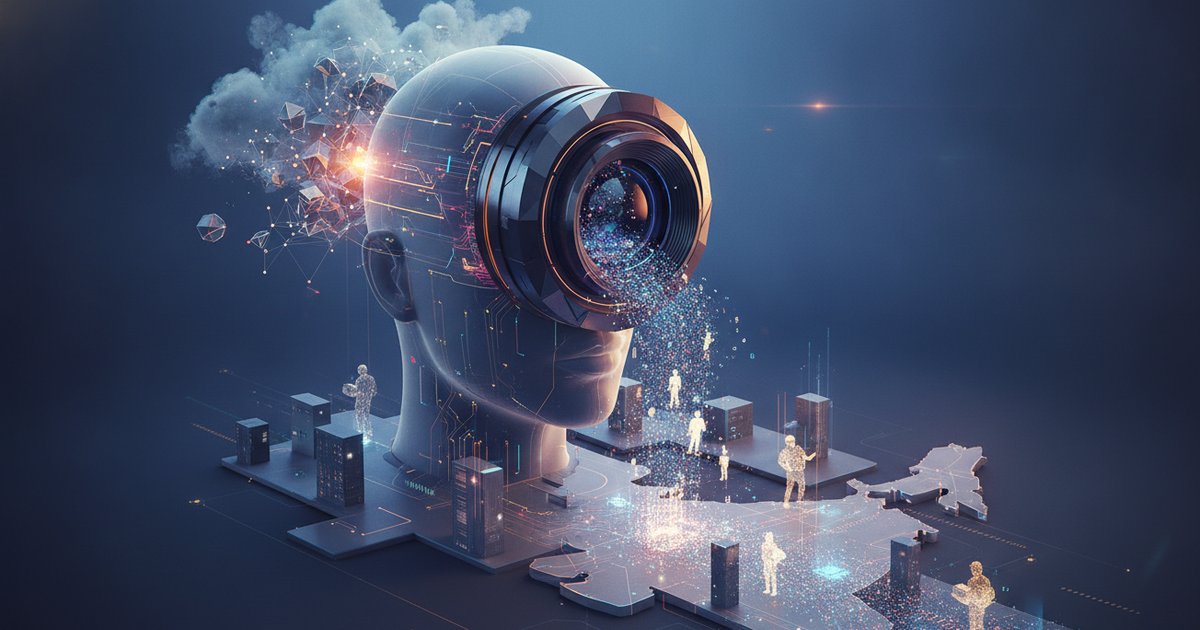
Somewhere in Tamil Nadu, a worker straps a small camera to her head, walks into a furnished room that exists only to be filmed, and begins folding a stack of laundry. Each crease, each reach, each small correction of a slipping towel is recorded from her point of view. She is paid by the hour. The footage will travel far beyond the room – sold, in time, to companies trying to teach machines how to do exactly what she is doing.
This is not a thought experiment. Over the past year, a quiet industry has taken root across India in which ordinary people – homemakers, gig workers, factory hands – are paid to capture egocentric data: first-person recordings of everyday physical tasks. That footage has become a prized raw material for the companies building humanoid robots and what the industry calls physical AI. It is a story about a new kind of work, a new kind of export, and an uncomfortable question that sits at its centre: what happens when the people generating the training data are teaching machines to replace them?
The cameras on their heads
The premise is simpler than it sounds. A worker wears a camera – sometimes a smartphone, a GoPro or smart glasses, sometimes a more elaborate rig – and films routine chores from their own perspective: slicing vegetables, making coffee, sorting objects, cleaning a room. The result is what researchers call egocentric data, because it captures the world as seen through the worker’s own eyes, roughly the vantage point a robot’s own sensors would one day occupy.
For most of the last decade, this kind of work happened invisibly inside the broader data-annotation economy. What pushed it into national news in India was a combination of viral footage and dogged reporting. In April 2026, a clip of textile workers wearing head-mounted cameras on a factory floor circulated widely; an investigation by Scroll.in subsequently traced the hardware and asked hard questions about whether the workers had agreed to be filmed. Separately, the human-interest angle – that real Indian households and factories were quietly building the muscle memory of future robots – caught the attention of outlets including AFP. The industry that had been operating in the background suddenly had a public face.
The data bottleneck behind physical AI
To understand why anyone would pay for footage of laundry-folding, you have to understand a wall the robotics industry has hit. Large language models learned to write by ingesting trillions of words scraped from the open web. Robots cannot learn to wash a dish the same way. There is no comparably vast corpus of physical demonstrations lying around online, and you cannot infer the precise force needed to lift a slippery cup from a paragraph of text. This is the data bottleneck: the thing money and compute alone cannot fix.
The dominant technique for getting past it is imitation learning – training a robot to copy human demonstrations rather than hand-coding every motion. The more demonstrations, and the more varied they are, the better a model generalises to situations it has not seen. Hence the appetite for sheer volume and diversity of recorded human activity.
A second problem is the sim-to-real gap. It is cheap to train robots inside a 3D simulation, but simulations are tidy in ways the real world is not. A drawer sticks. A cloth folds unpredictably. A cup is wetter than expected. Robots trained only in simulation tend to fail when reality misbehaves, and real human footage is meant to close that gap. As Spandan Roy of IIIT-Hyderabad described the shift to Scroll.in, an alternative to the older recruit-and-replicate-in-simulation method is simply to record humans doing a task – capturing object movements, joint angles and even speech – and train on that directly.
The frontier is no longer plain video. The most valuable – and most invasive – datasets are multimodal: synchronised video plus depth sensing (RGB-D), tactile force, and full-body motion capture. According to reporting from AFP, the Indian Express, TechCrunch and Inc42, capture setups range from smartphones and depth cameras to wrist cameras, motion-sensor bands, tactile gloves and full-body mocap suits. The richer the signal, the more a robot can learn not just what a hand did but how hard it pressed and where every joint was when it did so. That richness is precisely what makes the privacy questions sharper.
Why India became the hub
If the world needs an enormous volume of human demonstration data captured cheaply, India is an obvious place to capture it. By an estimate from NITI Aayog cited via AFP, the country has roughly 490 million informal workers – a vast cohort with flexible time, comfort with task-based piecework, and exposure to the gig platforms that make recruitment easy. That same cohort is the one most exposed to this new line of work.
The economics follow. Reporting from AFP, the Indian Express and TechCrunch puts typical pay for camera-worn task footage at roughly ₹250–₹350 per hour (about $2.6–$4.2), with one US startup said to pay a base rate of around $1 an hour. These should be read as a reported range rather than a fixed wage; rates clearly vary by company, complexity of capture and whether sensors beyond video are involved. For a homemaker or a gig worker, a few hundred rupees an hour for filming chores can be a meaningful supplement. For a robotics lab abroad, the same footage is a bargain against the cost of generating it in California.
That combination – a huge informal workforce, mature gig platforms, low labour cost and a large English-and-multilingual talent pool for the annotation that often accompanies the raw capture – has made India a global collection floor for egocentric data. It is, in one sense, a familiar story: India supplying the labour-intensive layer of a high-value global technology. The novelty is what the labour is for.
Training your own replacement
Here is the tension that gives the story its edge. The explicit purpose of much of this data is to teach machines to perform manual and household tasks autonomously. The people supplying the demonstrations are, in many cases, doing the very work those future robots are meant to do.
This does not make the work illegitimate, and it is worth resisting a tidy doom narrative. Plenty of technologies are built on labour they later transform, and the timeline for capable, affordable, general-purpose humanoids remains genuinely uncertain. Some founders in the space argue the future is collaborative rather than substitutive – that humans and robots will work alongside each other for a long time. Bengaluru-based Humyn Labs, for instance, has publicly framed its position around augmentation rather than replacement.
But the honest framing for our audience is this: the short-term incentive and the long-term risk point in opposite directions for the same worker. The income is real and immediate; the displacement, if it comes, is diffuse and years away. And a recurring concern in the reporting is how much workers actually understand about what they are building. Filming yourself folding laundry feels like a benign odd job. Understanding that the footage is destined to train embodied AI for industrial and domestic automation is a different proposition – and the gap between those two understandings is exactly where the consent debate lives.
Consent, privacy and surveillance (reported)
The most serious questions in this story are not about the existence of the work but about how consent and data are handled – and these are best treated as reported scrutiny, not settled findings.
The central reported flashpoint came from a Scroll.in investigation in May 2026, by reporters Ayush Tiwari and Raghav Kakkar, which traced the viral factory footage to a manufacturing unit in Gurugram. According to that reporting, workers said they were asked to wear head-mounted devices through their shifts and were told the cameras would capture their activities, but said their consent had not been taken in writing or verbally. The investigation also noted that many of the affected workers came from marginalised backgrounds – a detail that matters because it speaks to bargaining power and the conditions under which any ‘agreement’ is reached. These are workers’ accounts as reported; companies are entitled to respond, and the point here is the phenomenon and the questions it raises, not an adjudication of any single firm’s conduct.
On the regulatory side, MeitY is reportedly examining consent and data practices in the sector under the Digital Personal Data Protection (DPDP) Act, according to coverage by Moneycontrol and Inc42. That is significant because egocentric capture is unusually intrusive: a head-mounted camera in a home or on a factory floor inevitably records bystanders, faces, interiors and routines far beyond the task being demonstrated. Under a consent-based data regime, the obvious pressure points are whether consent is informed, specific and freely given; what happens to incidental footage of third parties; and how long the data is retained and where it travels.
What would meaningful informed consent look like? At minimum, plain-language disclosure of who the footage is sold to and for what purpose; clarity on which sensors are capturing what; explicit handling of bystander and household data; the ability to withdraw; and pay terms that are not contingent on waiving basic rights. None of that is exotic – it is roughly what the DPDP framework gestures at – but applying it to a piecework, gig-mediated, multilingual collection process is genuinely hard. That difficulty, rather than any single villain, is the real story.
The money and the market (all estimates)
The scale of capital pulling at this data layer helps explain the urgency – though every figure here should be treated as an estimate, not gospel.
- The broader physical AI market has been projected to reach around $15.24 billion by 2032, growing at more than 47% CAGR over 2026–32, per MarketsandMarkets as cited by Inc42. As with most multi-year market forecasts, the exact figure, base year and methodology should be confirmed against the primary report before being relied on.
- On the demand side, an expert estimate cited by Scroll.in suggested robotics labs could spend somewhere between roughly $1.5 billion and $50 billion over two to three years to gather between 100 million and 1 billion hours of egocentric data. That is an enormous range – which is exactly the point: it is an informed guess about a young market, not measured spend, and the spread itself signals how unsettled the economics are.
- On the long horizon, Morgan Stanley’s widely cited outlook, referenced via AFP, anticipates more than a billion humanoid robots in use by 2050, concentrated in industrial and commercial settings. A 2050 projection is a scenario, not a forecast to bank on, but it conveys the ambition the investment is chasing.
Put together, these numbers describe a field where the prize is believed to be large, the timeline is contested, and a meaningful chunk of the foundational input is being sourced cheaply from Indian workers. That asymmetry – high projected value upstream, low and uncertain wages downstream – is the commercial heart of the story.
What to watch
For founders, policymakers and workers, a few questions will decide whether this becomes a fair and durable industry or a cautionary tale.
- Regulation and enforcement. The reported MeitY interest under the DPDP Act is the one to track. Whether scrutiny translates into concrete consent standards, third-party-data rules and audit expectations – and whether enforcement reaches gig-mediated, subcontracted collection chains – will shape behaviour far more than any voluntary pledge.
- Value capture versus labour supply. India is clearly positioned to supply the labour. The open question is whether it captures more of the value – through domestic dataset ownership, India-headquartered firms that retain IP, or licensing structures that pay workers ongoing royalties rather than one-time hourly fees. Supplying raw material cheaply and importing finished automation later would be the least favourable outcome.
- Worker protections and literacy. Clear disclosure, fair and transparent pay, and genuine understanding of what the data is for would narrow the gap between an odd job and an informed transaction. Some form of collective standard-setting may be needed, given how little bargaining power individual contributors hold.
- The honest unknowns. Whether capable, affordable humanoids actually arrive at scale – and how fast – remains uncertain. So does the displacement question. It is entirely possible this work augments more than it replaces, or that the robots underperform the hype. The responsible position is to hold both the opportunity and the risk in view, rather than collapsing into either techno-optimism or alarm.
What is not in doubt is that a new layer of the AI economy is being built, frame by frame, in Indian homes and factories. The least we owe the people building it is clarity about what they are part of – and a fair share of whatever it turns out to be worth.
