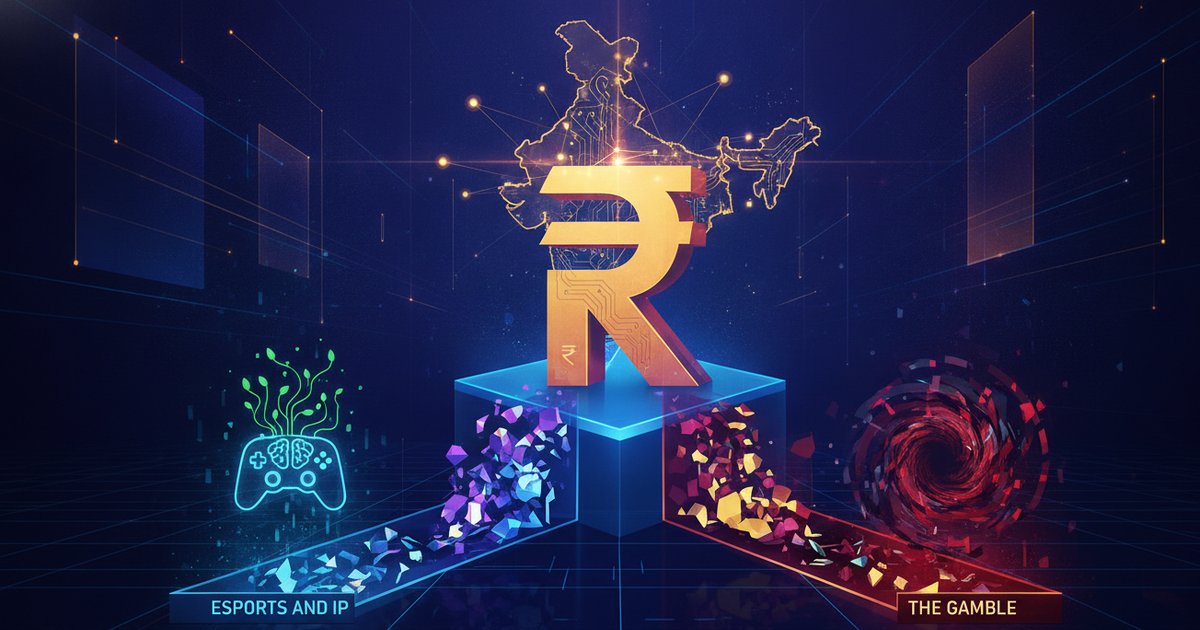
India did something in 2025 that most governments only threaten: it killed an entire revenue model in one legislative stroke. Real-money gaming — the fantasy contests, poker tables, and rummy apps that had become some of the country’s most-downloaded products — was declared illegal, full stop. The state did not tax it harder or regulate it tighter. It banned it.
In its place, New Delhi offered a different vision of what Indian gaming should be: esports as recognised sport, original intellectual property as the engine of value, and entertainment that does not depend on users losing money. It was a brutal, decisive bet. Roughly a year on, global capital is voting with its chequebook even as hundreds of founders count their losses. Whether the gamble is working depends entirely on which ledger you read.
What India Actually Did
The instrument was the Promotion and Regulation of Online Gaming Act, 2025, with its accompanying Rules brought into force on 1 May 2026. The law draws a hard line through a sector that had spent years arguing about where one should sit. It bans all online money games — every format where users stake money in the hope of winning more — regardless of whether the outcome turns on skill or chance. That distinction, the legal hair that the industry had split for the better part of a decade, was rendered moot.
To police the new order, the Act creates the Online Gaming Authority of India (OGAI) under the Ministry of Electronics and Information Technology. The government’s stated rationale was social, not fiscal: by its own estimate, around 45 crore people were exposed to money-gaming platforms, with user losses exceeding Rs 20,000 crore. The framing was deliberate — addiction, financial ruin, and household debt rather than tax leakage.
Crucially, the same law that outlawed RMG formally recognised the things the state wants to grow. Esports is acknowledged as a legitimate competitive sport, and social or casual games — those without a wagering mechanic — are explicitly carved out as permitted. In one document, India banned an industry and blessed its intended successor. The message to the market was unambiguous: build games people play, not games people bet on.
The Case It’s Working
The clearest evidence that the gamble might pay off is where serious money is going. KRAFTON, the South Korean studio behind PUBG and its India-specific successor BGMI, has signalled plans to invest roughly $200 million in India over three to four years — about $50 million a year — with a focus on esports and original IP. BITKRAFT, one of the most respected gaming-focused investment firms globally, is increasing its exposure too. Neither is a small, opportunistic player. Both are betting that the post-ban Indian market is a more investable one, not a less investable one.
That logic is worth taking seriously. Regulatory ambiguity had long been the tax that scared institutional capital away from Indian gaming. Investors hate writing cheques into companies whose core mechanic might be illegal next quarter. By drawing a firm line — money games out, esports and IP in — the state did something paradoxically pro-investment: it removed the existential question. The companies that survive on the right side of that line now operate with clarity, and clarity is what long-horizon capital prices in.
The market context supports the optimism. India’s online-gaming market was estimated at around INR 232 billion in 2024 and is projected to reach roughly INR 316 billion by 2027. Even with RMG excised, the underlying demand — a young, mobile-first, hyper-engaged audience — has not vanished. It has been redirected. The thesis from KRAFTON and BITKRAFT is essentially that this demand can be monetised durably through subscriptions, in-game purchases, esports ecosystems, and brand-building IP rather than through extractive wagering loops. If they are right, India trades a fast, fragile revenue model for a slower, sturdier one.
The Case It Carried a Heavy Cost
None of that erases the carnage. The RMG ban did not gently encourage a pivot; it detonated an industry. Hundreds of real-money gaming startups, many of them venture-backed and employing skilled engineers, product designers, and operations teams, lost their entire reason to exist overnight. Companies that had raised at lofty valuations on the strength of fantasy and card-game revenues found those revenues legally extinguished.
The marquee names felt it most visibly. Dream11, the fantasy-sports giant that had become a household brand and a unicorn poster-child, and its peers across the sector saw their core business model legislated away. These were not fringe operators; they were among the most valuable consumer-internet companies India had produced, and their disruption rippled outward to advertisers, sports leagues that depended on their sponsorship money, and a payments-and-marketing ecosystem built around them.
The human cost is the part that rarely makes it into the triumphant investment headlines. Jobs disappeared. Capital that had been committed in good faith under a permissive interpretation of the law was stranded. Founders who had spent years building inside what they believed was a legal grey zone discovered there was no grey zone left.
And the policy itself sits atop unresolved tensions. India has long fought a Centre-versus-state battle over gaming jurisdiction, with some states banning formats the Centre tolerated and vice versa. The new Act asserts central authority, but the friction is structural, not settled. So too is the skill-versus-chance debate — for years the industry’s legal shield, now bulldozed by a law that simply refuses to recognise the distinction where money is staked. Whether collapsing that distinction is sound policy or a blunt overreach is a genuinely open question, and reasonable people read it differently.
What Founders Should Read Into It
For anyone building in or around Indian gaming — and arguably for consumer-internet founders generally — the episode offers lessons that outlast the news cycle.
The first is the most uncomfortable: do not build on loophole monetisation. If a meaningful chunk of your revenue depends on a permissive reading of an ambiguous law, you are not running a company — you are running a regulatory option that can expire. The RMG sector’s defining mistake was treating the skill-versus-chance argument as a durable moat. It was a temporary one, and when it closed, the businesses behind it had little else.
The second is to treat regulation as a market-shaper, not merely a compliance cost. The state did not just take something away here; it actively named winners. Esports and original IP are now the categories the law protects and the capital favours. Founders who internalise that signal — building durable revenue through subscriptions, in-game economies, content, and brand equity — are aligning with where both policy and patient money are pointing. Those who treat the ban as a temporary setback to be lobbied away are likely misreading the political will behind it.
- Build IP, not just mechanics. Original characters, worlds, and franchises travel across formats and survive regulatory shifts in ways a single monetisation trick cannot.
- Design for durable revenue. Recurring, transparent monetisation is harder to build but far harder to ban.
- Watch the esports infrastructure layer. Tournaments, talent, broadcasting, and the tooling around competitive play are now blessed categories — and currently underbuilt.
Where could the next Indian breakout come from? The honest answer is that the most likely winners are not the survivors of the RMG era retrofitting their old products, but new builders who take the recognised categories seriously from day one. KRAFTON and BITKRAFT are not investing in the past; they are funding the version of Indian gaming the law was written to create.
The gamble, then, is neither vindicated nor disproven. India chose a slower, sturdier industry over a fast, fragile one, and it paid for that choice in shuttered startups and lost jobs. The arrival of disciplined global capital suggests the new structure is investable. Whether it produces a generation of world-class Indian game studios — or merely a smaller, tamer market — is the question the next three to four years will answer. For now, the smart founders are reading the law not as a wall, but as a map.
