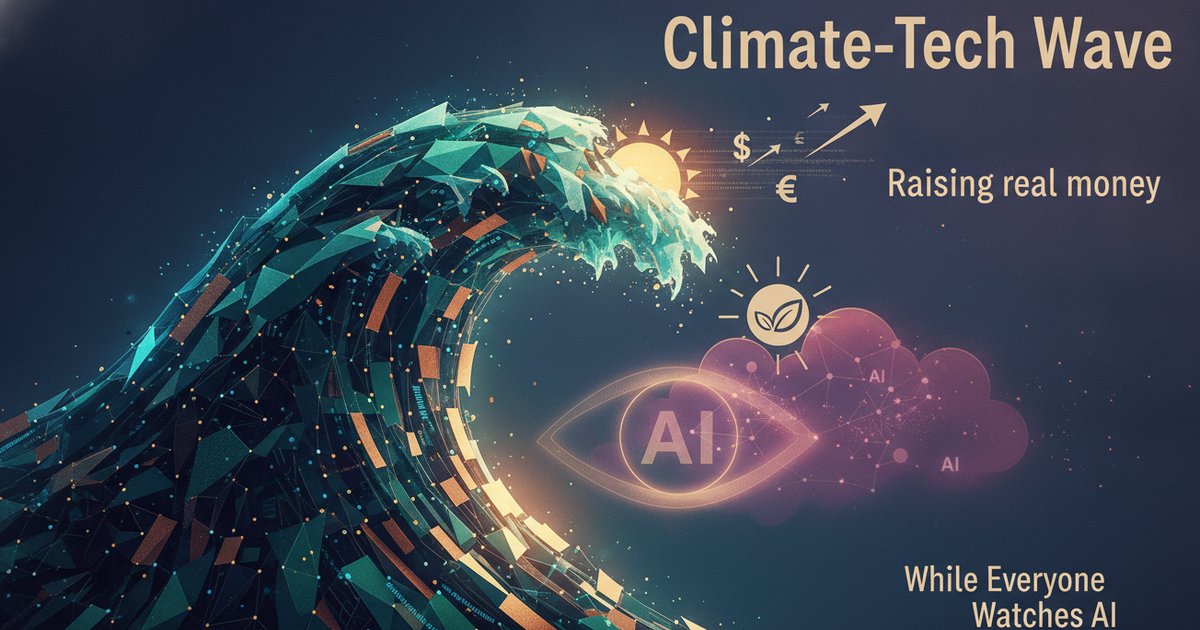
Open any startup feed in 2026 and the noise is all AI: copilots, agents, foundation-model rounds. But scroll past the headlines and a different story is unfolding — slower, heavier and arguably more consequential. Across green hydrogen, rooftop solar, EV charging and fast-charging batteries, Indian companies are pulling in serious cheques from development-finance institutions, strategic corporates and global growth funds. Weekly funding trackers now show capital rotating toward climate, EVs, healthcare, defence and ‘practical’ AI use cases rather than pure consumer apps — a sign of a maturing, problem-solving funding mix, according to Newskart’s India funding updates. This is what that shift looks like up close.
The wave, in deals
The clearest tell is who is writing the cheques. In June 2026, green-hydrogen firm Hygenco raised roughly $105 million, with backers including IFC, Siemens Financial Services and the Fullerton Carbon Action Fund, per Newskart’s funding roundup (figures worth verifying against the company’s own announcement). That investor mix is the headline within the headline: a development-finance institution, a strategic industrial financier and a dedicated decarbonisation fund all in one round. Green hydrogen and its derivative, green ammonia, are precisely the kind of bet that needs patient, infrastructure-grade money — and increasingly they are getting it.
Rooftop solar is scaling on a different rhythm but the same logic. In the same window, SolarSquare raised about $53 million in a Series C led by B Capital, according to Newskart. Rooftop platforms are attractive because they bundle hardware, installation, financing and after-sales service into a repeatable, consumer- and SME-facing model — closer to a distribution business than a pure energy play. That makes them legible to growth investors who are wary of long-gestation infrastructure but want exposure to the clean-energy transition.
The third leg is mobility and storage. GPS Renewables and fast-charging battery company Exponent Energy are both drawing investor interest, Newskart reports, alongside the broader EV-charging buildout. Fast-charging is a particularly interesting wedge: it sits at the intersection of batteries, power electronics and software, and it directly addresses the single biggest psychological barrier to EV adoption — range and charging time. Taken together, these deals are not a one-off; they read as a broad-based climate-tech funding wave spread across generation, distribution, mobility and storage.
Why investors are leaning in
The first driver is policy. India’s National Green Hydrogen Mission, production-linked incentives for solar manufacturing and battery cells, and aggressive renewable-capacity targets have created a durable demand signal that investors can underwrite against. Layer on energy security — reducing import dependence on crude and, increasingly, on Chinese solar and battery supply chains — and clean energy stops being purely an environmental thesis and becomes a strategic one. Governments and corporates both want resilient, domestic energy infrastructure, and that alignment is rare and valuable.
The second driver is the shape of the returns. Climate infrastructure offers long-duration, contracted, utility-like cash flows once assets are built and offtake is locked. For a certain class of capital — pension-adjacent funds, infrastructure investors, development-finance institutions — that profile is more attractive than the binary, winner-take-all dynamics of consumer software. You are not betting on a viral product; you are betting on a 20-year power purchase agreement and a depreciation schedule.
The third driver is the composition of the capital itself. The Hygenco round is a case study: IFC brings concessional, credibility-conferring development capital; Siemens Financial Services brings strategic and equipment-linked exposure; a carbon-action fund brings mandate-driven climate money. This blend de-risks projects in ways a single venture fund cannot, and it signals to follow-on investors that the underlying engineering and offtake assumptions have survived serious diligence. When DFIs and strategics anchor a round, it lowers the perceived risk for everyone downstream.
The hard parts
None of this makes climate tech easy money — and founders romanticising the space should sit with the hard parts. The first is capital intensity and payback. A green-hydrogen electrolyser plant or an ammonia facility costs orders of magnitude more to build than a SaaS product, and the payback runs over years, not quarters. That means dilution risk, reliance on debt structures most early founders have never navigated, and a long, unforgiving runway between groundbreaking and first revenue. The fundraising treadmill never really stops.
The second is execution and offtake risk. It is one thing to announce a green-ammonia plant; it is another to commission it on schedule, hit cost-per-kilogram targets, and — crucially — sign binding offtake agreements with buyers willing to pay a green premium. Many hydrogen projects globally have stalled not on technology but on the absence of committed buyers. Without offtake, a beautifully engineered asset is a stranded one. The same applies to EV charging: utilisation rates, not station counts, decide whether the unit economics ever work.
The third is grid and policy dependence. Rooftop solar economics hinge on net-metering rules and DISCOM cooperation, both of which vary by state and can change with a single notification. Hydrogen and charging depend on power tariffs, grid availability and the pace of transmission buildout. This is a sector where a regulatory tweak can reprice an entire business model overnight. Investors leaning in on policy tailwinds must also accept policy as a standing risk — the same wind can shift direction.
What founders and operators should watch
For founders and operators, the opportunity is real but the discipline required is unusual. Three things deserve close attention.
First, follow the offtake demand. The most fundable climate businesses are the ones that can point to who, specifically, will buy their output and why. For green hydrogen and ammonia, that means hard-to-abate industrial buyers — refineries, fertiliser plants, steel, shipping — and increasingly export markets in Europe and Japan with carbon-border pricing. For rooftop solar, it is SMEs and homeowners doing straightforward payback maths. Map the demand before you map the plant.
Second, build on top. Not every founder needs to pour concrete. The capital-intensive layer creates a software, financing and services layer above it — and that is where leaner, faster-compounding businesses can emerge. Consider:
- Financing platforms that underwrite rooftop, EV-fleet and battery purchases — turning capex into manageable opex for customers.
- Operations and energy-management software that lifts asset utilisation, the single biggest lever on infrastructure returns.
- Maintenance, monitoring and offtake-marketplace services that the hardware players need but rarely want to build themselves.
These are the picks-and-shovels plays of the climate wave, and they fit a venture risk-return profile better than the asset-heavy core.
Third, watch the energy-cost link to AI. Here is where the two stories — the loud AI one and the quiet climate one — collide. AI’s compute boom is a power story before it is a chip story. Data centres need vast, reliable, ideally clean electricity, and India is positioning itself as a data-centre hub. That creates a structural new buyer for renewable power, storage and grid services — potentially a more reliable offtaker than many traditional industrial customers. Founders in clean energy should be watching data-centre demand as closely as anyone in AI is watching GPU supply. The companies that can credibly supply firm, green power to compute clusters may find their most lucrative customers were never in the energy sector at all.
The takeaway is not that climate tech is the new AI. It is that, beneath the AI headlines, India is quietly building the unglamorous infrastructure that everything else — including AI — will run on. The capital is patient, strategic and increasingly global. The founders who win will be the ones who treat offtake, execution and grid reality as seriously as they treat the pitch deck.
