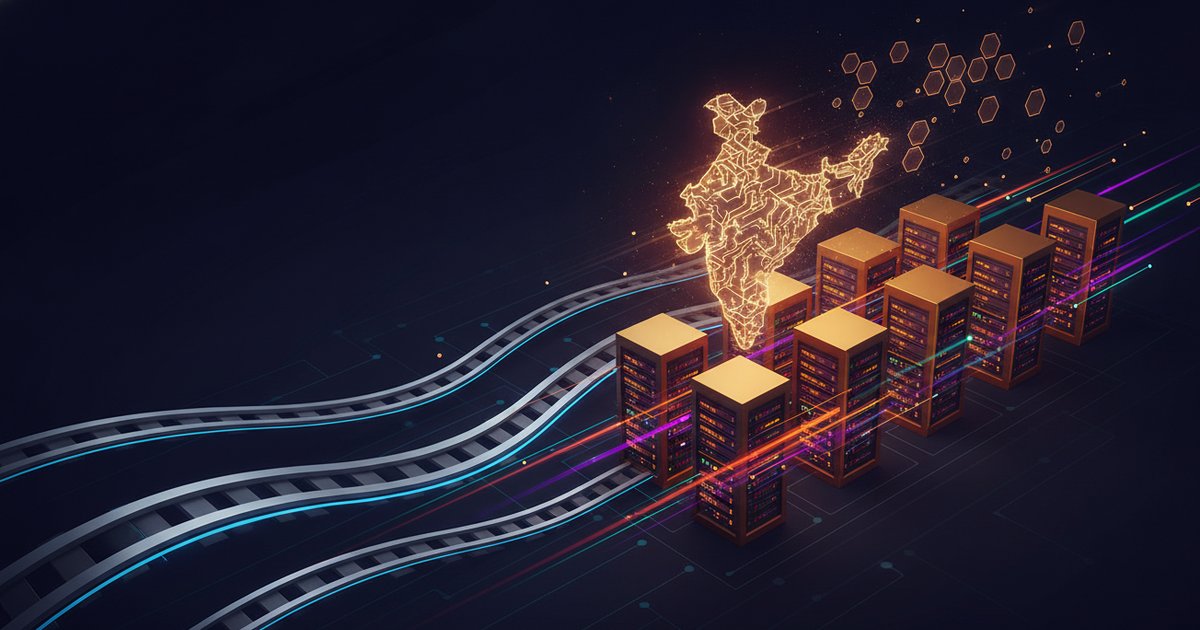
For a decade, India’s tech story abroad has been told in software and standards. UPI, Aadhaar, the broader Digital Public Infrastructure (DPI) stack — these are the rails India exports, the playbook other countries now license and localise. But the next phase of the AI economy is not a protocol you can copy. It is physical: power, land, water, silicon, and the buildings that hold them. India is now moving to anchor that layer at home, and a reported partnership between Meta and Reliance to build an AI data centre — with Jamnagar floated as a potential new AI hub — is the clearest signal yet that the country wants to be a compute builder, not just a compute customer.
This shift matters because the constraints are different, the politics are harder, and the payoff is larger. Owning rails made India influential. Owning racks could make it strategically self-sufficient — or expose new dependencies if the build-out is mishandled.
From rails to racks
India’s DPI achievement is genuine and exportable. The scale is staggering: UPI processed roughly 21.70 billion transactions worth over Rs 28.33 lakh crore in January 2026 alone, according to PIB and IBEF figures citing NPCI. That volume is not just a payments statistic — it is a map of where data is being generated, where fraud detection runs, where personalisation could live, and where AI inference would naturally want to sit close to the user.
The logic of moving from rails to racks follows from that scale. A country generating this much real-time transaction and behavioural data has every reason to want the compute that processes and learns from it located domestically. Until recently, the heavy AI training and a large share of inference for Indian products effectively happened on foreign cloud capacity. The reported Meta-Reliance AI data centre, positioning Jamnagar as a potential new AI hub (as reported by Newskart in June 2026, and worth verifying against the official announcement), is the anchor event in a broader wave of compute investment landing on Indian soil.
Why do hyperscalers want sovereign-adjacent capacity here in the first place? Three reasons converge. First, demand: India is one of the largest single markets for digital services on the planet, and latency-sensitive AI features perform better when served locally. Second, regulation: data-residency expectations and the Digital Personal Data Protection regime push toward keeping certain workloads in-country. Third, partnership economics: a player like Reliance brings land, captive power, energy expertise, and political relationships that a foreign hyperscaler cannot assemble alone. “Sovereign-adjacent” is the right phrase — not state-owned, but built with enough local control and residency to satisfy both governments and enterprises.
The opportunity for startups
For India’s AI startups, the upside is concrete rather than symbolic. The most immediate gain is cheaper, closer inference. When the GPUs serving your model sit in Gujarat rather than Virginia or Singapore, round-trip latency drops and egress costs fall. For consumer-facing products — voice assistants in Indian languages, real-time fraud scoring on payments, agentic workflows for small businesses — that difference is the gap between a demo and a product people actually use.
The second opportunity is data-residency-friendly AI. A growing number of Indian enterprises — banks, insurers, healthcare providers, government departments — cannot or will not send sensitive data outside national borders. Startups that can credibly say their models train and run on domestic compute gain access to procurement conversations that were previously closed. Compliance becomes a feature, not a cost.
The third, more strategic opportunity is the chance to build on top of local compute rather than merely rent it. As hyperscale capacity lands, expect a layered ecosystem to form: GPU-as-a-service intermediaries, fine-tuning platforms, vector databases, evaluation and observability tooling, and vertical AI applications that assume cheap nearby inference. The companies that win will be those that treat domestic compute as a platform to specialise on — Indian languages, Indian regulatory contexts, Indian price points — rather than as a generic cloud substitute. The risk for founders is over-indexing on a single provider’s roadmap. The opportunity is real all the same.
The hard constraints
None of this is easy, and the constraints are not the kind you can engineer around with a clever architecture. The first is power and cooling at scale. Hyperscale AI data centres are extraordinarily energy-hungry; a single large campus can draw as much electricity as a small city, and the load is continuous. India’s grid is improving but still strained in many regions, and adding gigawatt-class demand without dedicated generation risks crowding out other users or leaning on coal. Jamnagar is a deliberate choice here — Reliance’s existing energy and refining complex offers captive power and infrastructure that a greenfield site would lack.
The second constraint is land, water, and grid stability. Cooling AI clusters consumes water, and water stress is a serious and growing issue across much of India. Siting decisions that ignore local water tables or community access will invite — and deserve — opposition. Land acquisition at scale carries its own political and legal friction. And even with power generated nearby, transmission, redundancy, and grid stability must be engineered to data-centre-grade reliability, which is a higher bar than the average industrial connection.
The third, and least controllable, constraint is chip access under export controls. The most capable AI accelerators are subject to a shifting US export-control regime, and India sits inside a complex geopolitical calculus that determines which chips arrive, in what quantity, and on what timeline. A data centre is only as useful as the silicon inside it. India can build the buildings and the power, but the highest-end GPUs remain a chokepoint outside its direct control. This is the single biggest reason to be sober about declaring compute sovereignty too early.
What policy has to get right
If the compute build-out is to deliver national benefit rather than just corporate scale, policy has to get several things right at once.
The first is energy strategy. India cannot decarbonise on paper while powering AI campuses on coal in practice. The honest path is to tie large new compute loads to genuinely additional clean generation — solar, wind, storage, and where appropriate nuclear — rather than letting them absorb existing capacity. Water-use standards and transparent reporting for data centres should be mandatory, not voluntary. Getting this right turns the AI build-out into an accelerant for the clean-energy transition; getting it wrong makes it a liability.
The second is incentives without lock-in. Subsidies, tax breaks, and land deals will be necessary to attract hyperscale investment, and that is legitimate industrial policy. But incentives should be structured to build an open ecosystem — interoperability, fair access for smaller players, and conditions that prevent a handful of large firms from owning the entire stack from power to application. The goal is a compute commons that startups can plug into, not a walled garden with a national flag on it.
The third is talent and the compute-cost curve. Cheaper local inference only translates into innovation if there are enough engineers who can use it well. India produces vast technical talent but loses much of its frontier AI expertise abroad. Policy that funds research compute for universities and startups — effectively subsidising the early part of the cost curve — would do more for long-term capability than any single mega-campus. The compute-cost curve is the real lever: as the price of running models domestically falls, the range of viable products expands, and that is where broad-based economic value is created.
India spent a decade proving it could build digital rails the world wanted to copy. The compute era asks a harder question — whether it can build, power, and govern the physical infrastructure of AI on its own terms. The Meta-Reliance project in Jamnagar is a strong opening move and a useful signal of intent. But signals are not strategy. The countries that win the AI infrastructure race will be the ones that solve energy, water, and access honestly, and that keep the resulting compute open enough for the next generation of founders to build on. India has the demand, the data, and now the first racks. The rest is policy and execution.
