
For most of the modern era, the relationship between the state and the technology industry has run along a familiar track: companies build, governments set rules, and the two meet in courtrooms and committee hearings when things go wrong. Artificial intelligence is quietly rewriting that arrangement. The question is no longer only how governments should regulate frontier AI, but whether they should own a piece of it.
That shift moved from theory to headline this year. Understanding what is actually being reported, versus what is being inferred, matters more than usual here, because the difference between a regulator and a shareholder is not a rhetorical flourish. It is a structural change in who controls the most consequential technology of the decade.
What’s reported
Get the direction right, because it matters: this is not Washington moving to seize a slice of OpenAI. According to the Financial Times, which broke the story citing people familiar with the matter, OpenAI has held preliminary internal discussions about offering the US government an equity stake of around 5% — potentially through a sovereign-wealth-style vehicle, and ideally with other leading labs (Anthropic, Google, Meta) contributing similar stakes. It is a proposal reportedly floated by OpenAI to defuse political blowback, not a government initiative. We flag it carefully: the reporting is single-origin (the FT, relayed by Reuters, Bloomberg, CNBC and others), OpenAI declined to comment and the White House did not respond, and nothing has been agreed — so treat every specific, including the ~5% figure, as provisional.
The same reporting places the possible stake alongside advanced talks between Washington and major AI companies over voluntary standards for releasing powerful models. Those standards reportedly touch three practical levers: the benchmarks a model must clear, the timelines on which new systems can be released, and the access rules that determine who gets to use the most capable versions.
Read together, these two threads describe a subtle but important change in tone. The public conversation around AI has spent years framed in the language of safety, alignment, and existential risk. What is emerging now sounds different. Benchmarks, release windows, and access controls are the vocabulary of operational control, not abstract principle. The state is moving closer to the machinery, deciding not just whether a model is safe but when it ships and to whom. A financial stake, if it materialises, would be the logical endpoint of that trajectory: influence exercised not through rules alone, but through ownership.

The national-champion question
This is where the phrase national champion becomes unavoidable. The idea is old and familiar in other strategic sectors. Governments have long taken direct or indirect stakes in defence contractors, aerospace firms, energy giants, and banks deemed too important to fail or too sensitive to leave entirely to the market. The logic is that some industries are so tied to national power that the state cannot afford to be a mere bystander.
Frontier AI fits that template with unsettling ease. A handful of labs now sit at the center of economic productivity, military capability, information ecosystems, and scientific research all at once. Seen through that lens, a government stake looks less like an anomaly and more like the continuation of a very old habit applied to a new commanding height.
But the AI case carries a complication that the older precedents largely lacked. A state that owns equity in a frontier lab is also the state writing the rules that govern frontier labs. As industry analysts have noted, state equity in a leading AI company would blur the line between regulator and shareholder, and that blur reflects a broader shift in which governments increasingly seek to shape who builds advanced AI and who is allowed to access it. When the referee also holds shares in one of the teams, the integrity of the whole contest comes into question. That is the tension a national-champion model in AI cannot easily escape.
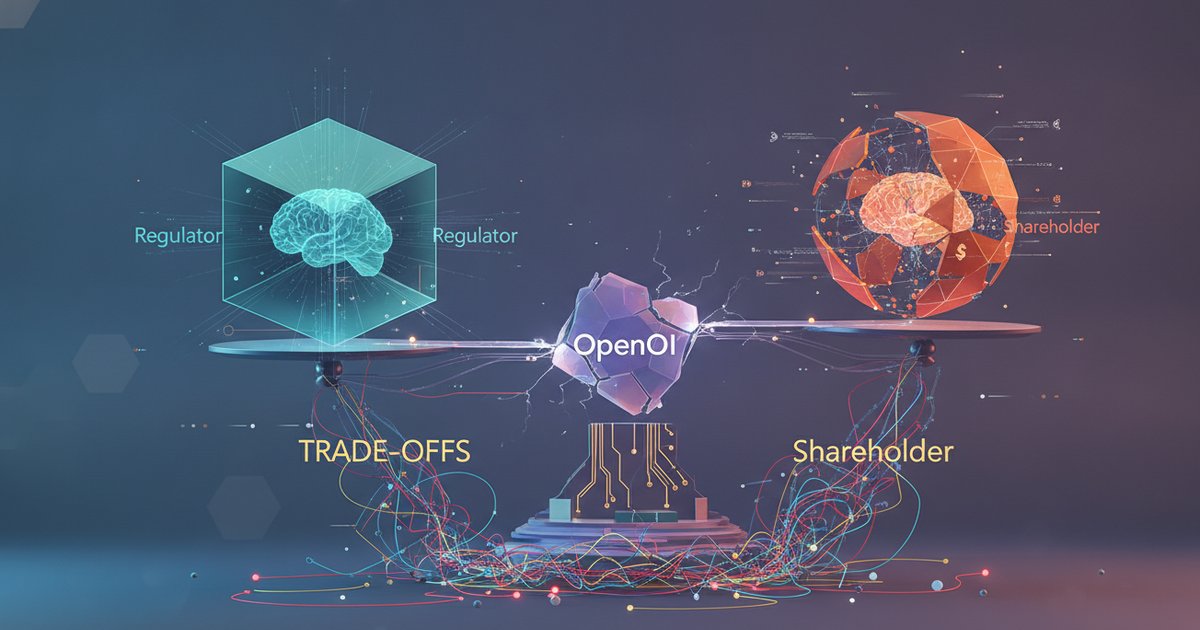
The trade-offs
None of this is to say the impulse is illegitimate. There is a serious national-security argument for wanting the most powerful models aligned with a country’s strategic interests rather than drifting toward rivals or leaking into the open market unchecked. If you believe advanced AI confers durable geopolitical advantage, treating it like any other consumer product starts to look reckless. Ownership offers a government a seat at the table on release decisions, security practices, and export choices that regulation alone might not reach.
The costs, though, are real and they arrive quickly.
- Market distortion. A lab with the government as a shareholder enjoys an implicit backstop that its competitors do not. Capital becomes cheaper, procurement doors open, and the perception of official favour can crowd out rivals long before any explicit advantage is granted. Innovation tends to suffer when the state anoints a winner.
- Competition and access. If release timelines and access rules are shaped partly by an owner-government, the definition of who counts as a trusted user becomes a political question. Smaller firms, startups, and international partners may find themselves on the wrong side of rules they had no hand in writing.
- Governance and conflicts of interest. A government that profits from a company it also polices faces an inescapable conflict. Every enforcement decision, every safety mandate, every subsidy carries the shadow of financial self-interest. Public trust in AI oversight is already fragile; a shareholding state does not obviously strengthen it.
The honest position is that these trade-offs do not resolve neatly. Strategic control and open competition pull in opposite directions, and any government pursuing the first will have to spend credibility defending the second.
The India read
For readers in India, this is not a distant American curiosity. It is a preview of a debate that is already underway at home, and one that will intensify. States everywhere are becoming more hands-on with AI, moving from light-touch observers to active participants in funding, infrastructure, and access.
India’s own conversation runs under the banner of sovereign AI: the argument that a country of India’s scale and ambition should not depend on foreign models for its most sensitive applications, and should build indigenous capability across compute, data, and foundation models. The IndiaAI Mission, public investment in shared GPU capacity, and support for homegrown model-building all point in the same direction. The national-champion question is therefore not hypothetical here. It is whether the Indian state should pick, fund, and effectively back one or a few domestic labs as standard-bearers.
The American case offers India a useful cautionary frame rather than a template to copy. The strategic instinct to want capable, aligned, locally controlled AI is reasonable, especially given India’s data-sovereignty and security concerns. But the same conflicts that dog a US stake in OpenAI would apply, with the added risk that a young and still-forming domestic AI ecosystem could be distorted before it matures. Anointing a champion too early can starve the very competition that produces breakthroughs.
The more durable path for India is likely to separate the functions that the national-champion model conflates. The state can fund infrastructure, underwrite research, and set procurement standards without taking equity that compromises its role as regulator. It can build public digital infrastructure for AI, as it did with UPI for payments, while leaving the competitive layer genuinely open. Strategic control and open competition need not be a binary choice, but keeping both alive requires deliberate institutional design rather than the path of least resistance.
What Washington decides about OpenAI will be studied closely in Delhi, not because India should imitate it, but because it will reveal how a leading power reconciles the pull of ownership with the duty of oversight. If the reported stake becomes real, it will mark the moment the state stopped merely governing the frontier of AI and started owning it. Whether that makes the technology safer, or simply more captured, is the question the rest of the world, India included, now has to answer for itself.
