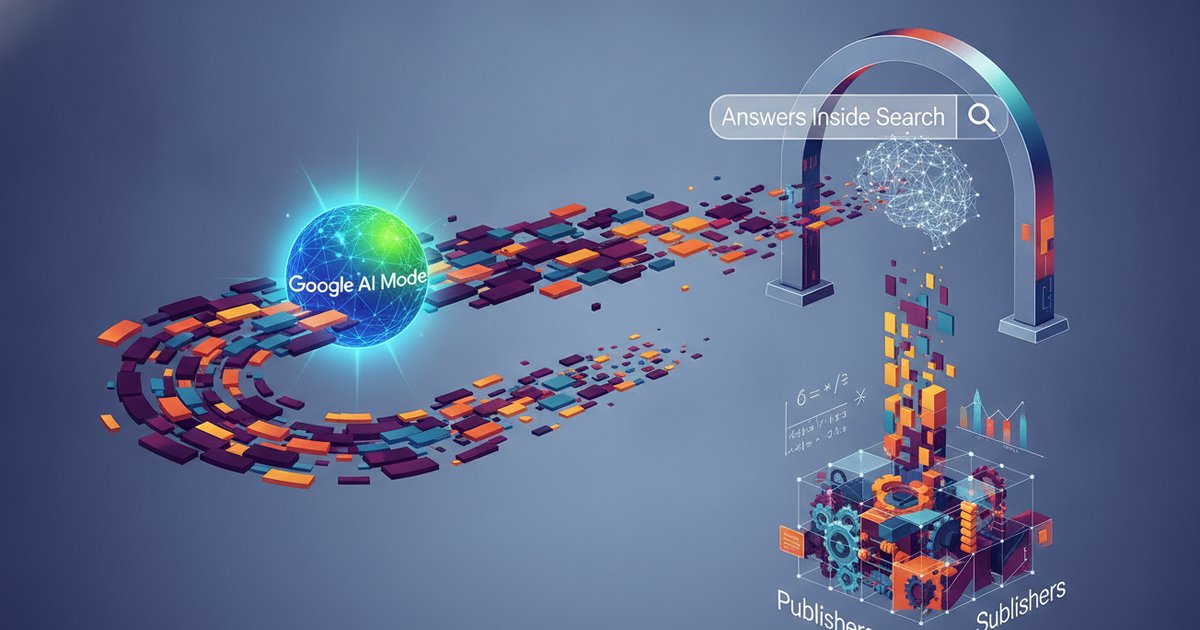
For 25 years, the deal was simple: Google sent you a question’s worth of links, and you clicked through to a website that did the explaining. That website made money — from ads, subscriptions, affiliates — and Google made money on the way in. The web grew on the back of that arrangement.
At I/O 2026, Google effectively rewrote it. AI Mode — the conversational, answer-first version of Search — is now the default experience for most users, and it is built to resolve queries inside the results page rather than ship traffic out to publishers. This is the biggest change to the search box in two and a half decades, and for anyone whose business depends on organic referral traffic, it is not a citation-optimisation problem. It is a survival-math problem.
What changed at I/O 2026
The headline announcement was that AI Mode is no longer an opt-in experiment tucked behind a tab. It is becoming the default front door to Search, powered globally by Gemini 3.5 Flash as the standard model. According to Google’s own Search blog from I/O 2026, AI Mode crossed roughly one billion monthly users about a year after its debut, while AI Overviews — the summarised answers stitched into classic results — now reach around 2.5 billion users a month. That is not an edge case. That is the mainstream search experience.
Three shifts matter most. First, AI Mode as default means a user’s first interaction with a query is now a generated answer, not a list of ten blue links. Second, conversational follow-ups keep people inside Google: you ask, you refine, you ask again, and the entire session can complete without a single outbound click. Third, Google is pushing what it calls information agents — assistants that can carry out multi-step tasks, compare options, and synthesise across sources on the user’s behalf. Each of these is designed to answer, not to refer.
The strategic intent is unmistakable. Where the old Search monetised the journey off the platform, the new Search is engineered to keep users on Google for as long as possible. For publishers, that flips the foundational assumption of the entire SEO industry: that ranking well means earning a visit.
The traffic math nobody can ignore
Here is the uncomfortable arithmetic. On traditional Google searches, roughly 60% already end without a click, according to analysis drawing on Semrush and Bain data compiled by Pasquale Pillitteri. Inside AI Mode, that zero-click rate rises to around 93%. In other words, the format that is now becoming default is one where fewer than one in ten searches sends a user anywhere at all.
The damage is not evenly distributed. Informational content — the “how to,” “what is,” “best way to” queries that powered a generation of blog-driven media businesses — is hit hardest, because that is exactly the kind of answer an AI can summarise cleanly and completely. Some informational publishers are already reporting organic-traffic losses in the range of 40% to 70% year on year, per the same analysis. Transactional and high-intent commercial queries hold up somewhat better, because users still want to compare, buy, book, or contact a real provider — but even there, the buffer is shrinking as information agents start handling comparison tasks directly.
There is a second, less obvious problem: volatility. The old SEO playbook assumed stable rankings — earn position three, hold it, forecast the traffic. AI citations don’t behave that way. Which sources an AI answer chooses to cite can shift from query to query and model update to model update, with little of the predictability of the classic ranking algorithm. You can be cited today and invisible tomorrow without your page changing at all. That breaks the planning models, the traffic forecasts, and the revenue projections that media businesses were built on. You cannot run a business on a referral channel that is both shrinking and unpredictable.
What still works
None of this means content is dead. It means commodity content is dead. The line is sharper than it has ever been between work an AI can flatten into a two-sentence summary and work it cannot.
The defensible categories are the ones that require something a model does not have:
- Original reporting. News an AI cannot generate because it hasn’t happened yet — interviews, scoops, documents, on-the-ground observation. If the answer didn’t exist until you reported it, the AI has to come to you for it.
- Primary data. Proprietary surveys, benchmarks, pricing studies, and datasets. When you are the source of the numbers, you become the thing every summary cites — and the thing users seek out directly.
- First-person depth. Lived expertise, hands-on testing, opinionated analysis, and judgement. A generic explainer of “the best CRM for small business” is AI fodder; a founder’s account of migrating between two CRMs and what broke is not.
On the technical side, the citation game still matters even if it can’t be your whole strategy. Clean structured data helps machines understand what your content actually is, and genuine E-E-A-T signals — experience, expertise, authoritativeness, trustworthiness — improve your odds of being the source an AI answer leans on. Be the citation, not the casualty. But treat that as insurance, not income.
The real durable asset is owned audience — the channels Google cannot intermediate. Email lists, a strong app, push notifications, communities, and direct, branded traffic from people who type your name into the bar. These are the relationships no algorithm change can sever. The publishers who survive the next two years will be the ones who used their remaining search traffic to convert strangers into subscribers before that traffic evaporated.
The revenue lever you control
If pageviews are no longer reliable, the metric that matters is revenue per session, or RPS — how much value you extract from each visit you do get. When traffic was cheap and abundant, you could afford a low yield per visitor. In a world where every visit is harder to win, the math inverts: fewer, more valuable sessions beat a flood of drive-by readers who bounce after one AI-deflected click.
Practically, that means a few things. Lean into higher-yield monetisation — subscriptions, memberships, premium newsletters, well-matched affiliate and commerce integrations, and direct ad relationships — rather than depending on programmatic impressions that scale only with volume. Build conversion paths on the pages that still get traffic, so a single visit captures an email address or a sale. And measure ruthlessly: a 30% traffic decline with a 50% RPS gain is a healthier business than the one you had before.
Second, diversify your traffic sources with the urgency of someone whose single biggest supplier just announced a price war against them. That is what Google has effectively done. Search dependency was always a concentration risk; AI Mode has simply made the bill due. Put real weight behind direct, email, app, social, video, and even being present inside the AI ecosystems themselves — because attention is migrating there too.
Finally, watch the regulatory timeline but do not build your plan around it. The EU’s Digital Markets Act gives some hope that regulators may eventually force changes to how Google surfaces and credits third-party content, and there is genuine policy pressure building over AI answers cannibalising the open web. That story is worth tracking closely. But regulation moves in years, and your traffic is changing in quarters. Any business that waits for Brussels to fix its revenue model is choosing to be a passenger.
The brutal summary: the era of treating Google as a reliable, free customer-acquisition channel is ending. AI Mode at this scale — a billion monthly users and rising — is not a trend to ride out. It is the new baseline. The publishers and small businesses that come through it will be the ones who produce work an AI genuinely can’t replace, who own their audience relationships outright, and who optimise for the revenue from each session rather than the size of a traffic number that is no longer in their control.
