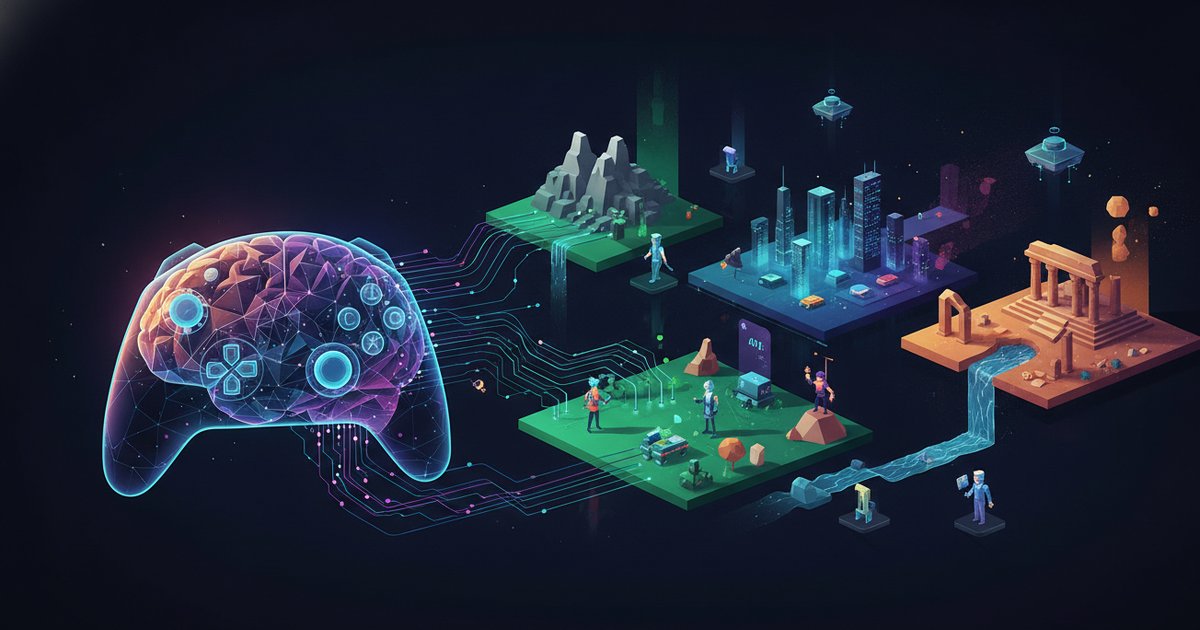
For decades, video games have been AI’s favourite proving ground — from chess engines to the reinforcement-learning agents that mastered Go and StarCraft. But those systems learned to win games. A new bet, freshly capitalised, is that games can teach machines something more fundamental: a working intuition about how the physical world behaves. Same brain that plays a shooter, the pitch goes, drives a robot down a corridor.
That bet now has a price tag, a marquee cap table, and a genuinely interesting technical wager underneath it. It also sits at the centre of one of the hottest — and least settled — races in AI right now: world models and embodied agents. Here’s what General Intuition is claiming, where the science is still unproven, and why the whole thing matters for founders and operators watching from India.
The raise and the bet
General Intuition has raised $320 million at a $2.3 billion valuation, according to TechCrunch. The round was led by Khosla Ventures, with General Catalyst, Jeff Bezos and Eric Schmidt among the backers — a roster that reads like a who’s-who of people who make asymmetric, decade-long bets. The deal brings the company’s total disclosed funding to roughly $454 million.
The core idea is deceptively simple. General Intuition trains its agents on hundreds of millions of hours of gameplay drawn from its sister app, Medal — a clip-capture tool gamers already use to record and share their best moments. That existing firehose of footage becomes the training corpus. But the company insists the real value isn’t the video; it’s the action labels riding alongside it: exactly which inputs a player pressed, and precisely when.
To dramatise the thesis, the company demonstrated a single model powering two very different things: a game-playing agent and a quadruped robot. Per TechCrunch, the robot was fine-tuned with only about eight minutes of real-world data before it could move. If that holds up, it’s a striking claim — that most of what a machine needs to navigate the physical world can be absorbed from games, with reality supplying only a light final polish. That is the promise. As we’ll see, it’s also where the caveats begin.

Why action data, not just video
To understand why General Intuition is excited about button presses, it helps to understand what video alone can and can’t teach.
A model trained on raw video has to infer motion. It sees a character arrive at the top of a ladder and has to guess how they got there — and guessing is exactly where machine learning tends to hallucinate. Action data removes the guesswork. It’s a record of intent and consequence: the player pushed ‘up’ against the ladder, and the character climbed. Do that across hundreds of millions of hours and the model isn’t just watching the world; it’s watching decisions and their outcomes, paired frame by frame.
That pairing is what lets a system start learning cause and effect rather than surface correlation:
- Walls are walls. Push toward one and you stop. The model learns solidity as a consequence of failed inputs, not as a label someone hand-coded.
- Ladders are for climbing, ledges for dropping. Affordances — what an object lets you do — get learned from how players actually interact with them.
- Timing matters. When an input was pressed, relative to what was happening on screen, encodes reaction and sequencing that pure video flattens.
This is the conceptual heart of a world model: an internal simulation of how an environment responds to actions. General Intuition’s framing is worth internalising for anyone tracking the space — the world model is the training gym, and the agent is the product. You build a rich, physics-plausible sandbox where an agent can rehearse millions of scenarios cheaply, then ship the agent that comes out of it. Games are simply the most abundant, most densely instrumented gym humanity has ever built, and Medal happens to own a very large slice of one.

The open question
Here is the part that separates a compelling demo from a defensible science: nobody yet knows whether simulation-to-real transfer holds at scale.
An eight-minute fine-tune on one quadruped in one controlled setting is a promising signal, not a proof. The graveyard of robotics is full of systems that performed beautifully in simulation and fell apart against the messy, high-variance texture of the real world — the ‘reality gap.’ Lighting, friction, sensor noise, unmodelled edge cases, and the sheer long tail of physical situations are precisely what games abstract away. A skidding wheel, a slippery floor, a child darting into frame — none of that is well represented in gameplay clips. Whether intuition learned from games generalises to the physical world’s chaos, robustly and across many robot bodies and tasks, is the single biggest unknown here, and it’s honest of the company (and its investors) to treat it as unsolved rather than settled.
General Intuition is also not alone. World models and embodied AI have become a crowded, well-funded frontier, with large labs and specialist startups all chasing versions of the same prize: agents that can perceive, predict, and act in dynamic environments. That competition raises the stakes on execution and on the other hard constraint — compute. Pre-training on hundreds of millions of hours of anything is brutally compute-hungry, which is why the company has reportedly lined up a CoreWeave deal for capacity. In this race, access to GPUs is nearly as strategic as access to data, and both are getting more expensive to secure.
The reasonable read: General Intuition has a genuinely differentiated data story and a plausible architecture, wrapped around a transfer problem the whole field is still trying to crack. That’s a high-variance bet — which is exactly what a $2.3B valuation on this thesis represents.
The India read
For an Indian audience of founders, operators and investors, three threads are worth pulling.
First, the moat is data, not the model. Model architectures diffuse fast; frontier techniques are public within months. What doesn’t diffuse is a proprietary, hard-to-replicate dataset with a natural collection engine attached. Medal’s gameplay firehose is General Intuition’s real defensibility. The lesson for Indian builders is durable and cheap to state, expensive to execute: own a data-generating product before you try to own a model. India has enormous latent troves — vernacular voice, logistics and mobility traces, retail and payments behaviour, agricultural and manufacturing sensor data — but most of it is unlabelled and un-instrumented. The teams that build the boring collection layer now will own the moat later.
Second, embodied AI is India-relevant, not just Silicon Valley theatre. If world models genuinely lower the real-world data required to make robots useful, the economics of automation in warehousing, manufacturing, agriculture and last-mile delivery shift — sectors where India has both scale and a hard labour-and-safety story. A cheaper path from simulation to a working robot changes who can afford to deploy one. Indian robotics and industrial-automation startups should be watching the transfer research closely, because if it works, the capability arrives as a platform they can build on rather than a moonshot they have to fund alone.
Third, note the jobs angle. General Intuition’s orbit reportedly includes a marketplace, Nerve, aimed at giving gamers a stake — a way to earn from the very activity and data feeding the AI. That’s a small but telling design choice as automation reshapes work: instead of harvesting user behaviour silently, build a mechanism where the people generating the data participate in the upside. For India, where the anxiety about AI displacing services and knowledge work is acute and legitimate, that model — data contributors as stakeholders — is worth studying. It won’t answer the displacement question on its own. But it gestures at a version of the AI economy where the humans in the loop aren’t only its subjects.
None of this is guaranteed to work. The transfer problem could stall; the compute bill could outrun the progress. But the underlying insight — that intuition might be learnable from the record of millions of small decisions people already make for fun — is one of the more elegant bets in AI right now. Whether it pays off is, fittingly, the open question.
