
For two years the AI conversation has been dominated by chatbots — systems that answer. The next wave answers and then acts: booking the meeting, filing the ticket, pushing the code, moving the money. Agentic AI collapses the gap between a model’s output and a real-world consequence, and that is exactly what makes it useful — and dangerous. So it matters that the cyber agencies of five governments have, for the first time, agreed on how to deploy these systems without setting fire to your infrastructure.
According to a roundup by Crescendo AI citing the Five Eyes agencies, the US, UK, Canada, Australia and New Zealand jointly released guidance titled Careful Adoption of Agentic AI Services. (We’d encourage readers to verify the wording against the primary CISA and NCSC publications.) The document names five risk categories and lands on a single, unglamorous principle: roll out incrementally, govern strongly, and keep a human in the loop. For anyone moving agents from demo to production, it is the most practical security read of the year.
Why a rulebook now
The shift from “chat” to “act” is the whole story. A model that hallucinates an answer wastes your time. An agent that hallucinates while holding API keys, database credentials, or the ability to execute shell commands can cause damage that propagates faster than any human can catch it. The risk surface is no longer the conversation — it’s everything the agent is wired to touch.
That escalation is why a multi-nation security consensus appeared now rather than later. Critical infrastructure operators, banks, hospitals and government departments are all piloting agents, and the agencies behind the Five Eyes alliance share threat intelligence precisely so that emerging risks don’t have to be learned five times over. A single, harmonised framework signals that agentic AI has graduated from novelty to something that warrants the same scrutiny as any other privileged system on the network.
The timing isn’t abstract. The guidance echoes a run of real agent-security incidents. As Build Fast with AI reported, the period saw “Agentjacking” attacks on coding agents and the manipulation of AI support chatbots into doing things their operators never intended. The lesson, repeated across cases, is blunt: agent inputs and tool outputs must be treated as untrusted. A web page an agent reads, a file it parses, a response from a third-party tool — any of these can carry an instruction designed to hijack its behaviour. The old security boundary assumed the attacker was outside; with agents, the malicious instruction can ride in on data the agent was asked to process.
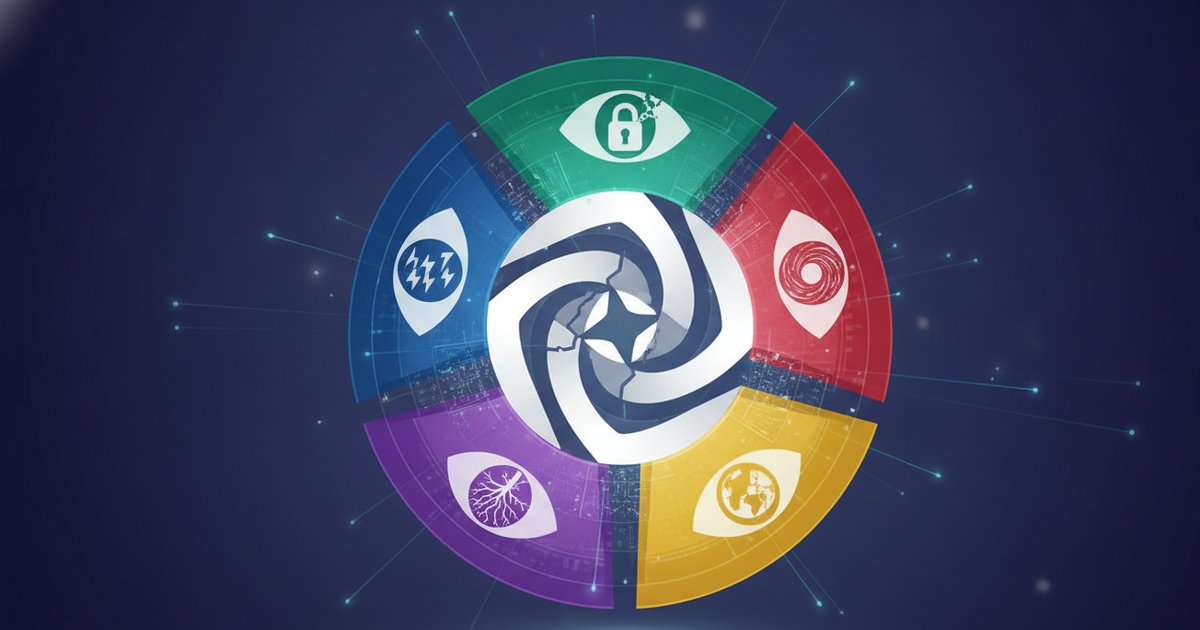
The five risk categories
The framework’s strength is that it gives teams a shared vocabulary. Rather than “the AI did something weird,” you can classify failure modes and assign owners. The five categories cover the full lifecycle — from how an agent is granted access to who answers for it when something breaks.
- Privilege. What the agent is allowed to do. Over-permissioned agents are the single most avoidable risk: hand an agent broad credentials “for convenience” and you’ve built a powerful insider with no judgement. In practice this means scoping access tightly and gating anything irreversible.
- Design and configuration. How the agent is built and wired up. Insecure defaults, exposed tool integrations, unmonitored memory, and prompt or system configurations that can be overridden all live here. Most production incidents trace back to a configuration choice nobody reviewed.
- Behaviour. What the agent actually does at runtime, which is where untrusted inputs bite. Prompt injection, manipulated tool outputs, and goal drift mean an agent’s behaviour can diverge from intent without anyone changing a line of code. This is the category that demands continuous monitoring rather than one-time testing.
- Structural. The systemic risks of agents operating in fleets and chains. When agents call other agents, errors and compromises cascade. A flaw in one widely reused component, or a feedback loop between automated systems, can amplify a small problem into a large one.
- Accountability. Who is responsible, and can you prove what happened. Without thorough logging, attribution and clear ownership, an agent becomes a liability black box — you can’t audit a decision, can’t explain it to a regulator, and can’t reliably learn from it.
Read together, these categories enforce a full-lifecycle view: you assess privilege before deployment, harden design and configuration during build, watch behaviour in production, account for structural risk as you scale, and bake in accountability throughout. Skipping any stage leaves a gap an attacker — or a bad day — will eventually find.

The core principle
If you remember nothing else from the guidance, remember this: deploy incrementally, govern strongly, and keep humans in the loop. It is deliberately undramatic, and that’s the point.
Deploy incrementally. Start with low-stakes, reversible tasks in narrow domains, observe behaviour under real conditions, and expand only when you have evidence the agent behaves as intended. The temptation to hand an agent the keys to a critical workflow on day one is exactly what the framework is written to resist. Treat each expansion of scope as a deliberate decision, not a default.
Strong governance and monitoring. Governance here is not a policy PDF; it’s operational. It means logging every action an agent takes, monitoring for anomalous behaviour in real time, maintaining an inventory of which agents exist and what they can access, and having a kill switch you’ve actually tested. You cannot govern what you cannot see, so observability is the prerequisite for everything else.
Continuous human oversight. Humans stay in the loop — especially for sensitive or irreversible actions. The framework leans toward human-in-the-loop or human-on-the-loop designs, where consequential steps require approval or can be interrupted. This is where a lot of “fully autonomous agent” marketing meets reality: full autonomy is a destination you earn through demonstrated reliability, not a starting configuration.
Our take: none of this is anti-innovation. It’s the same maturity curve every powerful technology travels. The teams that institutionalise these habits early will ship agents into production faster than the ones who treat security as a cleanup job after an incident.
The India read
Indian enterprises are not waiting. From IT services giants embedding agents into delivery pipelines to fintechs and SaaS startups racing to ship agentic features, the deployment curve here is steep — and competitive pressure is pushing teams to grant agents real authority over real systems quickly. That urgency is precisely the environment the Five Eyes guidance was written to slow down, in the productive sense.
The framework isn’t Indian, but it’s adaptable, and it should be adapted locally rather than copied. That means mapping the five risk categories onto India’s own regulatory context — the DPDP Act’s expectations around personal data, sectoral rules from the RBI for anything touching payments, and CERT-In’s incident-reporting obligations. An agent that processes customer data or moves money sits inside frameworks that already carry legal teeth; the accountability category isn’t optional here, it’s compliance.
For operators putting agents into production now, two principles travel especially well. First, least privilege: give an agent the narrowest possible access to do its job, and resist credential sprawl even when it’s slower. Second, gate sensitive actions: anything irreversible — a payment, a deletion, a customer-facing communication, a production deploy — should require human approval or a hard confirmation step until the agent has earned trust through a track record you can audit.
The opportunity is real, and so is the exposure. The agencies behind this guidance aren’t telling anyone to stop building agents. They’re telling builders to treat agent inputs and tool outputs as untrusted, to expand scope only as fast as their monitoring can keep up, and to make sure that when an agent acts, a human is still accountable for the consequence. For Indian teams sprinting toward production, that’s not red tape. It’s the difference between an agent that scales and one that becomes the post-mortem.
