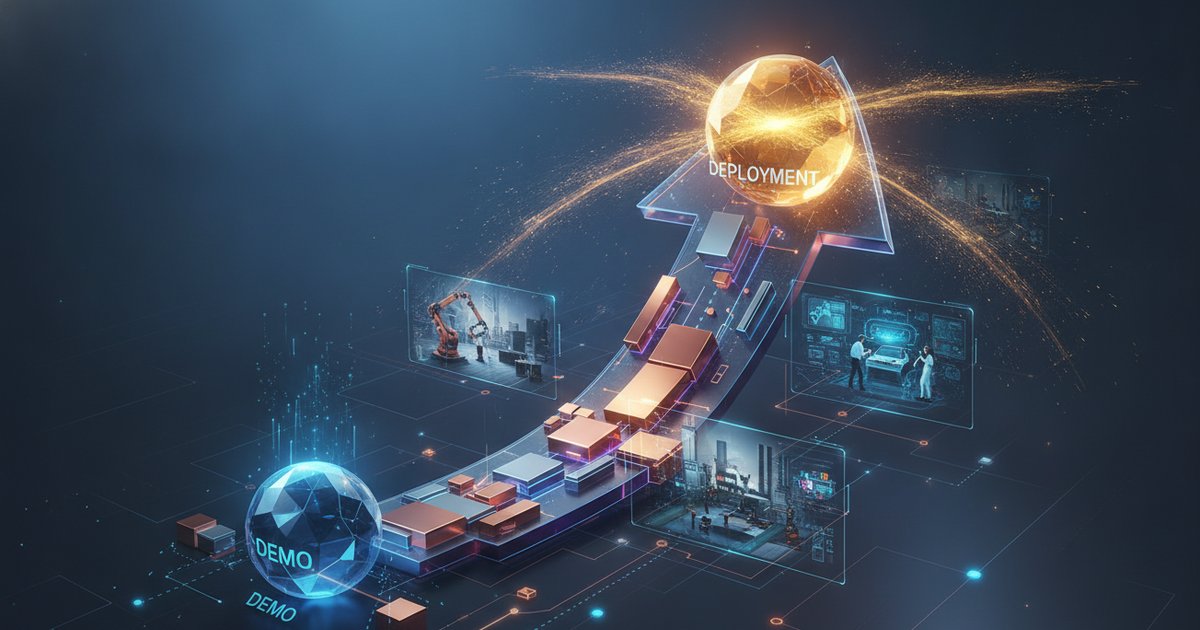
For most of the last decade, the AI conversation lived on screens — chatbots, copilots, image generators, and the endless debate over whether a model can write a passable email. China is quietly moving the argument off the screen and into the warehouse, the road, and the factory floor. The thesis taking shape there is simple and aggressive: the next phase of AI is physical, and the country that owns the hardware, the energy, and the deployment culture will own the operating system for how work gets done.
This isn’t a forecast about some distant singularity. It’s a read on the next three to five years of operations, logistics, and manufacturing — and a practical guide for the founders, marketers, and operators who’ll have to decide when to adopt, what to build, and where their people still matter most.
From spectacle to deployment
The clearest signal yet came in mid-2026, when BYD — the carmaker better known for out-shipping Tesla on EVs — moved into humanoid robotics. According to David Akpovi’s Weekly AI News roundup for the week of June 1-7, 2026, BYD’s entry is part of a broader Chinese push that bundles humanoids, robotaxis, and embodied-AI systems together as a single industrial bet (a claim worth verifying against BYD’s own announcements). What makes the move notable isn’t the novelty of a walking robot — we’ve seen those on stage for years — but who is making it. A company with mature automotive supply chains, battery expertise, and factory-scale manufacturing is treating humanoids as a production problem, not a research demo.
That distinction matters. The story of embodied AI has long been one of spectacle: glossy launch videos, careful choreography, robots that fold laundry exactly once for the camera. The shift now underway is from spectacle to deployment — machines logging real hours doing real, boring, repeatable work.
Robotaxis are the most measurable proof point. Baidu’s Apollo autonomous-driving platform has logged more than 50 million kilometres of public-road testing across roughly 30 cities, per a Softcircles overview of Chinese AI innovations for 2025-2026 (figures to be verified independently). Whatever you make of the safety debates, that is deployment at a scale that generates the one thing embodied AI is starved for: real-world data from messy, unpredictable environments.
The connective tissue here is the manufacturing-to-robotics pipeline. The same industrial base that builds EVs, batteries, and consumer electronics is being pointed at robots. Actuators, sensors, lidar, motors, and battery packs are components China already makes at volume and low cost. Robotics, in this framing, is less a moonshot and more an extension of an existing factory.
Why China has an edge here
Three structural advantages explain why the physical-AI wave is cresting in China first.
The first is hardware supply chains and cost. Embodied AI is brutally expensive in atoms, not just bits. A humanoid robot is a dense stack of motors, gearboxes, batteries, and sensors — exactly the bill of materials China has spent two decades learning to manufacture cheaply and iterate on quickly. When the cost of building and rebuilding a robot drops, you can run more experiments, fail faster, and converge on something that works in production. That iteration speed compounds.
The second is state-backed compute and energy. Training and operating embodied systems at scale demands enormous computing power and, just as critically, cheap and abundant electricity. China’s willingness to direct state resources toward compute infrastructure and its sheer energy capacity lower the floor for ambitious deployment. Robots that run all day in a logistics hub are an energy story as much as an AI story.
The third, and most underrated, is an applied-over-theoretical culture. The dominant instinct is to ship a useful-enough system into a constrained real-world environment and improve it through use, rather than perfecting it in the lab. Robotaxis logging tens of millions of kilometres is that philosophy in action. It carries real risks — safety, reliability, public trust — but it also produces a feedback loop that pure research cannot match.
None of this guarantees Chinese dominance; regulation, geopolitics, and export controls all cut against it. But the combination of cheap hardware, heavy compute, and a deploy-and-iterate mindset is a genuine structural edge.
What it means for operators
For the people actually running businesses, the relevant question isn’t “will robots take over” — it’s “which tasks, in what order, and what should I do about it.”
Expect automation to arrive first where the work is structured, repetitive, and physically constrained. Think warehouse pick-and-place, palletising, materials transport, quality inspection on a line, and predictable point-to-point movement. These are environments where the variables are limited and the economics are clear. The messier the environment and the more dexterity or improvisation required, the further out the automation timeline.
The bigger opportunity for most operators isn’t building robots — it’s the support layer around them. Every deployed fleet needs software for fleet management, monitoring, maintenance scheduling, and safety compliance. It needs integration work to connect robots to existing warehouse and ERP systems. It needs training, financing, insurance, and analytics. You do not have to manufacture a humanoid to profit from the physical-AI wave; you can sell the picks and shovels — the orchestration software, the integration services, the data tooling — that make someone else’s hardware useful.
And then there’s the part the launch videos skip: where human judgment still wins. Robots are strong at the predictable and weak at the exceptional. Handling a non-standard customer escalation, negotiating with a supplier, redesigning a workflow when demand shifts, exercising taste, ethics, and accountability — these remain human domains for the foreseeable future. The smart operating model treats robots as capacity for the repetitive and redeploys people toward judgment, relationships, and exception-handling. The org charts that win will be the ones that figure out this division of labour deliberately, rather than reactively.
The India read
For Indian operators, the temptation is to either dismiss this as a China story or panic-buy automation. Both are mistakes.
On manufacturing and MSME automation timing: India’s labour-cost advantage means the economic case for expensive humanoids is weaker here than in higher-wage economies, and that buys time. But it’s a window, not a wall. As global hardware costs fall — driven precisely by Chinese manufacturing scale — that math shifts. The right posture for most MSMEs is to automate the obviously repetitive and safety-critical tasks now using proven, cheaper systems (cobots, AGVs, vision inspection) while watching humanoid economics carefully, rather than waiting for a general-purpose robot that’s still years from cost parity.
The build-on-top opportunity is where India’s real strength lies. The country’s software and services depth maps neatly onto the support-layer thesis. Fleet orchestration, integration, remote monitoring, data labelling for embodied systems, and maintenance services are all areas where Indian firms can serve both domestic and global demand without owning a single factory. As physical AI scales globally, someone has to make it work in the field — and that’s a services-and-software problem India is structurally good at.
Before investing, watch a few signals:
- Unit economics, not demos. Track the total cost of ownership of deployed systems versus the labour they replace in your specific context — not the headline price.
- Reliability in messy environments. Public uptime and intervention rates (the robotaxi data is a useful proxy) tell you more than a staged demo ever will.
- Supply-chain and geopolitical exposure. If your automation depends on hardware subject to export controls or tariffs, price that risk in.
- Regulation and liability. Watch how Indian regulators treat autonomous systems on roads and in workplaces; that will gate deployment timing as much as technology does.
The honest summary: China is converting AI from spectacle into deployed industrial capacity, and BYD’s humanoid move is the anchor signal of that shift. It will reshape how operations, logistics, and manufacturing work — but unevenly, and over years, not months. For operators everywhere, including India, the winning play isn’t to fear the robots or worship them. It’s to automate the repetitive deliberately, build the tooling the wave will need, and reinvest your people into the judgment work that machines still can’t touch.
