For three years, enterprise AI has run on a comforting fiction: that the model is the product. Buy access to a frontier model, wire it into a chatbot, and transformation follows. It rarely has. The gap between a slick demo and a system that survives contact with real data, real compliance, and real workflows has quietly become the defining problem of the era — and the industry’s most valuable unsolved one.
AWS has now put a number on that problem. In a move that reads less like a product launch and more like a strategic confession, the cloud giant has stood up a dedicated organisation to do the unglamorous work of making AI actually work inside customer companies. The message is unambiguous: the hard part isn’t the model, it’s everything around it.
The move
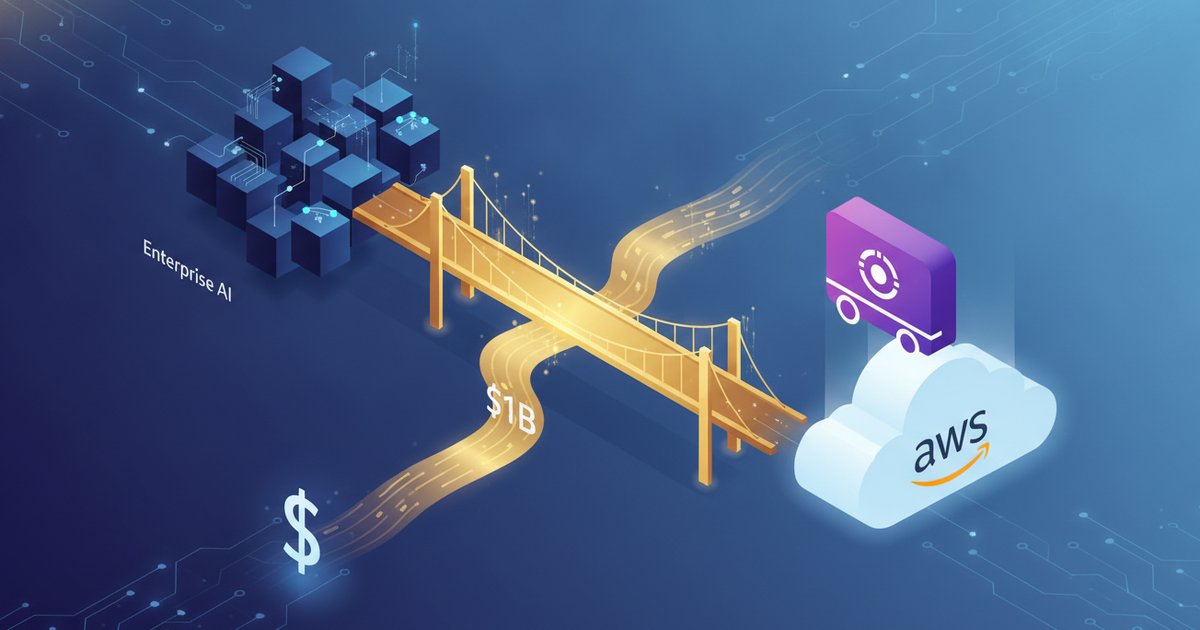
AWS has created a $1 billion Forward Deployed Engineering organisation that embeds its frontier engineering teams directly inside customer organisations to build production agentic AI systems, according to The Neuron, citing an AboutAmazon post dated July 2, 2026. The structure is the interesting part. Rather than shipping a model, a set of APIs and some documentation and hoping customers assemble the rest, AWS is sending its own engineers to sit alongside client teams and build the thing with them.
The focus on agentic systems matters. Agents — software that plans, calls tools, and takes multi-step actions rather than just answering a prompt — are precisely the category where the demo-to-production chasm is widest. An agent that books travel or reconciles invoices touches internal systems, permissions, and edge cases that no generic model has ever seen. You cannot buy that off a shelf. You have to build it inside the customer’s environment, against the customer’s data and constraints.
A billion dollars is a serious commitment of frontier engineering talent — the most expensive, scarcest resource AWS has — pointed not at building bigger models but at deploying existing ones. That allocation tells you where AWS believes the bottleneck now sits.
Why last-mile matters
The uncomfortable truth of the last two years is that most enterprise AI pilots never reach production. The reasons are boringly consistent, and none of them are about model quality. Data lives in a dozen incompatible systems. Access controls have to be honoured. Workflows that look simple on a slide turn out to encode years of exceptions and institutional knowledge. Integration, in other words, is the work — and it is expensive, specific, and un-automatable at the point where value is created.
This is the last mile, and it has always been where technology either compounds or dies. A model that scores brilliantly on a benchmark can still be useless to a bank if it cannot read the bank’s ledgers, respect its audit trail, and fit the way its people already operate. The intelligence is a commodity; the plumbing is the moat.
What AWS’s move validates — and what The Neuron frames as the central shift — is that enterprise AI value hinges on last-mile integration rather than the model alone. And once you accept that, the economics change. The unlock for enterprise AI isn’t a cheaper token; it’s a services layer that carries a model the final, brutal distance into a working production system. Software companies have spent a decade trying to eliminate services as a low-margin drag. AWS is now spending a billion dollars to build one on purpose.

The model’s rise
None of this is new, exactly. AWS is adopting a delivery approach pioneered by firms like Palantir and OpenAI, both of which built forward-deployed engineering into their DNA. Palantir has run this playbook for the better part of two decades: send elite engineers into the customer’s operation, learn the domain in painful detail, and build software against the reality of the business rather than a sanitised spec. OpenAI has more recently deployed its own forward-deployed teams to help large customers turn frontier models into shipped systems.
The philosophy runs directly against the reigning SaaS orthodoxy of self-serve, product-led growth. Self-serve assumes the customer can close the last mile themselves. For agentic AI in complex enterprises, that assumption breaks. High-touch engineering is slower and harder to scale, but it does something self-serve cannot: it aligns the vendor’s incentives with the customer’s outcome. When your engineers are in the room until the system works in production, you cannot hide behind "the model performs; integration is your problem."
For AWS, there is a defensive logic too. If the durable value in enterprise AI accrues to whoever owns the last mile, then a hyperscaler that sells only infrastructure risks becoming a commodity underneath someone else’s services relationship. Building a forward-deployed org is a bid to own the customer outcome, not just host it.
The India read
For India, this is one of the clearest strategic signals in a while — and it cuts against a fashionable anxiety. Much of the domestic debate has fixated on whether India can build a frontier model. AWS’s billion-dollar bet suggests that may be the wrong scoreboard. The value is migrating to deployment, and deployment is a services business — the exact discipline India has spent thirty years mastering at global scale.
Consider what forward-deployed engineering actually demands: large numbers of capable engineers who can embed with clients, understand a domain quickly, integrate with messy legacy systems, and stay until the software works. That is a description of the Indian IT services industry’s core competence, upgraded for the agentic era. The forward-deployed model is not a threat to Indian IT majors; it is arguably the most natural evolution of their business, if they choose to take it seriously.
But taking it seriously means change. The traditional services model is optimised for staffing bodies against tickets and billing hours. Forward-deployed AI work is optimised for outcomes — a working agent in production — and it requires:
- Engineers fluent in both agent architecture and the client’s business domain, not just one or the other.
- A shift from time-and-materials pricing toward outcome-aligned commercial models, where the vendor shares risk on whether the system actually ships and works.
- Deep specialisation by vertical — banking, insurance, telecom, retail — because last-mile integration is inherently domain-specific.
- A tolerance for smaller, elite teams that go deep, rather than large teams that go wide.
The opportunity is genuinely large, and it flows in two directions. Indian firms and Global Capability Centres can serve global enterprises as the deployment layer for agentic AI — the hands that carry frontier models into production for banks in New York and manufacturers in Germany. Domestically, the same muscle can be turned inward, building production agents for Indian enterprises that will never staff their own frontier engineering teams.
The strategic instruction is to build deployment muscle, not just models. A country that produces the world’s best forward-deployed AI engineers captures a durable, high-margin slice of enterprise AI regardless of who trains the biggest model — because someone will always have to make it work in the last mile. AWS just spent a billion dollars proving that point. India, of all places, should not need convincing.
The risk, of course, is complacency dressed as confidence: assuming that legacy services skills transfer automatically to agentic work. They do not. The firms that win will be the ones that rebuild their delivery model around outcomes and specialisation now, while the category is still forming — not the ones that discover, two years late, that forward-deployed is a different sport played on the same field.
