
Every startup ecosystem likes to count its unicorns. Far fewer like to talk about the chasm a company has to cross before it becomes one. Australia is having that uncomfortable conversation now. A high-profile scaleup collapse and a contested tweak to capital gains tax have, between them, exposed a structural truth that flattering seed-stage statistics tend to obscure: Australia is good at starting companies and bad at scaling them. The money flows freely when a founder has a deck and a dream, then thins dramatically when the same founder needs serious growth capital to take on the world.
It is a pattern that should feel familiar to anyone watching India’s own venture landscape, where a celebrated seed scene gives way to a notably tougher Series A-and-beyond grind. Australia, then, is less a cautionary tale from a distant market and more a useful mirror — one worth holding up to any ecosystem that confuses early-stage vibrancy with late-stage depth.
The wake-up call
The trigger for Australia’s introspection was a familiar kind of shock: a well-known, well-funded scaleup running aground. Collapses like these are jarring precisely because they puncture the narrative of inevitability. A company that raised confidently, hired aggressively and was held up as proof of the ecosystem’s maturity can still hit a wall when the capital required to sustain its growth simply isn’t available domestically at the scale and on the terms it needs.
The headline numbers don’t look like a crisis. According to data attributed to Tracxn and Startup Daily, Australia counts somewhere in the region of six to twelve unicorns and raised around $1.77 billion across roughly 82 equity rounds in 2026 year-to-date. That is a respectable, functioning market. But aggregate figures hide a shape problem. Commentators consistently flag that the strength sits at seed — plenty of cheques for early-stage bets — while the late-stage layer, the growth rounds that turn promising companies into category leaders, remains structurally thin.
The consequence is predictable and corrosive: founders who succeed at home are forced to look abroad to grow. When the Series C, D and beyond aren’t reliably available in Sydney or Melbourne, the natural gravitational pull is toward US and, increasingly, Asian capital. That offshoring isn’t just a financing footnote. It often drags headquarters, senior hiring, decision-making and eventually the most valuable equity offshore too. The ecosystem nurtures the seedling and then exports the tree.
The concentration of what capital does exist makes the gap sharper. Citing Startup Genome via the Mean CEO newsletter, in 2024 startups in New South Wales — effectively Sydney — attracted roughly 65% of all Australian startup funding. An ecosystem leaning that heavily on a single hub is an ecosystem with fewer shots on goal, fewer competing pools of growth money, and a thinner bench when a marquee company stumbles.
Policy in the spotlight
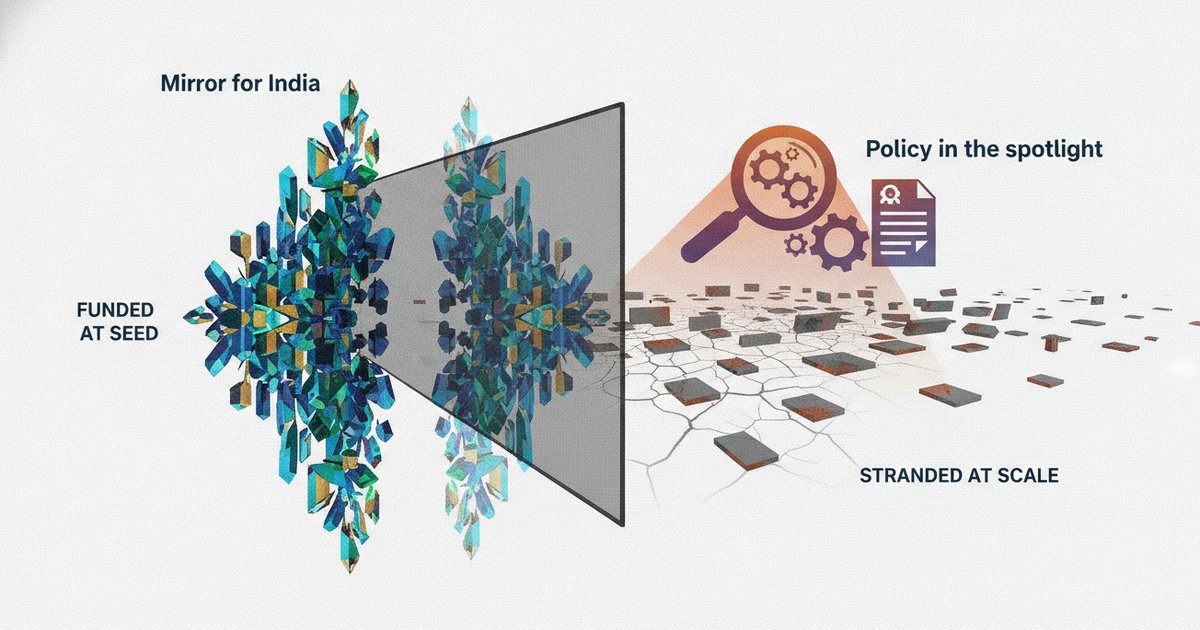
Into this raw nerve walked the policymakers. The Albanese government’s proposed startup capital gains tax carveout became a lightning rod, and the debate around it is revealing precisely because it splits the ecosystem rather than uniting it. Carveouts that sharpen incentives for founders and early investors are genuinely useful — they reward risk-taking and can keep talent and capital domiciled at home. But critics argue, fairly, that a tax tweak at the front end does little to fix a void at the back end. You can make starting up more attractive without making scaling up more fundable.
Running in parallel is a long-simmering fight over the R&D tax incentive and who, exactly, qualifies for it. For many Australian tech companies, the R&D rebate is a meaningful line in the cash-flow model, and periodic disputes over eligibility introduce exactly the kind of uncertainty that growth-stage businesses cannot easily absorb. When the rules of the game feel contestable, founders discount the benefit and plan around it — or relocate to jurisdictions where the support is more predictable.
The deeper tension these debates surface is incentives versus structural depth. Tax carveouts and R&D rebates are levers governments reach for because they are politically legible and relatively cheap to announce. Building actual late-stage capital depth — deeper domestic growth funds, more sophisticated institutional investors willing to write nine-figure cheques, robust local exit markets — is slower, harder and less headline-friendly. Australia’s risk is mistaking the former for the latter: optimising the on-ramp while the highway stays one lane wide.

Why the gap persists
So why does the scaleup gap prove so stubborn? Start with the obvious: thin domestic late-stage capital. Australia’s superannuation pools are enormous, but they have historically been cautious about, and structurally awkward at, deploying into illiquid, high-risk growth-stage venture at the scale that would move the needle. Without large, patient domestic pools competing to fund growth rounds, late-stage founders face a sellers’-market-in-reverse — too few buyers for their equity, on terms set largely by overseas money.
Then there’s risk appetite and exit pathways. Late-stage capital is, at bottom, a bet on a liquid, lucrative exit. If the IPO market is shallow, if local acquirers are few, and if the most credible exits are foreign acquisitions, the entire chain skews offshore. Investors price that in, founders internalise it, and the result is an ecosystem optimised for being bought rather than for building enduring, independent giants.
Underneath both sits the brute fact of talent and market size. Australia’s domestic market is comparatively small, which pushes ambitious companies to expand internationally earlier than they otherwise might — and international expansion is capital-hungry. The senior operator talent that has actually scaled a company from $50 million to $500 million in revenue is scarce, because relatively few companies have done it locally. Scarcity of that experience feeds the funding gap, and the funding gap perpetuates the scarcity. It is a loop, and loops are hard to break with a single tax clause.
The India read
None of this should read as schadenfreude from the subcontinent, because India’s profile rhymes more than it differs. India has a famously deep, energetic seed and angel scene — but founders and investors alike will tell you the Series A crunch is real, and the gap widens further at growth stage. The pattern is the same as Australia’s even if the absolute numbers are far larger: abundant capital to start, a narrowing funnel to scale, and a persistent pull toward foreign growth investors and foreign domiciles.
India’s emerging answer is instructive precisely because it goes beyond incentives. Public-capital instruments — of the kind envisaged in a research, development and innovation (RDI) push, alongside funds-of-funds and government-anchored vehicles — represent an attempt to crowd in domestic growth money rather than merely tax-advantage it. The logic is sound: where private late-stage capital is structurally shy, public capital can de-risk the early cohorts of large funds and signal that the state is serious about building the missing layer. It is a partial fix, not a panacea — public money can crowd out as easily as crowd in if it’s deployed clumsily — but it is at least addressing structural depth rather than just the on-ramp.
The shared prize, for both Australia and India, is retention: keeping scaleups, and the value they create, at home. That means more than money. It means credible domestic exit routes, deeper benches of operators who have scaled before, and a policy environment that treats late-stage funding as the strategic priority it is. Incentives at the seed stage are necessary; they are nowhere near sufficient.
Australia’s wake-up call is a gift, in a sense — an early, visible warning that a thriving seed scene can coexist with a hollow middle. The ecosystems that heed it will stop counting unicorns and start asking a harder question: when our best companies need to get big, can they do it here? Right now, in Sydney and Bengaluru alike, the honest answer is not yet a confident yes.
