
For most of the generative-AI boom, the hardware question had one answer: Nvidia. The frontier labs trained and served their models on Nvidia GPUs, paid Nvidia’s prices, and waited in Nvidia’s queue. That dependence is now loosening. A reported set of early-stage talks between Anthropic and Microsoft hints at where the industry is heading — toward a world where the biggest model makers spread their workloads across several kinds of silicon, by design rather than by accident.
The story is narrow on its face but wide in its implications. If Anthropic adds Microsoft’s homegrown chips to a stack that already includes Nvidia, AWS, and Google hardware, it would be running Claude on four distinct silicon families at once. That is not a quirk of one company’s procurement strategy. It is a signal that the economics and politics of AI compute are changing.
The reported deal
According to Crescendo AI, citing CNBC, Anthropic is in early-stage discussions with Microsoft to run Claude inference on Microsoft’s custom Maia 200 AI chips via Azure. The conversations are reportedly preliminary, and nothing about a final agreement, volume, or timeline has been confirmed — so treat the specifics as directional rather than settled.
The chip at the center of it is the Maia 200, which Microsoft launched in January 2026 and built on TSMC’s 3nm process. Crucially, it is an inference-focused part — designed to serve models to users at scale rather than to handle the heavy lifting of training. Microsoft claims the Maia 200 delivers more than 30% better performance per dollar than rival silicon, a figure attributed to the same reporting and one worth holding lightly until independent benchmarks emerge.
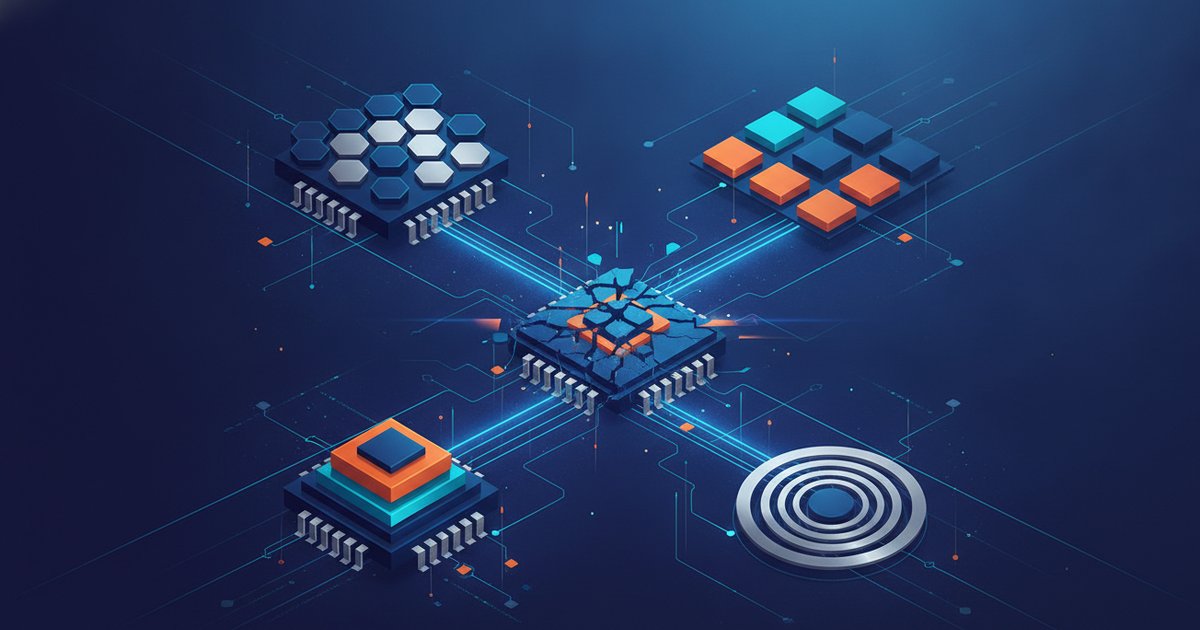
What makes the talks notable is the context. Anthropic’s compute already spans Nvidia GPUs, Amazon’s AWS Trainium, and Google’s TPUs. Adding Maia 200 would make Microsoft silicon a fourth type in the mix. A company that once would have been described simply as “running on Nvidia” is becoming a company that runs on whatever delivers the best mix of price, availability, and performance for a given job.
Why diversify silicon
The logic behind a multi-silicon strategy comes down to three pressures, and they reinforce one another.
The first is cost and performance-per-dollar. Inference — the act of actually answering user queries — is a recurring operating expense that scales with usage, unlike the one-time capital burst of training. At the volumes a frontier lab like Anthropic operates, even single-digit improvements in cost per token compound into enormous sums. If Maia 200 genuinely offers better performance per dollar for inference, routing a slice of Claude traffic to it could meaningfully change the unit economics of running the model.
The second is supply security and negotiating leverage. When a buyer depends on one vendor, that vendor sets the terms. Spreading workloads across Nvidia, Trainium, TPUs, and potentially Maia gives Anthropic options — and options are leverage. A lab that can credibly move volume between suppliers negotiates from a stronger position on price and allocation, particularly during periods when GPU supply is tight and lead times stretch out.
The third is reducing single-supplier risk. Concentration is fragile. A shortage, a price hike, a roadmap delay, or a geopolitical shock at one vendor can stall an entire product. By diversifying the silicon underneath Claude, Anthropic insulates itself from any single point of failure. As Crescendo AI frames the broader theme, this kind of diversification “underscores an industry shift toward multi-silicon strategies to manage cost and supply risk.” The headline is about one deal; the trend is about everyone.
What it validates
If the talks lead anywhere, they validate three things at once.
The first is Microsoft’s homegrown chip program. Designing AI silicon is expensive, slow, and unforgiving. The proof of a custom chip is not its launch press release but whether sophisticated outside customers choose to run real workloads on it. A frontier lab like Anthropic evaluating Maia 200 for production inference is exactly the kind of external endorsement that justifies the years of investment — and it positions Azure not just as a place to rent Nvidia GPUs but as a vendor with differentiated hardware of its own.
The second is the broader custom-silicon wave. Amazon has Trainium and Inferentia. Google has its TPUs. Microsoft has Maia. The hyperscalers are no longer content to be resellers of someone else’s chips; they want their own silicon tuned to their own data centers and priced to win. Anthropic’s willingness to mix and match across all of them confirms that this is no longer experimental. Custom accelerators have become a normal, expected layer of the AI stack.
The third, and most strategically important, is that inference is the new cost battleground. Training grabs the headlines, but inference is where the money is spent day after day, query after query. A chip explicitly built for inference, marketed on performance per dollar, tells you where the competition is now fiercest. The labs that win on inference economics will be able to offer more capability at lower prices — and that advantage flows directly to everyone building on top of them.
The India read
For Indian founders, marketers, and operators, this is not distant Silicon Valley plumbing. It is upstream of the bills you pay.
Compute cost and access are among the hardest constraints on Indian AI builders. GPU scarcity and dollar-denominated pricing make experimentation expensive, and many teams ration their usage accordingly. When the underlying inference economics improve — because labs are routing workloads to cheaper, more efficient silicon — the cost of the API calls that power Indian products has a better chance of trending down. The price curve that matters to a startup in Bengaluru is set, in part, by decisions like the one Anthropic is reportedly weighing.
The deeper lesson is strategic, and it applies to companies far smaller than Anthropic. If the most capital-rich labs in the world refuse to bet on a single supplier, smaller builders should internalize the same principle in their own way. That means designing for multi-cloud and multi-silicon from the start: abstracting your model layer so you are not hard-wired to one provider, keeping an eye on more than one inference vendor, and being ready to shift traffic when pricing or availability changes. The cost of that flexibility is some engineering discipline; the payoff is resilience and bargaining power.
Finally, the price curve has downstream consequences worth planning around. As inference gets cheaper, use cases that were once uneconomical — long-context document processing, high-volume customer support, always-on agents — start to pencil out. Indian businesses operating on thinner margins than their Western counterparts stand to benefit disproportionately from each step down in cost per token. The teams that win will be the ones who have architected to take advantage of falling prices rather than locking themselves into yesterday’s assumptions.
None of this rests on a single chip or a single deal. Maia 200 may or may not end up serving Claude at scale; the talks are early and unconfirmed. But the direction is unmistakable. The age of buying all your AI compute from one place is ending, and the smartest operators — at every size — are already building for a world of many suppliers, much like the giants whose moves they read about.
