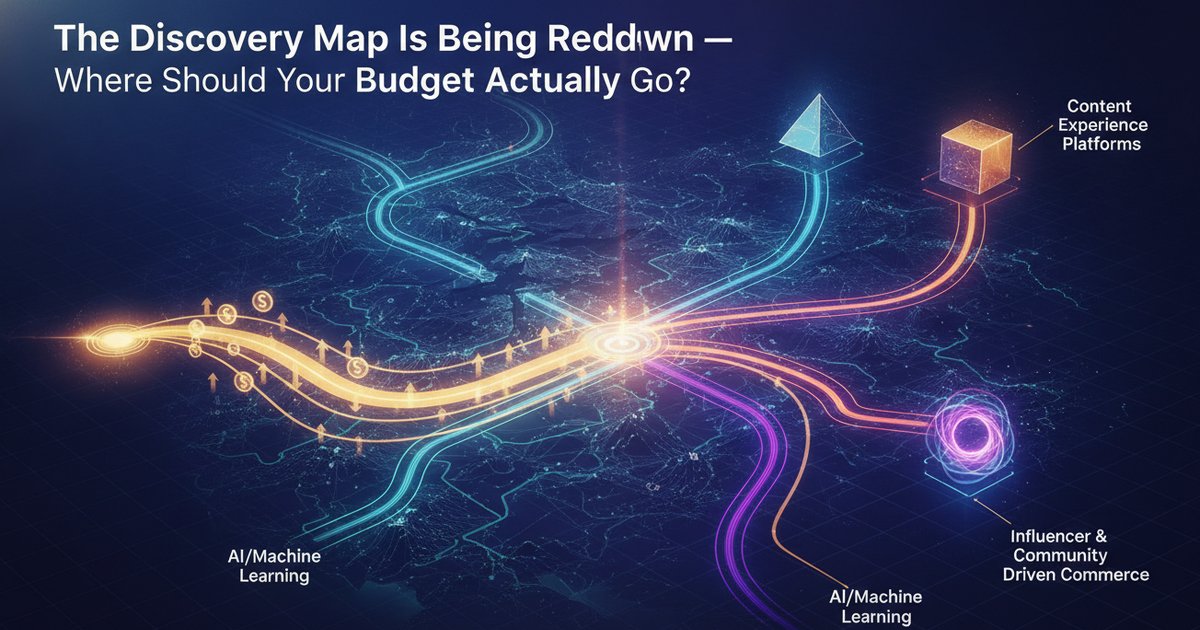
Three shifts are happening at once, and together they redraw where attention — and money — flows online. Google has pulled its AI Overviews back from the very queries marketers care most about: the ones where people are ready to buy. AI Mode, meanwhile, is testing the ability to complete a purchase inside the answer itself. And Meta is quietly experimenting with limits on how often business Pages can post external links, putting the entire referral-traffic model under pressure. For founders, marketers, and operators, the question is no longer whether the playbook changes — it’s where the next dollar should go.
The commercial-query exception
The most counterintuitive data point of the past year is that AI Overviews have largely retreated from shopping. According to analysis from Ahrefs and Seer Interactive surfaced by Pasquale Pillitteri, AI Overviews now appear on roughly 3.2% of e-commerce and shopping queries — down from close to 29% when Google first rolled the feature out aggressively. That’s not a quiet decline; it’s a deliberate pullback.
The likely reason is brutally commercial: AI answers on transactional queries weren’t converting to sales. When someone searches with intent to buy — a model number, a ‘best running shoes under 5000’, a comparison query — a synthesised paragraph that summarises options can actually depress the click that leads to a transaction. Google makes its money when commercial intent flows into ads and merchant listings, not when it’s absorbed into a zero-click summary. Pulling AI Overviews off these queries protects the part of search that still pays.
For bottom-funnel SEO, this is genuinely good news, and it deserves to be said plainly: the queries where ranking has always mattered most are, for now, the queries least disrupted by AI answers. Product pages, comparison content, category landing pages, and review-driven assets continue to compete for clicks the old-fashioned way. The temptation over the past 18 months was to treat all of search as ‘AI-disrupted’. The data suggests the opposite — the disruption is concentrated in informational and top-of-funnel queries, while transactional search remains a relatively intact battleground. Marketers who quietly defunded their bottom-funnel SEO out of AI panic should reconsider.
Ads move into the answer
That reprieve comes with a caveat, because Google isn’t abandoning commercial queries — it’s re-architecting how it monetises them. AI Mode, the conversational successor to Overviews, is testing direct-purchase functionality: offers, checkout, and buy actions inside the answer itself. The strategic logic is clear. If a generated answer can’t profitably hand a shopper off to a third-party site, the next move is to keep the transaction on Google’s surface entirely — ‘buy here’ instead of ‘go to the seller’.
This is the quiet convergence of AI search and retail media. Retail media — the fast-growing business of selling sponsored placements against shopping intent — has been the most lucrative ad category of the decade precisely because it sits closest to the purchase. AI Mode shopping is retail media wearing a chatbot’s clothes. The ‘answer’ becomes an inventory unit, and the question of which products get surfaced becomes a blend of organic relevance and paid placement.
Citation is where this gets interesting for marketers. Being named or linked inside an AI answer is emerging as both an organic and a paid battleground. The same Ahrefs/Seer analysis suggests brands cited in an AI Overview see roughly a 35% higher click-through rate than uncited brands — a meaningful premium for simply being the source the model trusts. As AI Mode matures, expect citation slots to become contested in two ways at once: earned through authority, structured data, and genuine review presence on the organic side, and bought through retail-media-style placements on the paid side. The brands that win will treat ‘getting cited’ as a discipline, not an accident — the way they once treated ranking on page one.
Platforms tax the link
While Google reshapes the front door, social platforms are tightening the side ones. Meta is reportedly testing limits on how often Facebook business Pages can post external links — with figures circulating of around two link posts per month unless a Page subscribes to Meta Verified, according to Emplifi’s social media tracking. We’d treat the specific cap as unconfirmed until Meta says so directly, but the direction of travel is unmistakable and consistent with years of platform behaviour: organic link distribution is being throttled, and link reach is increasingly something you pay for.
For any business whose model depends on referral traffic — publishers, affiliate-driven retailers, content marketers funnelling readers to a site — this is an existential nudge. The platforms have always preferred that you keep users inside their walls; now they’re putting a price on the exit. The squeeze rewards on-platform conversion (Shops, lead forms, in-app booking) and punishes the old strategy of using free organic reach to siphon audiences elsewhere.
The defensive response is the one platforms can’t tax: owned audiences. Email lists, SMS and WhatsApp opt-ins, communities you control, and apps where the relationship belongs to you rather than to an algorithm. Referral traffic from social was always borrowed; the throttling simply makes the lease terms explicit. Brands that spent the borrowed reach on building owned channels are now insulated. Those that treated Facebook reach as a permanent distribution asset are discovering it was never theirs to keep.
Budget reallocation playbook
Put the three shifts together and a practical allocation strategy emerges. None of this requires a wholesale tear-up — it requires moving money toward durability and away from rented reach.
- Protect transactional queries. The commercial-query reprieve is real but may not last. Keep investing in bottom-funnel SEO — product pages, comparison content, category pages — and in shopping ads where intent is highest. This is still where clicks convert, and it’s the part of search least eroded by AI answers today. Don’t let AI-disruption headlines justify defunding the channel that actually pays.
- Invest in being cited. Treat AI citation as a new core KPI. That means structured product data, genuine third-party reviews and mentions, authoritative content that models reach for, and a presence on the sources AI systems trust. With cited brands seeing materially higher click-through, citation is becoming as valuable as a top organic ranking once was — and it spans both earned authority and, increasingly, paid retail-media placement inside answers.
- Build channels platforms can’t throttle. Shift a meaningful slice of organic-social effort into owned audiences: email, SMS, WhatsApp, and communities. When a platform can cap your link posts overnight, every owned subscriber is a hedge. Pair this with on-platform conversion where it makes sense — if Meta wants users to stay, meet them there with Shops and lead forms rather than fighting for an exit click you can no longer get for free.
The through-line is that the middle layer of digital marketing — the free distribution that platforms once handed out generously and search once routed automatically — is being monetised, absorbed, or closed off. Both Google and Meta are pulling value back toward their own surfaces, whether through in-answer commerce or link throttling. The budgets that survive this redrawing of the map will be the ones anchored at the two ends marketers can still control: real purchase intent at the bottom of the funnel, and audiences they own outright. Everything in between is increasingly a toll road — and the toll is going up.
