
Two corporate events landed within the same news cycle, and on the surface they had nothing to do with each other. One was a stock chart collapsing in real time; the other was a line item buried in a filing. But read together, they form the clearest signal yet about how artificial intelligence is reshaping professional work — and where the money is going.
The short version: capital is moving from people to compute. Investors are no longer rewarding companies that grow by adding bodies. They are rewarding companies that grow by deploying machines. For an Indian IT and consulting industry built almost entirely on the first model, that is not a distant disruption. It is a repricing already underway.
Two data points, one signal
Start with Accenture. The consulting and IT-services giant suffered what amounted to the worst trading day in its history. Shares fell as much as roughly 20% intraday and closed down around 18%, as investors openly debated what some are now calling an ‘AI discount’ on IT-services valuations, according to coverage from Investing.com and TechStartups citing CNBC (June 2026). The mechanism behind that sell-off matters more than the number. Markets were not punishing a bad quarter in the ordinary sense. They were questioning whether a business that bills clients for human hours can keep growing when AI threatens to compress the very hours it sells.
Now place Oracle beside it. Over the course of the year, Oracle cut roughly 21,000 roles — about 13% of its workforce — amid AI-linked efficiency drives, per the same reporting. It did this quietly, without the market drama, and it did it while pouring billions into AI infrastructure and capacity. That juxtaposition is the whole story in miniature: fewer people, more compute. The headcount line shrank as the capital-expenditure line surged.
One event was loud and one was quiet, but the message is identical. The market is repricing headcount-led growth. For decades, a services or software firm could signal health by hiring aggressively — more people meant more capacity, more capacity meant more revenue. AI breaks that equation. If software can deliver the output that headcount used to, then headcount becomes a cost to be optimized, not an asset to be accumulated. Accenture’s chart and Oracle’s filing are two ways of saying the same thing: investors have started to believe it.

Why professional work is exposed
It helps to understand why professional services, of all industries, sits squarely in the blast radius. The consulting business model is essentially a pyramid. A small number of senior partners win the work and own the client relationship; a large base of junior analysts and associates does the actual production — the research, the slide-building, the data cleaning, the first drafts. The economics depend on billing many junior hours at a margin. The pyramid is the product.
That base is exactly where current AI tools are most capable. The work that fills a first-year analyst’s day — summarizing documents, building models from templates, drafting decks, pulling and reconciling data — is increasingly automatable. When the production layer of the pyramid can be done faster and cheaper by software, the billable-hours engine starts to misfire. You cannot keep charging a client for forty hours of analyst time when the analysis takes four.
The same logic extends across routine knowledge work and the back office. Process-heavy, rules-based tasks — claims processing, basic accounting, ticket triage, standard contract review — are first in line. These are the jobs that look most like the training data: repetitive, documented, structured. The further work moves toward genuine judgment, ambiguity, relationship management, and accountability, the safer it is, at least for now.
This is where the augmentation-versus-replacement debate gets real, and where honest reporting matters more than hype. In many cases AI is a force multiplier: it makes a skilled professional dramatically more productive, letting one person do the work that used to need three. That is augmentation. But augmentation and replacement are not opposites — they are the same curve viewed from different ends. If one augmented worker does the job of three, two jobs disappear even though no machine technically ‘replaced’ a human. The market does not care which word you use. It cares about output per head, and that ratio is climbing.
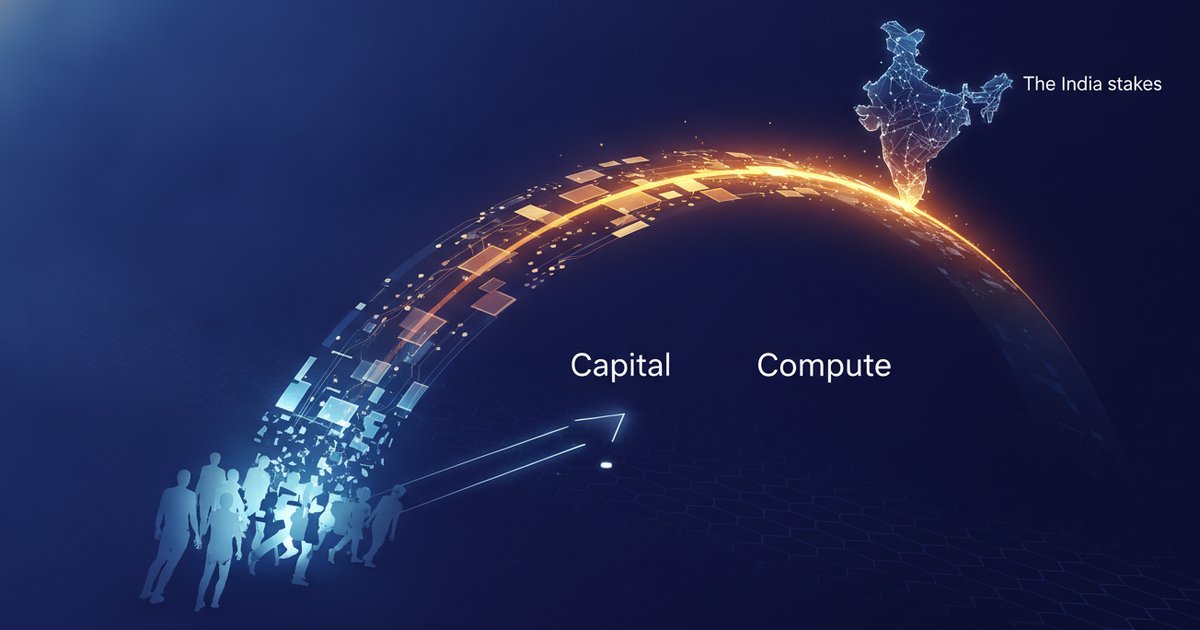
The India stakes
Nowhere are the stakes higher than in India. The country’s IT-services sector exports well over $200 billion annually and employs millions of people, according to NASSCOM and industry estimates — a scale that makes any structural repricing of headcount-driven services a direct and material risk to its largest firms.
TCS, Infosys, and Wipro built their global dominance on a specific promise: deliver high-quality technical and process work at scale, reliably, for less. The lever was labor arbitrage — large, well-trained teams executing at a cost advantage. It was, and remains, an extraordinary achievement. But the model is fundamentally headcount-led. Revenue has historically tracked the number of billable people deployed. When the market starts applying an ‘AI discount’ to that model — as it just did to Accenton’s American peer — Indian majors face the same question by extension: what is the business worth if the work no longer needs the bodies?
The exposure runs through several layers. The BPO layer — the call centers, the back-office processing, the transaction handling — is the most immediately vulnerable, because it is concentrated in exactly the routine, structured work AI handles best. Above it sits the global capability centers, the GCCs, where multinationals run captive operations in India. GCCs have actually been a bright spot, moving up the value chain into product, engineering, and analytics. But they too will be measured on output, not seats, and the firms that staff them cannot assume that rising demand for capability translates into rising demand for people.
The hardest internal challenge is reskilling at scale and rebalancing toward senior-heavy teams. If AI absorbs entry-level production, the traditional pyramid inverts: you need fewer juniors and more experienced people who can direct AI systems, validate outputs, and own client outcomes. That is a profound shift for organizations whose growth, training pipelines, and campus-hiring engines were all designed around a wide base. You cannot produce senior judgment by skipping the years that used to create it. Solving that — how you grow expertise when the apprenticeship rungs are being automated away — is arguably the defining workforce problem of the decade for Indian services.
What adapts and survives
None of this is a death sentence. It is a forcing function. The firms that thrive will be the ones that stop selling time and start selling results — and that transition is already legible in how the smartest players are repositioning.
The first shift is from bodies-on-seats to outcome-based pricing. When a client pays for a defined business result — a reduced fraud rate, a faster close cycle, a shipped product — rather than for a count of staffed engineers, AI stops being a threat to revenue and becomes a margin opportunity. The firm that can deliver the outcome with fewer people simply keeps more of the value it creates. The catch is that outcome pricing requires the provider to take on real accountability and risk, which many services firms have historically avoided. That discomfort is now the price of survival.
The second is owning the AI delivery layer rather than being disrupted by it. The companies most at risk are those that treat AI as something happening to them. The ones that adapt build, integrate, and operate the AI systems for their clients — becoming the trusted partner who deploys the automation, governs it, and stands behind its output. There is enormous, durable demand for that role: enterprises do not want to build AI capability from scratch, and they need someone accountable when it goes wrong. Indian majors are well-positioned here precisely because of their deep enterprise relationships and operational discipline — if they move fast enough.
The third, and most cultural, is measuring output instead of seats. As long as a services organization reports its health in headcount, it is optimizing for the wrong variable. The metric that matters in an AI-leveraged business is value delivered per person, and revenue decoupled from linear hiring. That is exactly the metric the market just rewarded at Oracle and penalized at Accenture. Investors have already changed what they measure. The firms that internalize that change — that learn to grow revenue without growing payroll in lockstep — will be the ones that come out the other side intact.
The signal from this June was unambiguous. Capital is voting for compute over headcount, and professional work is the frontier where that vote is being counted. For India’s services giants, the comfortable era of growing by hiring is closing. The next era belongs to whoever can deliver the outcome — with or without the bodies.
