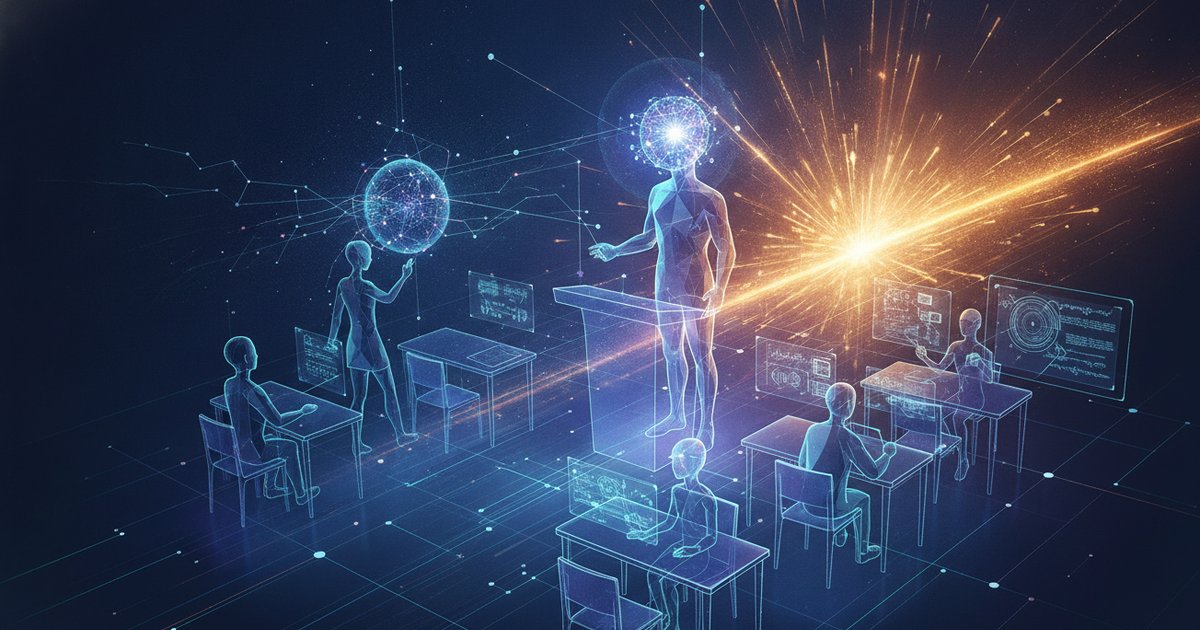
The most consequential AI deployment of this decade may not happen in a corporate office or a government ministry. It is happening in classrooms — millions of them — where teachers and students are quietly improvising new ways to teach, study, cheat, and learn alongside machines that can write, explain, and grade. As a major global education conference opens, fresh data confirms what anyone walking a school corridor already senses: adoption is surging. The harder, unglamorous question is whether schools can move from novelty to responsibility before bad habits set in. For India — with the world’s largest school-age population and an education culture organised around high-stakes exams — the answer will shape how an entire generation learns to work with AI.
The state of adoption
AI use in schools is rising fast, and not just in wealthy districts. Microsoft’s third annual AI in Education report — based on a PSB Insights survey of roughly 3,345 K-12 and higher-education respondents across the US, UK, Australia, Brazil, Japan and Saudi Arabia — points to strong, cross-country momentum in adoption. Crucially, the report also flags a persistent gap: enthusiasm and experimentation are running well ahead of structured, responsible implementation. Teachers are trying tools; institutions are still figuring out the guardrails.
The timing is not incidental. The report landed ahead of ISTELive (June 28-July 1, 2026), one of the calendar’s biggest gatherings of education technologists, alongside a wave of new AI teaching tools offered at no additional cost. Free or bundled access matters enormously: it lowers the barrier for under-resourced schools and accelerates the move from curiosity to classroom routine. But zero-cost rollouts also mean adoption can outpace policy. When a capable tool is suddenly available to every teacher, the lag between ‘we can use this’ and ‘here’s how we should use this’ becomes the central risk.
That gap — between interest and responsible implementation — is the real story. Pilots and proofs-of-concept are easy. Embedding AI into everyday teaching in ways that are safe, equitable, and pedagogically sound is the work that few systems have actually finished.
The hard questions
Three problems keep surfacing wherever AI enters a school.
Bias, equity, and oversight. AI systems reflect the data they are trained on, which means they can quietly disadvantage students who write in non-standard English, come from under-represented backgrounds, or attend schools with weaker connectivity. Equity cuts both ways: AI can democratise access to personalised help, but it can also widen gaps if richer schools deploy premium tools and oversight while others adopt blindly. Without human review of how these systems grade, recommend, and flag students, errors scale silently.
Cheating versus learning — and the limits of detection. The instinct of many institutions has been to buy AI-detection software and police their way back to normality. The evidence increasingly says this is a dead end. Industry reporting tied to the same Microsoft findings underscores that AI-detection tools are unreliable, producing false positives that can wrongly accuse honest students and false negatives that miss actual misuse. The responsible path is not better detection but redesigned assessment: tasks that prize process over polished output, provenance and version history that show how work evolved, oral defences, in-class components, and assignments that assume AI is in the room. Detection alone cannot tell the difference between a student who cheated and one who learned with a tool — and pretending otherwise erodes trust on every side.
Teacher training and trust. The Microsoft report’s headline demand is for support, not just access. Teachers are being handed powerful systems with little training in prompt literacy, data privacy, or how to spot a confident-sounding wrong answer. Trust is fragile: an educator burned by a hallucinated lesson plan or an unfair flag will disengage. Sustainable adoption depends on professional development that treats teachers as professionals making judgement calls, not as users to be onboarded.
What good looks like
The schools getting this right share a few traits.
Grounded in learning science. Good AI use starts from how people actually learn — spacing, retrieval practice, productive struggle, timely feedback — and asks where a machine can amplify those mechanisms. An AI tutor that gives instant answers undermines retrieval; one that asks guiding questions and lets a student work toward the answer reinforces it. The pedagogy should drive the tool, never the reverse.
Human-in-the-loop and transparency. Responsible deployments keep a teacher in the decision chain for anything consequential — grades, interventions, flags — and are transparent with students about when and how AI is used. Provenance and disclosure beat surveillance. Students who understand the rules of engagement are far more likely to use AI to learn rather than to launder work.
Outcomes over novelty. The temptation with any new technology is to confuse activity with progress. A chatbot in every classroom is not an achievement; improved comprehension, retention, and equity are. The institutions worth watching are measuring whether AI actually moves learning outcomes, and are willing to switch off tools that only generate excitement.
The India read
Nowhere are these dynamics more charged than in India. The system is vast, young, and exam-driven — hundreds of millions of students, a median age under 30, and a culture in which board exams and competitive tests like JEE, NEET, and CUET function as life-defining gateways. That structure creates a powerful, double-edged pull on AI.
On the demand side, the appetite is real. The National Education Policy (NEP) 2020 explicitly champions critical thinking, flexibility, and technology integration, and the digital-learning momentum from the pandemic years never fully receded. India’s edtech sector, vernacular-language AI, and a generation of mobile-first students create conditions for AI tutoring to scale faster here than almost anywhere. An AI tutor that explains a physics concept in Hindi or Tamil at midnight, for a student whose school lacks a strong teacher, is a genuinely transformative proposition.
That is the opportunity. The risk is that India’s exam intensity bends AI toward the wrong end. If the dominant use case becomes faster answer-generation, shortcut-driven exam prep, and rote drilling, AI will simply industrialise the cramming culture that NEP set out to dismantle. AI tutors at scale can either personalise genuine learning for the underserved or mass-produce sophisticated shortcuts — and market incentives, left alone, often favour the latter.
The same hard questions apply with sharper edges. Equity is not abstract in a country with enormous gaps in connectivity, device access, and language support; an AI rollout that assumes reliable bandwidth and English fluency will leave out exactly the students it should help most. Detection-based policing is even less viable in classrooms of 50-plus students. And teacher training — already stretched — is the binding constraint: India cannot deploy responsible AI faster than it can support the teachers expected to supervise it.
The realistic agenda, then, is unglamorous but clear. Invest in teacher capability before tools. Redesign assessment so AI assists learning rather than rewarding shortcuts. Insist on transparency, human oversight, and vernacular equity from vendors. And measure outcomes, not adoption. The global data says the world’s classrooms have crossed the experimentation threshold. Whether India’s — and everyone’s — students emerge as people who can think with AI, or merely lean on it, depends on the choices schools make in the next few years, not the next few decades. The frontline is the classroom. The work is now.
