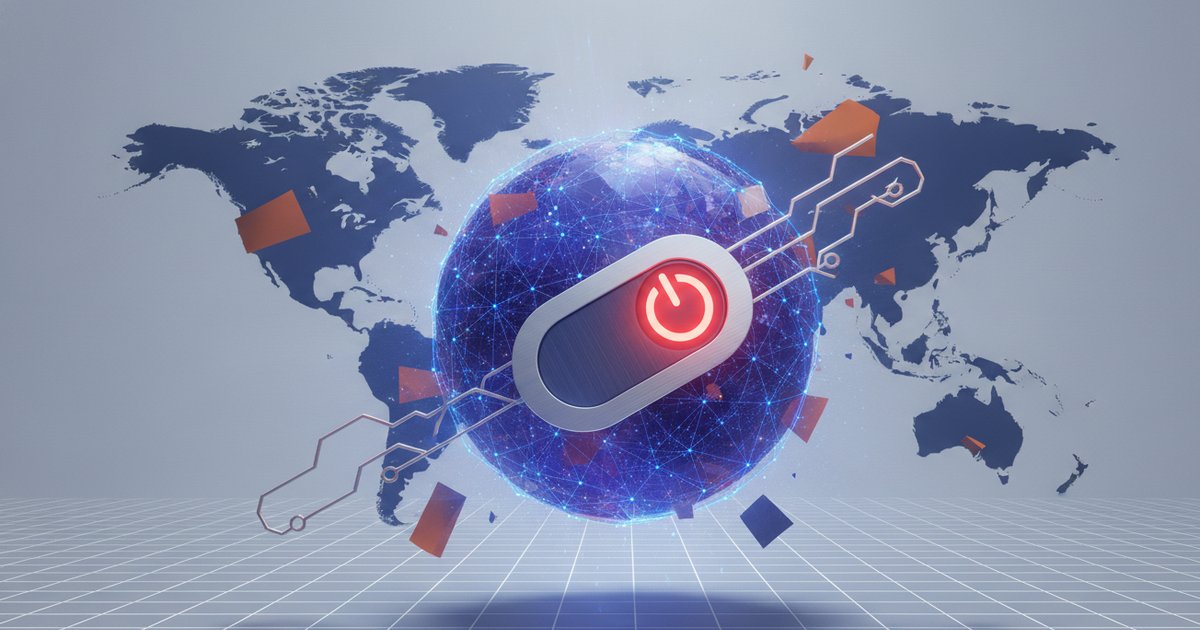
For most of the past three years, the AI conversation has been about capability — bigger context windows, cheaper tokens, smarter agents. That framing is now obsolete. In 2026, the most important property of a frontier model is not how clever it is, but who controls the switch. A US directive that suspended access to a frontier model worldwide, China’s commitment of roughly 2 trillion yuan to sovereign data centres, and a memory squeeze quietly rerouting global chip supply all point to the same conclusion: models and compute have become geopolitical levers. If you build on top of AI but don’t run a frontier lab, that shift changes your risk calculus whether you’ve noticed it or not.
Models are now export-controlled goods
On June 12, a US directive suspended access to a frontier model on a global basis — not throttled, not rate-limited, but switched off as a matter of policy. The technical details matter less than the precedent: a capability that thousands of products depended on disappeared because of a regulatory decision made in a single jurisdiction, with no input from the businesses downstream of it.
This is the moment the industry should internalise. A model is no longer just a service with an SLA; it is increasingly treated like an export-controlled good, akin to advanced chips or encryption. That means the availability of your core dependency can be determined by trade policy, national security review, or diplomatic friction — variables entirely outside your roadmap and invisible to your monitoring dashboards.
“A model can be switched off by policy” is a sentence every CTO should sit with. It reframes vendor risk. Traditional dependency planning assumes a provider might raise prices, deprecate an endpoint, or suffer an outage. Those are commercial and operational risks you can negotiate or engineer around. Policy risk is different: it is binary, sudden, and non-negotiable. A model you fine-tuned against, built prompts around, and shipped to customers can become unavailable in your market overnight because of a decision in a capital you have no relationship with.
The defensive posture is architectural. Multi-model and fallback architectures — long treated as an optional cost-optimisation — are now a continuity requirement. That means an abstraction layer that lets you route requests across providers, prompt sets validated against more than one model family, and graceful degradation paths so that losing your primary frontier model means reduced quality, not a dead product. The teams that survive a policy shock will be the ones who treated their frontier dependency as a single point of failure before it failed.
The sovereign-compute land grab
If models are levers, compute is the fulcrum — and governments have worked that out. According to Build Fast with AI’s roundup, China announced a national AI infrastructure plan worth roughly 2 trillion yuan (about $295 billion) over five years to build interconnected data centres, with a requirement that at least 80% of the technology be domestic. (We flag that figure as one to verify against primary sources, but the direction of travel is unambiguous.)
The size is striking, but the 80% domestic-technology mandate is the more revealing detail. It signals chip nationalism as deliberate industrial policy: a bet that depending on foreign accelerators is a strategic vulnerability worth spending hundreds of billions to eliminate. When access to frontier compute can be restricted by another government’s export rules, building your own stack stops being expensive and starts being existential.
This is why every large economy now wants a sovereign stack — its own chips, its own data centres, its own models trained on its own data within its own borders. The US restricts. China substitutes. The EU is pursuing sovereign-cloud and home-grown model efforts. India, with its data-centre build-out and indigenous model ambitions, is making the same calculation at its own scale. The logic is contagious: once one major power treats AI compute as a national-security asset, no rival can afford to remain dependent on it.
For builders, the consequence is fragmentation. The clean assumption that you can serve a global product from one provider on one set of chips is eroding. Increasingly, where your compute physically sits, who manufactured it, and which government can reach it will shape what you can legally and reliably ship — and to whom.
The quiet supply-chain squeeze
Beneath the geopolitics runs a more prosaic but equally consequential force: physics and fab capacity. The AI build-out is voracious for high-bandwidth memory (HBM), the specialised stacked memory that feeds modern accelerators. Per dentro.de/ai, citing Simon Willison, HBM is projected to consume around 20% of total wafer capacity by the end of 2026 — up from roughly 2%. That is a tenfold jump in the share of the world’s silicon manufacturing redirected toward feeding AI data centres. (Again, treat the precise figures as provisional, but the trend is well-documented.)
Wafer capacity is finite and slow to add. Every wafer turned over to HBM is a wafer not making the DDR and LPDDR memory that goes into laptops, phones, cars, and consumer electronics. The result is a squeeze that radiates outward: memory prices firm up, and the knock-on effects reach devices that have nothing to do with AI training runs. The compute boom has a hidden tax, and consumers who never touch a frontier model may end up paying part of it through pricier hardware.
For anyone running inference at scale, this matters directly. Memory is a meaningful component of the cost of serving models, and a structural supply squeeze bends the inference cost curve the wrong way. The comforting industry narrative has been that token prices only ever fall. Algorithmic efficiency and competition do push them down — but a tightening memory market pushes in the opposite direction. The net path of inference costs over the next two years is now genuinely contested, not a guaranteed glide down. Builders planning unit economics on the assumption of ever-cheaper inference should stress-test that assumption against a hardware-constrained world.
What it means for non-frontier builders
You don’t need to run a lab to be exposed to all of this. If your product calls an API, sits on rented GPUs, or depends on a single model’s behaviour, you are downstream of every lever described above. The good news: the defensive playbook is concrete and most of it is good engineering hygiene anyway.
- Avoid single-provider lock-in. Treat any one frontier provider as a dependency that can vanish — commercially or by policy. Maintain at least one credible alternative you have actually tested in production, not just bookmarked. A fallback you’ve never run is not a fallback.
- Design for model portability. Build an abstraction layer between your application logic and any specific model. Keep prompts, evals, and guardrails in a form that can be re-validated against a new model family quickly. Capture your own usage data so you can fine-tune or distil a smaller open model if access to a closed one is cut off. Portability is the new high-availability.
- Watch jurisdiction, not just price. Where your compute physically lives, which entity owns it, and which government can reach it now belong on your due-diligence checklist alongside latency and cost per token. A cheaper provider in a jurisdiction exposed to export-control whiplash may be a worse bet than a pricier one with a stable legal footing in your market.
- Stress-test your cost model. Don’t assume inference only gets cheaper. Run the numbers against a scenario where memory-driven hardware costs hold prices flat or push them up, and make sure your margins survive it.
The strategic shift here is one of mindset. For years, building on AI meant picking the best model and optimising around it. That era is closing. The winning posture now treats models and compute as volatile, politically exposed inputs — to be diversified, abstracted, and hedged, the way a serious operation hedges any critical supply line. The frontier labs and the governments behind them are turning AI into an instrument of statecraft. You can’t change that. But you can make sure your product isn’t the thing that breaks when they pull a lever.
