
For most of the generative-AI boom, access to the best models was a question of money and an API key. You paid, you built, you shipped. That assumption is now being quietly dismantled in Washington. According to reporting from The Washington Post, the Trump administration is requiring both Anthropic and OpenAI to obtain government approval for each new customer of their most powerful models — and, per a Commerce Department letter, an export license for any entity outside a privileged list of allied nations that wants to touch Anthropic’s flagship system. The signal is unambiguous: frontier AI is no longer being regulated as software. It is being treated as a weapon.
If that framing sounds dramatic, the mechanics are drier and more consequential than any headline. A permission regime is being built — one customer, one license, one country tier at a time. Here is what changed, how the labs are responding, why this is a genuine inflection point, and what it means if you are building from Bengaluru rather than Berkeley.
What changed
The core of the shift, as reported by The Washington Post on June 26, 2026, is that the US government will vet the users of the latest, most capable models from both OpenAI and Anthropic. This is not a one-time clearance for the company. It is a per-customer approval requirement: for the top tier of models, the federal government expects a say in who gets access before that access is granted. Vetting that was once an internal trust-and-safety function inside a private company is being pulled into the orbit of national-security review.
The international dimension is sharper still. According to AI News coverage from Build Fast with AI (June 29, 2026), a Commerce Department letter associated with Secretary Lutnick reportedly requires export licenses for all non-Annex-A entities to access Anthropic’s Mythos 5. In plain terms: if you are a developer, company, or research lab outside the small group of countries on Washington’s allied list, you cannot use that model without US government approval. That is the clearest case yet of a frontier model being handled exactly like dual-use technology — the same category that governs encryption, certain chips, and equipment with both civilian and military applications.
The conceptual leap matters more than any single rule. Export controls have historically attached to physical things and to clearly weaponizable know-how. Applying them to access to a hosted model reclassifies the model itself as controlled technology. The frontier capability is no longer a product you license; it is an asset the state believes it must guard. Once that mental model takes hold inside government, it tends to expand rather than contract.
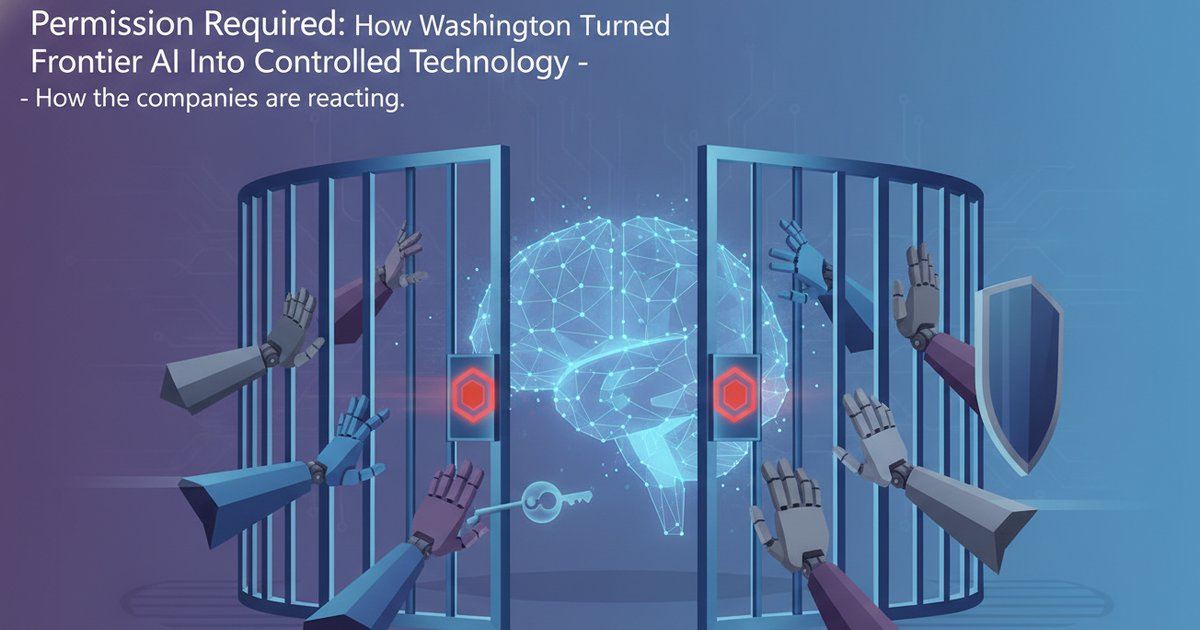
How the companies are reacting
The labs are walking a careful line, and their posture tells you a lot about where this is heading. OpenAI has publicly signalled concern about the prospect of expanding government oversight into who its customers are — a function that, until now, the companies have guarded as their own. The worry is not abstract. A per-customer approval process inserts a government gate between a lab and its revenue, and it does so at the precise moment the company is trying to scale its most valuable products.
At the same time, the companies appear willing to comply in the near term while resisting the idea of permanent, institutionalised per-customer approval. That distinction — cooperate now, oppose the precedent — is the rational stance for any firm that depends on government goodwill for chip allocations, data-centre permitting, and the broader political license to operate. You do not pick a public fight with the administration that controls your supply chain. But you also do not want to wake up in a world where every enterprise deal needs a federal sign-off.
Underneath the diplomacy sits a real operational cost. A vetting regime imposes a compliance burden that did not exist a year ago: legal review of customers, documentation of foreign-access requests, license applications, and the staff to manage all of it. For the largest labs, that overhead is survivable. The deeper question is what it does to the rhythm of the business — how much slower it becomes to onboard a customer, and how much that friction nudges the labs toward only the largest, lowest-risk, most obviously domestic accounts.

Why it’s a turning point
Three things make this more than a regulatory wrinkle.
First, the reclassification itself. Treating frontier AI as controlled technology rather than software changes the default. Software, in the American tradition, is presumed free to distribute unless a specific reason intervenes. Controlled technology is presumed restricted unless a license permits it. Flipping that presumption for the most capable models — even if only the top tier, for now — rewires the entire incentive structure around how models are built, hosted, and sold.
Second, the emergence of explicit access tiers. The Annex-A construct creates a world of insiders and everyone else. Allied nations sit inside a trusted ring with smoother access; the rest of the world faces a licensing checkpoint. This is the logic of arms-control alliances applied to a general-purpose technology. It is coherent as national-security policy. It is also a profound statement about how the US now sees the diffusion of capability: not as a tide that lifts global productivity, but as a strategic resource to be allocated.
Third — and this is where the policy meets reality — enforcement is hard and leakage is inevitable. Models can be accessed through intermediaries, resold capacity, VPNs, and shell entities. Open-weight models from other developers continue to circulate freely. A licensing wall around two American labs does not wall off the capability itself; it walls off the easiest, most accountable path to it. The risk is a regime that imposes maximum friction on legitimate, traceable users while determined adversaries route around it. That is the classic failure mode of export controls applied to information goods, and there is little reason to expect AI to be the exception.
The India read
For Indian builders, this is not a distant American policy story — it is a planning problem. India is not on the Annex-A list, which means that access to the very top tier of US frontier models is now contingent on US government approval rather than a commercial decision. A startup in Pune that wants to build on the most capable model available may find that capability gated by a licensing process it cannot influence and a timeline it cannot predict. Even where access is granted, the possibility that it could be revoked or re-scoped introduces a dependency risk that no serious founder should ignore.
The strategic implication is straightforward, even if the execution is hard: India needs credible alternatives that are not subject to a foreign government’s permission slip. That points in two directions. One is genuine sovereign capability — domestic models trained and hosted under Indian jurisdiction, the kind of effort that national AI-compute programmes are nominally meant to enable. The other is the open-weight ecosystem, where capable models can be downloaded, run, and fine-tuned without an API gate or a license letter. Open weights are not a perfect substitute for the absolute frontier, but they are improving quickly, and crucially they are not subject to per-customer vetting by Washington.
The pragmatic move for operators is to plan for an access-gated world now rather than be surprised by it later. That means:
- Avoid single-model lock-in. Architect so that the underlying model is a swappable component, not a load-bearing assumption. An abstraction layer over multiple providers is now a resilience measure, not just good engineering.
- Treat top-tier US model access as a privilege, not a guarantee. If your roadmap requires the single most capable closed model and nothing else will do, you have a concentration risk worth pricing in.
- Invest in open-weight competence. The teams that can fine-tune, host, and optimise open models will have optionality that pure API consumers will not.
- Watch the tiers, not just the technology. Where a country sits in Washington’s access hierarchy may matter more to your product roadmap than the next benchmark score.
None of this is a counsel of despair. Access controls create friction, and friction creates opportunity for those positioned to absorb it. But the comfortable era — when the best AI in the world was a credit card away regardless of where you sat — is ending. For builders outside the United States, the smart response is not to protest the wall. It is to build assuming the wall is real, and to make sure your business does not depend on someone in Washington saying yes.
