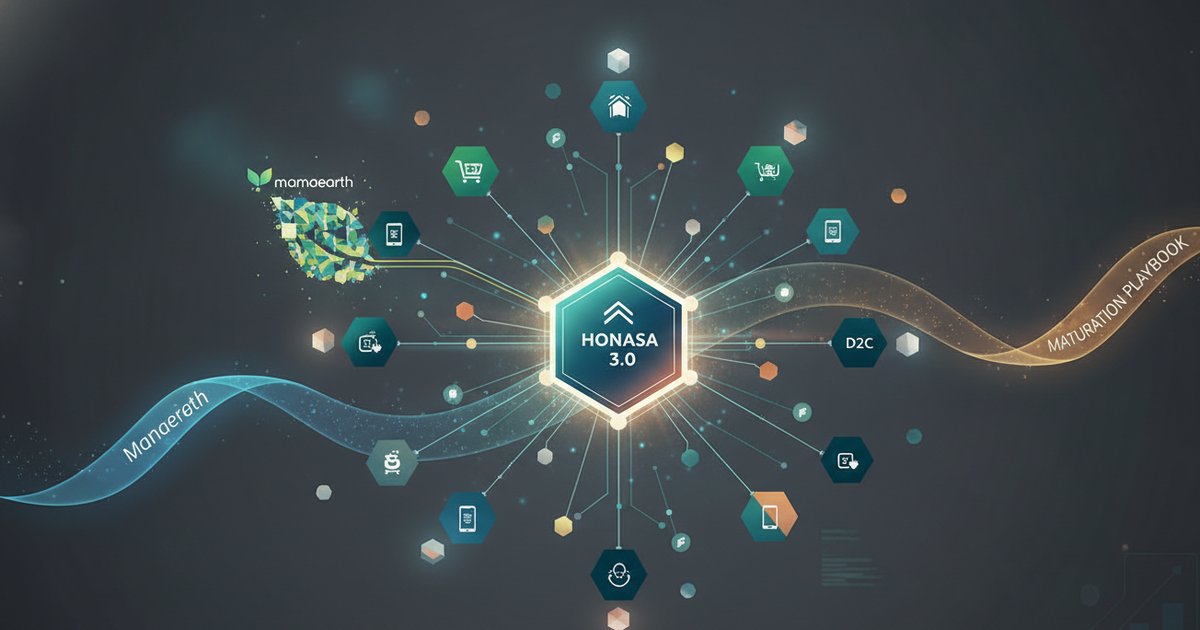
For years, the story of Indian direct-to-consumer brands was a story about spending. Spend to acquire customers, spend to outbid rivals on performance marketing, spend to win shelf space that incumbents had owned for decades. Growth was the headline; profit was a someday problem. That era is closing. Honasa Consumer, the parent of Mamaearth, has just offered a clean illustration of what comes next — a profitable, cash-generative business using its own balance sheet to buy capability rather than rent attention. The company has paired a steep jump in profit with an acquisition in nutraceuticals, packaging it under a new strategic banner it calls ‘Honasa 3.0’. It is worth reading closely, because it is the arc every scaled D2C brand in the country is now chasing.
The move
Honasa’s board has approved a majority-stake acquisition of nutraceuticals company Fluence Pharma for roughly Rs 135 crore, with plans to buy out the remaining stake — about 42% — over the next five to seven years, according to a StartupTalky daily roundup dated June 24, 2026. The deal is framed not as an opportunistic bolt-on but as a pillar of a broader ‘Honasa 3.0’ strategy, which the company has tied to a long-range revenue goal of around Rs 5,500 crore by FY31.
The acquisition lands at a telling moment. Per the same StartupTalky report, Honasa posted roughly Rs 200.2 crore in net profit in FY26, a jump of about 175% year on year. That number is the real story behind the headline. A 175% profit increase is the kind of result that changes what a company is allowed to do. It moves Honasa out of the survival conversation and into the capital-allocation conversation — the one where leadership debates not whether to be profitable, but what to do with the profit. ‘Honasa 3.0’ is, in effect, the answer: take the operating discipline that produced the profit and deploy it into adjacencies that the core brand can carry.
It is also a clear signal of self-belief. Funding a meaningful acquisition largely from internal strength, rather than from a fresh raise or heavy dilution, is the kind of move a company makes when it trusts both its cash generation and its ability to integrate. Whether the Rs 5,500 crore FY31 target proves conservative or ambitious will depend on execution — but the direction of travel is unmistakable.

From burn to profit to M&A
The Indian D2C maturation arc has three acts, and Honasa is now visibly in the third. Act one is the burn phase: raise capital, buy customers, prove the category. Act two is the discipline phase: cut wasteful spend, fix unit economics, prioritise contribution margin over vanity GMV, and convince public markets — or private investors — that the brand can stand on its own. Act three is what Honasa is demonstrating now: use durable profitability as a platform for inorganic growth.
Honasa has long positioned itself as a house of brands rather than a single product line, with Mamaearth as the flagship and a portfolio spanning skincare, haircare and beyond. A house-of-brands structure is precisely what makes adjacency expansion logical — once you own the customer relationship and the distribution, the question becomes how many categories you can responsibly sell into that same base. Acquisition accelerates that answer.
The deeper strategic choice here is buy versus build. Building a nutraceuticals capability from scratch means years of formulation, regulatory navigation, manufacturing relationships and brand trust. Buying it compresses that timeline dramatically. For a company that has just proven it can run a profitable operation, paying for capability — for an existing product engine, manufacturing know-how and regulatory standing — is often the rational trade. The risk shifts from ‘can we build it’ to ‘can we integrate it’, which is a problem disciplined operators are better equipped to solve than first-time category entrants.

Why nutraceuticals
The choice of nutraceuticals is not random. Wellness sits naturally adjacent to a personal-care house of brands. A customer who already trusts you for what they put on their body is a plausible customer for what they put in it — the brand permission is largely pre-built, which is the single hardest thing to manufacture in a new category.
The economics are compelling for two structural reasons. First, margin. Nutraceuticals and supplements typically carry attractive gross margins, which matters enormously for a company optimising for profitable scale rather than top-line alone. Second, and arguably more important, is repeat purchase. Supplements and wellness products are consumed and reordered on a predictable cadence in a way that many personal-care SKUs are not. That repeat-purchase behaviour improves customer lifetime value and smooths revenue — and it directly attacks the most expensive problem in D2C, which is re-acquiring customers you have already paid to win once.
Then there is distribution leverage. Honasa has spent heavily, over years, building reach across e-commerce platforms, quick commerce, marketplaces and a growing offline footprint. That distribution is a fixed asset that can carry incremental product lines at low marginal cost. Plugging a nutraceuticals portfolio into established distribution is exactly the kind of synergy that justifies an acquisition price — you are not just buying a product company, you are buying products you can immediately push through a pipe you already own.
What it signals for D2C
The clearest signal is that profitability has become table stakes. For a stretch, Indian D2C founders could win attention — and capital — purely on growth velocity. That window has narrowed. Public-market scrutiny, tighter funding conditions and the simple fatigue of subsidised customer acquisition have made profit the new minimum credential. Honasa’s FY26 profit jump is not just a good quarter; it is a permission slip to play the next game. Brands that cannot show a path to profit will increasingly find themselves unable to do what Honasa is doing.
The second signal is consolidation. When a category’s leaders turn profitable and start acquiring, roll-ups follow. Expect more scaled D2C players to hunt for sub-scale brands with strong products but weak distribution or thin balance sheets — and expect those smaller brands, facing a harder fundraising environment, to become willing sellers. The structure of the Indian consumer-internet market makes this almost inevitable: a handful of well-capitalised, profitable platforms acquiring capability and category access, while standalone single-product brands look for an exit into one of them.
Finally, Honasa is sketching a playbook for scaled brands that others will study:
- Fix unit economics first. Acquisition is a privilege earned by profitability, not a shortcut around it.
- Expand into adjacencies where you already have brand permission. The cheapest customer is one who already trusts you.
- Prioritise categories with repeat-purchase and margin logic over categories that simply add top line.
- Treat distribution as an asset to be leveraged, not just a cost to be managed — buy products that fit the pipe you already built.
- Buy capability when building it is too slow, and back yourself to integrate.
None of this guarantees the Fluence Pharma deal works; integration is where many promising acquisitions quietly underperform, and a five-to-seven-year buyout timeline leaves room for the thesis to be tested. But as a statement of intent, ‘Honasa 3.0’ is one of the more legible signals the Indian D2C sector has produced. The brands that internalise the lesson — that profit is the entry fee to the consolidation game, not the finish line — will define the next phase of the category. The ones still optimising for growth at all costs are, increasingly, optimising for an exit they didn’t choose.
