For years the assumption was that Apple, sitting on more cash than most national treasuries, would eventually unveil a frontier AI model to rival OpenAI, Google and Anthropic. The reality emerging from its 2026 announcements is stranger and, arguably, smarter. Apple appears to have decided that it does not need to win the model race at all. It needs to own the things that are genuinely hard to copy: the hardware in your pocket, the privacy architecture wrapped around it, and the distribution channel that puts AI in front of more than a billion people without them having to download anything.
That is the real story behind the headlines. Not a bigger Siri, but a clearer thesis about where value accrues in the AI era.
What Apple shipped
According to WWDC 2026 coverage from Build Fast with AI (which we’d flag as still requiring verification against Apple’s own announcement), Apple unveiled a new family of Apple Foundation Models alongside a substantially rebuilt Siri. The headline detail is that the new Siri is reportedly leaning on a large Google Gemini model — described in that coverage as roughly 1.2 trillion parameters — running inside Apple’s own private-cloud architecture.
The architecture matters as much as the model. Apple’s design splits work between smaller models that run directly on the device and heavier requests routed to a private cloud, where, in Apple’s framing, data is processed without being retained or exposed to the company operating the servers. The on-device tier handles the privacy-sensitive, latency-sensitive everyday tasks. The cloud tier handles the heavy reasoning Apple’s own models can’t yet match.
What’s notable is what Apple did not ship: a proprietary, world-beating frontier model with its name on it. Instead it built the orchestration plumbing and the privacy guarantees, then plugged a rival’s model into the gap. For a company that prizes vertical integration above almost everything, renting the brain of its flagship assistant from Google is a remarkable concession — and, read correctly, a deliberate strategic choice rather than an admission of defeat.
The strategy beneath it
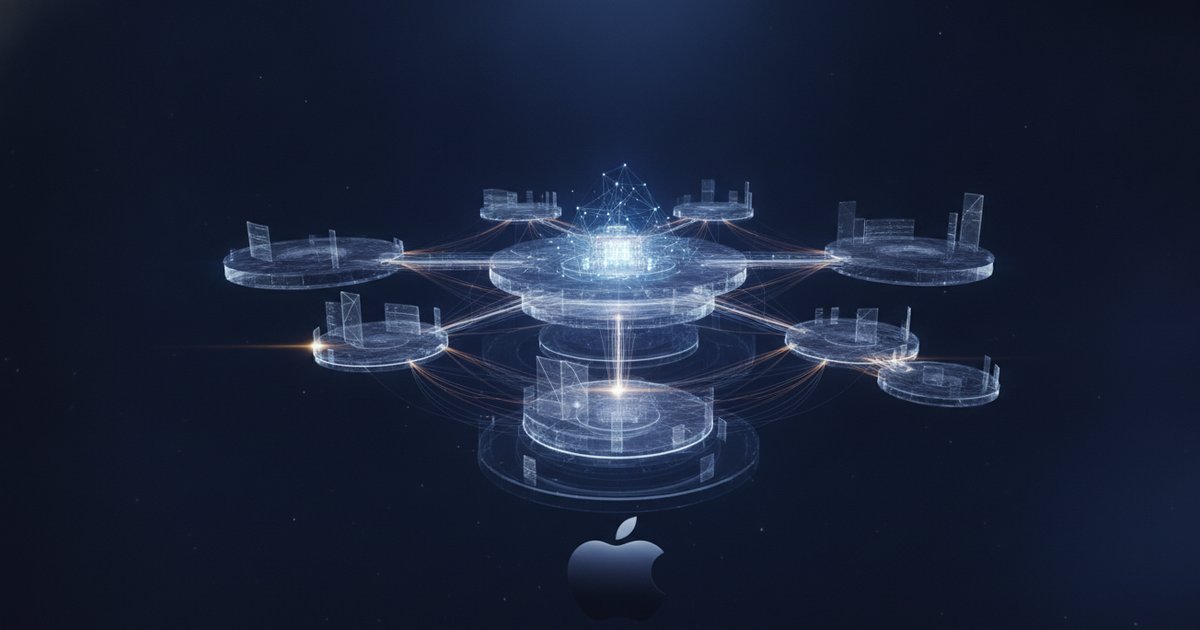
Strip away the product theatre and a coherent bet appears. Apple has concluded that the frontier model is becoming a commodity input — expensive to build, rapidly depreciating, and increasingly interchangeable. The durable, defensible assets are elsewhere: the device people already own and trust, the privacy layer competitors cannot easily replicate, and the distribution that comes from shipping AI to every iPhone by default.
This is the ‘orchestrate, don’t build’ play. As Build Fast with AI frames it, the approach lets Apple plug in the best-available model at any given moment while keeping control of the hardware and the privacy envelope that differentiate its products. If Gemini is the strongest option today, Apple uses Gemini. If a better model emerges next year — its own, OpenAI’s, an open-weights challenger — the orchestration layer swaps it in. Apple becomes the integrator, not the inventor.
This is a ‘Switzerland’ position, and it’s a powerful one. By refusing to marry a single model, Apple keeps every model maker competing for the most valuable real estate in consumer tech: the default assistant on a billion-plus devices. It extracts leverage without taking on the cost or the risk of leading the research frontier. Let others burn capital chasing the next benchmark; Apple owns the customer relationship, the on-device silicon, and the trust that lets it charge a premium.
There’s a historical rhyme here. Apple rarely invents a category first — it didn’t ship the first smartphone, MP3 player or tablet. It waits, integrates the pieces into something people actually want to use, and owns the experience. The AI strategy looks like the same playbook applied to a new technology wave.

The risks
The cleverness comes with real exposure. The most obvious is dependence on a direct rival. If the new Siri’s intelligence is materially powered by Google’s Gemini, Apple has handed a core capability of its most personal product to the company behind Android. That is a strategic vulnerability dressed as a partnership. Pricing, model access, and roadmap priorities now partly sit outside Apple’s control — an uncomfortable position for a firm that built its empire on owning the full stack.
Revenue and control questions follow. Apple already earns billions from Google for default search placement on Safari — an arrangement under regulatory scrutiny. Layering an AI model dependency on top deepens an entanglement that antitrust authorities are watching closely. If regulators force changes to these commercial arrangements, Apple’s orchestration strategy could be reshaped by forces it doesn’t command.
Then there’s trust. Apple has staked its brand on privacy, marketing it as a feature rivals can’t credibly match. Routing queries — even within a private-cloud architecture — to infrastructure running a third-party model invites scrutiny of exactly what is processed where, and by whom. The private-cloud design is engineered precisely to answer these questions, but the burden of proof is high. One credible breach, or one gap between the privacy marketing and the technical reality, and the differentiation Apple is counting on erodes fast. The company is, in effect, asking users to trust that a Google model running on Apple’s servers behaves nothing like a Google model running on Google’s servers.
The India read
For India, this strategy lands at a particularly interesting moment. Apple’s base in the country has been growing steadily, supported by expanding local manufacturing and a widening premium consumer class. As iPhones reach more Indian users, the question of how AI features behave — and how data is handled — stops being abstract.
On-device AI is a genuinely meaningful proposition in privacy-sensitive, regulation-evolving markets. India’s data protection framework is still maturing, and many users remain wary of where their personal information travels. An architecture that keeps everyday, sensitive processing on the phone itself — rather than shipping everything to a distant cloud — is a real selling point, not just a marketing line. For a market that is mobile-first and increasingly conscious of digital privacy, the on-device tier could matter more than any benchmark score.
But the sharpest lesson here is for India’s app builders and founders. The ‘orchestrate, don’t build’ principle is directly transferable — and arguably more urgent for a startup than for a trillion-dollar incumbent. Most companies have no business training their own frontier model; the cost is ruinous and the depreciation brutal. The winning move, increasingly, is to treat models as swappable commodities, build a strong orchestration and product layer on top, and own the things that actually compound: the user relationship, proprietary data, distribution, and trust.
- Don’t tie yourself to one model. Build an abstraction layer so you can swap providers as price and quality shift. Apple’s Switzerland stance is a template.
- Compete on the experience, not the model. The defensible value is in workflow, interface and integration — not in owning the smartest weights.
- Treat privacy as product. In India’s evolving regulatory environment, on-device and data-minimising design can be a feature users pay for, not a compliance afterthought.
- Own distribution. Apple’s real moat is the billion devices. For a startup, the equivalent is a channel or audience competitors can’t easily reach.
None of this is to declare Apple’s bet a guaranteed win. Renting your flagship product’s intelligence from a rival is a tightrope, and the privacy promise must survive contact with reality. But the strategy is internally consistent and, in our view, a clearer read of where AI value settles than the model-maximalism dominating the rest of the industry. Apple isn’t trying to build the best brain. It’s betting that owning the body — the device, the trust, the reach — is the harder thing to replicate. Often, in technology, it is.
