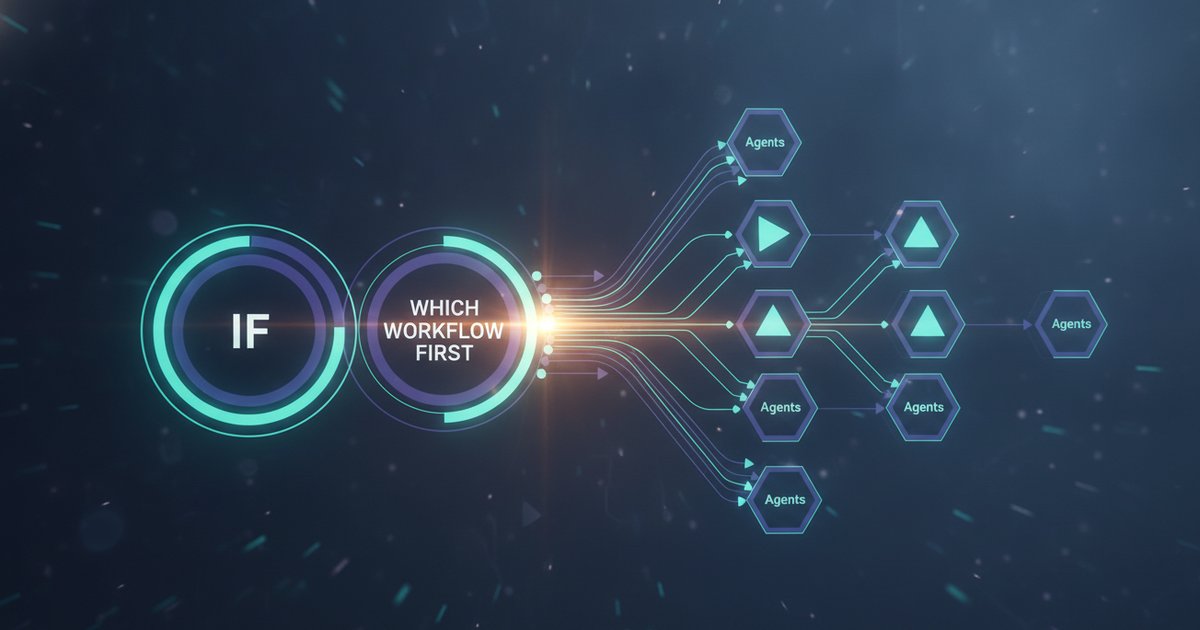
Something shifted in the conversation around AI agents this year, and it happened quietly. Walk into a product review, a board meeting, or a founder’s WhatsApp group in June 2026, and you will no longer hear the old question — are agents actually real, or is this another demo cycle? That argument is settled. The new question is sharper and more practical: which workflow do we agentize first?
That reframing is the whole story. It signals that agentic AI has moved from a thing teams talk about to a thing teams ship. Below, we map why agents crossed into production this year, what the orchestration layer actually looks like now, where the technology still breaks in embarrassing ways, and a starter stack you can put into production this month without betting the company on it.
The year agents became infrastructure
The clearest evidence that agents grew up is that the biggest cloud vendors stopped describing them differently. Through 2024 and 2025, AWS, Google Cloud, Microsoft, and IBM each marketed their own flavour of “agent” with subtly incompatible vocabularies. In 2026 they have effectively converged on the same five-part definition: an agent has a goal, persistent memory, the ability to plan a sequence of steps, access to tools it can call, and some degree of autonomy to act without a human approving every step. When four competitors stop fighting over the definition of a category, the category has become infrastructure.
The product language changed too. The 2024 pitch was about novelty — look what this thing can do unsupervised. The 2026 pitch is about reliability and observability: how often the agent completes the task, how you trace what it did, how you roll back when it goes wrong. That is the unmistakable signature of a technology crossing from demo into production. You do not build dashboards and audit logs for a toy.
The adoption numbers, where credible, point the same direction. Gartner projects that 40% of enterprise applications will include task-specific AI agents by 2026, up from under 5% in 2025 (per iTech Magazine, citing Gartner). Even allowing for the usual analyst optimism, an eight-fold jump in a single year is a production-adoption signal, not a hype curve. The capital is following: the AI-agent market is forecast to grow at roughly a 46.6% CAGR toward about $11.78 billion in 2026 (iTech Magazine, citing Barchart). Money at that scale chases deployment, not slideware.
The most underrated part of this shift is who it unlocks. The conventional wisdom held that agents were an enterprise play — big budgets, big integration teams, big risk tolerance. The reverse is turning out to be true. A three-person startup can now wire up an agent that does the work of a function it could never afford to staff: a tireless support triager, a research analyst, a lead-qualification engine. For small teams, agents are not an efficiency tweak on existing headcount; they are leverage that simply did not exist before. That is the quiet democratisation underneath the enterprise headlines.
What the orchestration layer looks like now
If agents are the workers, the orchestration layer is the floor manager — and that layer has consolidated faster than most people expected. LangChain has emerged as the de facto standard translator: the connective tissue that lets a planning loop talk to a vector store, a CRM, a payments API, and three different model providers without bespoke glue code for each. You can dislike LangChain’s abstractions — plenty of senior engineers do — but its gravitational pull is real. When teams describe their architecture in 2026, they increasingly describe it in terms LangChain made common. Standardisation at the orchestration layer is what let agent-building stop being artisanal.
The second big architectural lesson is that the do-everything agent was a dead end. The 2024 dream of one omniscient assistant that handles your entire workflow has given way to teams of specialised agents, each narrow and good at one thing, coordinated by an orchestrator. A research agent gathers, a writer agent drafts, a critic agent checks, a tool agent executes. This mirrors how human organisations actually work, and for the same reason: narrow scope is easier to test, easier to debug, and far easier to keep reliable. A single monolithic agent fails in ways nobody can reproduce. A team of small agents fails in ways you can isolate to one node.
The third shift is cultural as much as technical. Memory and evaluations have become first-class concerns rather than afterthoughts. Teams now design what an agent should remember across sessions — and, just as importantly, what it should forget — as a deliberate part of the architecture. And no serious team ships an agent without an eval harness: a battery of test cases that scores whether the agent still does the job correctly after you change a prompt, swap a model, or add a tool. Evals are to agents what unit tests are to software. The teams treating them as optional are the teams whose agents quietly degrade in production while everyone assumes they are fine.
Where agents still break
None of this means agents are solved. They break, and the failure modes are now well enough understood to name precisely.
The first is long-horizon reliability. An agent that nails a three-step task will reliably wander off on a thirty-step one. Errors compound: a small misread at step four cascades into nonsense by step twenty. The honest framing is that agents are excellent sprinters and unreliable marathon runners. The teams winning in production are the ones that decompose long workflows into short, checkpointed segments rather than handing the agent a giant goal and hoping.
The second is counterintuitive and important: most failures are integration failures, not model failures. The model usually reasons fine. What breaks is the API that returned an unexpected null, the rate limit that throttled a tool call mid-loop, the schema that changed without warning, the authentication token that expired. Teams that came in expecting the LLM to be the weak link discover their reliability budget is spent almost entirely on plumbing. This is good news, in a way — integration problems are conventional engineering problems with conventional solutions, not mysteries of machine cognition.
The third is cost runaway. An agent that loops can burn tokens spectacularly. A planning agent that re-plans on every minor obstacle, or two agents that ping-pong politely forever, can turn a few-cent task into a few-dollar one without anyone noticing until the bill arrives. Production agents need hard budget caps, loop limits, and cost instrumentation per run — not as a nice-to-have, but as a circuit breaker.
The fourth is the design question of human-in-the-loop gates. Full autonomy is a liability for any action that is expensive, irreversible, or customer-facing. The mature pattern in 2026 is not maximum autonomy; it is calibrated autonomy — the agent acts freely on low-stakes, reversible steps and pauses for human approval at the consequential ones. Sending a draft for review is fine to automate. Issuing a refund, deleting records, or emailing a client should pass through a gate. Knowing where to put the gate is now a core agent-design skill.
A starter stack you can ship this month
If the strategic question is which workflow to agentize first, here is a pragmatic answer you can act on before the quarter ends. The goal is not a moonshot. It is a small, real win you can measure.
- Pick one workflow — and make it narrow. Choose a task that is repetitive, well-defined, and reversible: triaging inbound support tickets, drafting first-pass responses, qualifying leads, summarising research, reconciling two data sources. Avoid anything with irreversible or financial consequences for your first build. Narrow scope is what makes the rest of this list achievable.
- Instrument it from day one. Before you optimise anything, make the agent observable. Log every step, every tool call, every input and output, and the cost per run. You cannot improve what you cannot see, and the integration failures that will define your reliability are invisible without tracing.
- Add guardrails before you add autonomy. Set a hard loop limit and a per-run budget cap so a runaway agent fails cheap. Put a human-in-the-loop gate on any consequential action. Write a small eval suite — even ten representative test cases — so you can tell whether a change made the agent better or quietly worse.
- Measure before and after. Capture a baseline of the manual workflow: how long it takes, how much it costs, the error rate. Then measure the agentized version against the same metrics. The teams that win the internal argument for agents are the ones holding a clean before-and-after, not a vibe.
An orchestration layer like LangChain will handle the plumbing between your model, your memory store, and your tools, which means most of your effort goes where it should: defining the workflow, instrumenting it, and setting the guardrails. Start with one agent doing one thing well. The teams that shipped this year did not bet everything on agentic AI — they found a single workflow worth agentizing, proved it with numbers, and moved to the next. That is what the 2026 question — which workflow first? — is really asking you to answer.
