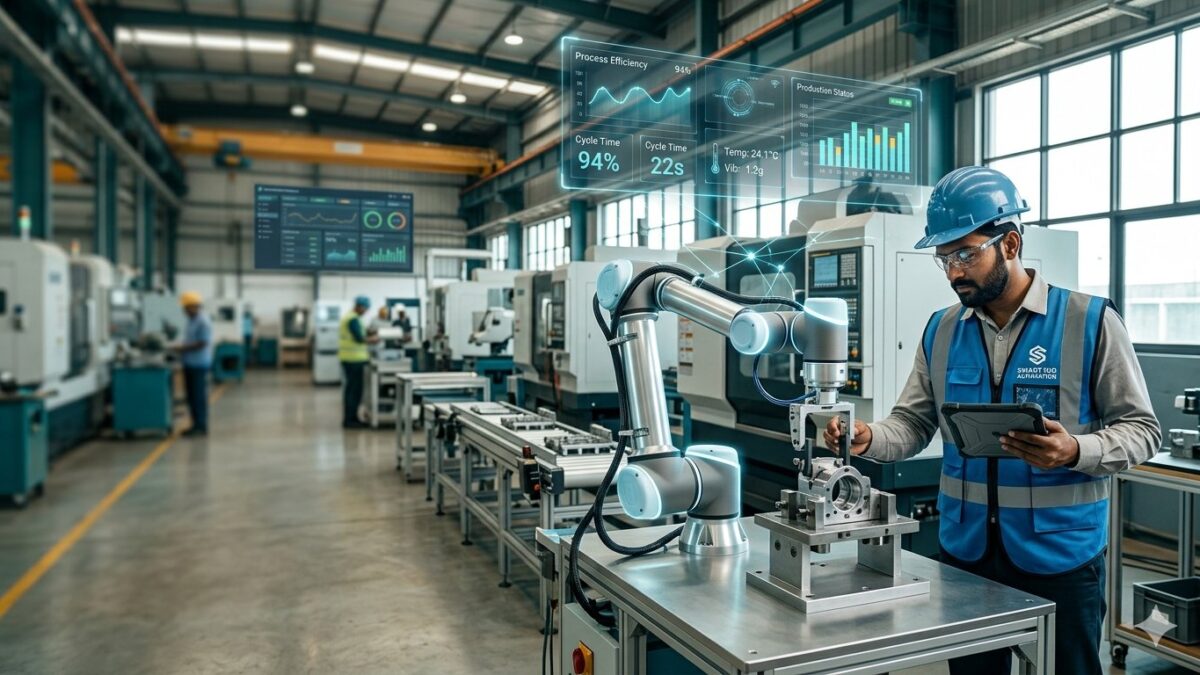
India’s factories are at an inflection point. Rising labour costs, thinning margins, demanding global buyers, and the falling price of sensors and compute have combined to make artificial intelligence and automation no longer a luxury reserved for large enterprises — but a survival tool for the mid-market and a growth lever for everyone.
The numbers tell the story. India’s industrial automation market has been expanding at double-digit rates, and the slice specifically tied to AI is growing even faster — industry analysts peg AI-in-manufacturing growth at roughly 18% a year through the next decade. Government schemes are pushing in the same direction, and by some estimates the smart adoption of AI by Indian manufacturers — particularly the country’s vast MSME base — could unlock $135–150 billion in value by 2035.
Yet adoption remains uneven. Surveys suggest that a majority of Indian MSMEs are still unaware of the AI tools available to them, even as the overwhelming majority who are tech-enabled say AI could drive real business growth. That gap between awareness and opportunity is exactly where the advantage lies for manufacturers willing to move now.
This article breaks down, practically, how a manufacturing business in India can use AI and automation across the three areas that matter most to growth: operational efficiency, production and quality, and lead generation and sales.
The numbers at a glance
- AI-in-manufacturing in India is growing at roughly 18% a year.
- Predictive maintenance cuts unplanned downtime by 20–40% and maintenance costs by 25–40%.
- AI computer-vision quality control reduces defect rates by up to 35%.
- Smart MSME adoption could unlock $135–150 billion by 2035.
Why now: the conditions have finally aligned
A few years ago, deploying AI on a factory floor meant custom hardware, expensive consultants, and a multi-year payback. Three things have changed that.
Cost has collapsed. Industrial sensors, edge computing devices, and cloud AI services are a fraction of their former price. A modular retrofit — adding intelligence to existing machines rather than buying new ones — can now pay for itself in under two years, which is what’s pulling small and mid-tier firms into the market.
The ecosystem has matured. Indian manufacturers no longer need to build AI from scratch. A deep bench of systems integrators — Infosys, TCS, Tech Mahindra, Tata Elxsi, and a long tail of specialist startups — can deploy proven solutions. When Dixon Technologies wanted AI-powered Industry 4.0 automation across its plants, it partnered with Tech Mahindra rather than building in-house. That “buy the capability” template is now available to any mid-sized manufacturer.
The government is actively subsidising the shift. Through the Production Linked Incentive (PLI) schemes, the Make in India initiative, the IndiaAI Mission, and the Ministry of Heavy Industries’ SAMARTH Udyog Bharat 4.0 programme, there is real money and real handholding available — including demo centres and subsidised digital-maturity assessments aimed squarely at MSMEs.
The competitive pressure is the final piece. Global buyers increasingly expect export-grade quality, full traceability, and digital supply-chain visibility as table stakes. For an Indian manufacturer, standing still is no longer neutral — it is falling behind.
Pillar 1: Operational efficiency — doing more with what you already have
Operational efficiency is usually where AI delivers its fastest, most measurable return, because the gains show up directly as reduced cost and reduced downtime. Three use cases dominate.
Predictive maintenance
This is the single highest-ROI starting point for most factories. Instead of running machines to failure (reactive) or servicing them on a fixed calendar whether they need it or not (preventive), AI models watch real-time sensor data — vibration, temperature, current draw, acoustics — and predict failures before they happen.
The documented results are substantial: predictive maintenance typically cuts unplanned downtime by 20–40% and lowers maintenance costs by 25–40%. Tata Steel deployed IoT sensors and AI algorithms to monitor temperature, vibration, and energy consumption on high-value equipment like blast-furnace components and conveyor systems, shifting from firefighting breakdowns to scheduling interventions in advance.
For a smaller manufacturer, you don’t need to instrument the whole plant on day one. Start with your single most critical or most failure-prone machine — the one whose breakdown stops the line — and prove the model there.
Energy and process optimisation
Energy is often a manufacturer’s largest controllable cost, and it’s frequently invisible. AI systems that continuously monitor consumption can spot inefficient equipment, optimise scheduling to avoid peak tariffs, and flag anomalies that signal waste. With carbon-compliance deadlines now arriving for energy-intensive verticals, automated energy monitoring is shifting from a nice-to-have to a regulatory necessity.
Supply chain and demand forecasting
AI demand forecasting analyses historical orders, seasonality, and market signals to predict what you’ll need to produce and procure — directly reducing both overstock and stockouts. Documented deployments have improved forecast accuracy by more than 25%, which flows straight to the bottom line through lower carrying costs and fewer rush orders. For manufacturers juggling raw-material volatility, this is one of the most underrated applications of all.
Pillar 2: Production and quality — building better, faster, and with fewer defects
If operational efficiency is about cost, this pillar is about output and reputation — the ability to make more, make it better, and prove it to demanding customers.
Computer-vision quality control
Human visual inspection is slow, expensive, inconsistent, and tiring — and it misses microscopic defects, especially at scale. AI-powered computer vision uses cameras and deep-learning models trained on images of good and defective parts to inspect every single unit in real time, catching cracks, scratches, dents, misalignments, and assembly errors that the human eye routinely overlooks.
Deployments have produced average defect-rate reductions of around 35%. Welspun used machine-learning models with computer vision for predictive quality control and reported roughly a 30% drop in post-production quality complaints, a 15% cut in raw-material waste, and full return on investment in under nine months. Tata Motors has run AI-powered computer vision to automate quality control of vehicle fit and finish.
A practical caution worth building into any plan: vision models are only as good as their training data, and high-quality factories produce few defects — so gathering enough defect images can be hard. This is often solved with synthetic data and image augmentation. And the factory environment itself — dust, vibration, fluctuating light — means industrial-grade enclosures and controlled lighting are necessary investments, not optional extras.
Throughput and yield optimisation
AI doesn’t just inspect output — it improves it. Machine-learning models that analyse process parameters (temperature, pressure, speed, material mix) can identify the exact settings that correlate with defects and recommend adjustments before bad parts are ever made. In foundry and casting operations, for example, ML models analysing core-making parameters and maintenance logs have been used to predict and prevent defects upstream, lifting both quality and production efficiency.
Robotics and cobots
The robot story in India has quietly shifted from giant caged industrial arms to collaborative robots (cobots) that work safely alongside people, are easier to programme, and suit the smaller batch sizes typical of Indian manufacturing. Applications now span welding, painting, assembly, palletising, and inspection. For an MSME, a single cobot handling a repetitive, ergonomically punishing task can free skilled workers for higher-value work while running consistently around the clock.
Generative design and digital twins
At the more advanced end, generative design lets AI propose optimised component geometries based on constraints you specify, while digital twins create a virtual replica of your plant or process. Manufacturers use digital twins to simulate changes, train operators, and validate process modifications virtually before committing them on the real line — de-risking decisions that used to require expensive physical trial and error.
Pillar 3: Lead generation and sales — turning a factory into a growth engine
This is the pillar most manufacturers ignore — and the one with the most untapped upside. AI for “business growth” isn’t only about the shop floor; it’s about filling the order book. The same intelligence transforming production can transform the commercial side of the business.
Smarter lead generation and qualification
Most manufacturers still rely on referrals, trade shows, and a small sales team working a manual pipeline. AI changes the economics here:
- Lead scoring and prioritisation. AI models analyse inbound enquiries and historical conversion data to tell your sales team which leads are most likely to close, so they spend time on the right ones.
- B2B prospecting at scale. AI tools can identify and enrich data on potential buyers — companies, decision-makers, contact details — that match your ideal customer profile, building a pipeline far larger than manual research allows.
- Digital visibility. A surprising number of capable Indian manufacturers are invisible online. AI-assisted content, SEO, and a well-structured website turn an enquiry-by-referral business into one that gets discovered by buyers searching globally for exactly what you make.
AI for RFQ and quotation
Responding to a request for quotation is often slow and manual, and slow responses lose deals. AI can parse incoming RFQs, estimate costs and lead times against your historical data, and help generate accurate quotes far faster — letting you respond to more opportunities and win on speed.
Conversational AI and customer service
AI chatbots and assistants can handle first-line buyer enquiries 24/7, qualify them, and route serious prospects to humans. In a B2B manufacturing context, this captures leads that would otherwise be lost to a missed call or an after-hours email — and increasingly these tools support Hindi and regional languages, widening the reachable market.
Marketing intelligence
AI-driven analytics reveal which products, regions, and channels are actually generating revenue, so marketing budgets stop being guesswork. For a manufacturer trying to grow, knowing where demand is coming from — and where latent demand exists — is as valuable as any factory upgrade.
What’s actually working in India: a quick reality check
The lighthouse examples are instructive, but the more important signal is momentum across the broader economy. By 2025, roughly 47% of Indian firms reported multiple generative-AI deployments, and a Microsoft survey found that 59% of Indian business leaders were already using AI agents to automate tasks, with the large majority planning broader rollout within 18 months.
AI delivers results only when it’s paired with clean data, trained people, and a genuine change to everyday workflows. Bolting an algorithm onto a dysfunctional process changes nothing.
The pattern across credible Indian case studies — Tata Steel, Tata Motors, Welspun, TVS, Bosch — is consistent and worth internalising. This is incremental transformation, not a magic switch.
Funding and support: don’t pay full price
A manufacturer planning an AI initiative in India should treat government support as part of the budget, not an afterthought:
- SAMARTH Udyog Bharat 4.0 (Ministry of Heavy Industries) runs demonstration and common-engineering centres nationwide, offering MSMEs awareness workshops, benchmarking, affordable point solutions, and subsidised digital-maturity assessments. Many introductory services are free or low-cost compared with private consulting.
- PLI schemes across sectors (the automotive scheme alone is worth around ₹25,938 crore) reward domestic value-addition and increasingly require the kind of traceability and smart supply-chain software that AI enables — so adoption and incentive eligibility reinforce each other.
- IndiaAI Mission provides subsidised compute and ecosystem support, and NASSCOM FutureSkills offers reskilling pathways to close the talent gap.
For most MSMEs, the smart play is to use these programmes to de-risk a first pilot, then reinvest the proven savings into the next step.
A practical roadmap: how to actually start (especially for MSMEs)
The biggest mistake is the “big bang” — trying to digitise everything at once. It’s expensive, slow, and usually fails. The proven approach is crawl, walk, run.
- Find your most expensive problem. Don’t start with the technology; start with the pain. Is it unplanned downtime? Quality rejections? A thin order book? Slow quoting? Pick the one costing you the most money right now.
- Run one small, measurable pilot. Instrument a single critical machine for predictive maintenance, or put a vision camera on one inspection station, or deploy lead scoring on one product line. Keep the investment modest and the metric clear. The savings or gains become the proof — and the funding — for the next step.
- Fix your data first. AI runs on data, and inconsistent or missing data is the most common reason Indian deployments stall. Before scaling, make sure the relevant process is actually capturing clean, usable data.
- Buy the capability, don’t build it. With a mature integrator ecosystem, very few Indian MSMEs should be writing AI from scratch. Partner with a systems integrator or a specialist startup that has done it before — and look for a partner with genuine skin in the game, not just a one-off sale.
- Bring your people along. Worker anxiety and skill gaps are real barriers. Frame AI as removing the tedious and dangerous parts of jobs, train your team, and involve floor supervisors early — because the technology only sticks when it’s woven into how people actually work.
- Measure, then scale. Once a pilot proves its return, expand it — to the next machine, the next line, the next plant — funding each stage with the gains from the last.
The barriers — and how to get past them
It would be dishonest to pretend this is frictionless. The recurring obstacles for Indian manufacturers are well documented: tight cash flow, unclear ROI, poor data quality, tiny or non-existent IT teams, worker anxiety, low awareness of available tools, over-dependence on third-party implementers, and a shortage of trusted local-language support.
None of these is a reason not to start. Each one is a reason to start small — with a focused pilot, government support to reduce the cost, a capable partner to supply the expertise, and a clear metric to prove the value before scaling. The manufacturers who win won’t be the ones who spent the most; they’ll be the ones who started early, learned fast, and compounded their gains.
The bottom line
For an Indian manufacturer, AI and automation are no longer about chasing a futuristic vision — they’re about three concrete, achievable outcomes. Leaner operations through predictive maintenance, energy optimisation, and better forecasting. Better production through computer-vision quality control, yield optimisation, cobots, and digital twins. And more growth through AI-powered lead generation, faster quoting, and sharper marketing.
The market is moving fast, the cost of entry has fallen, the government is subsidising the journey, and a mature ecosystem stands ready to help. The window to build a durable advantage is open now — and it will favour the manufacturers who take the first small, measurable step rather than waiting for certainty that never comes.
This article is for informational purposes and reflects industry data and reported case studies as of mid-2026. Specific results vary by sector, scale, and implementation quality; manufacturers should evaluate solutions against their own operations and verify the current terms of any government scheme before committing.
