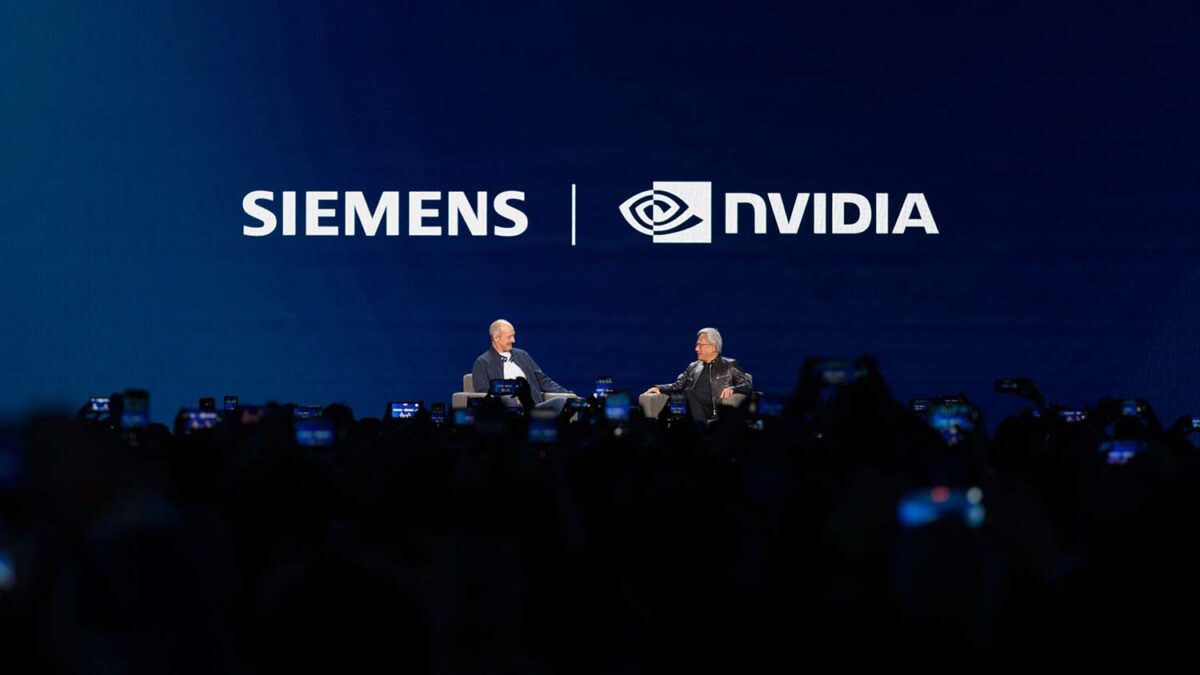
For a decade, “smart factory” has mostly meant a factory with more sensors. At CES 2026 in January, Siemens and NVIDIA made a bigger claim: they say they aim to build the world’s first fully AI-driven, adaptive manufacturing sites — plants that read their own digital twin, test changes in simulation, and push validated updates to the shop floor without a human rewriting the automation by hand. The two companies frame it as an “Industrial AI Operating System,” and they say the rollout begins in 2026 at Siemens’ own electronics plant in Erlangen, Germany.
It is important to be precise about what this is. This is an announced ambition and a rollout that is starting, not a finished factory you can walk through today. The “world’s first fully AI-driven” language is Siemens and NVIDIA’s own framing of their goal. Read that way — as a bet being placed rather than a result being reported — it is still one of the most consequential things either company has said about the next phase of manufacturing, and it sets a bar that India’s own factory ambitions will inevitably be measured against.
What Siemens and NVIDIA actually announced
On 6 January 2026, tied to CES, Siemens and NVIDIA expanded their existing partnership to build what they call an Industrial AI Operating System. In the companies’ words, they “aim to build the world’s first fully AI-driven, adaptive manufacturing sites globally, starting in 2026,” with the Siemens Electronics Factory in Erlangen serving as the first blueprint.
Every part of that sentence deserves attribution to the companies rather than the newsroom. “World’s first” and “fully AI-driven” are strong claims, and Siemens and NVIDIA are the ones making them. What is concrete is the structure: an expanded commercial and engineering partnership, a stated 2026 start, and a named first site. The pitch, as Siemens chief executive Roland Busch framed it, is that the two firms are building an operating system for industry that changes how the physical world is designed, built and run. NVIDIA’s Jensen Huang described it, in his own framing, as fusing Siemens’ industrial software with NVIDIA’s full-stack AI platform to shrink the distance between an idea and a working line. Both are paraphrases; treat the vision as ambition, and watch the plants.
How the “AI Brain” works
Underneath the marketing, the mechanism the companies describe is coherent. The system combines Siemens’ software-defined automation and industrial operations software with NVIDIA’s Omniverse simulation libraries and AI infrastructure. The result, in Siemens’ description, is a factory that can “continuously analyze their digital twins, test improvements virtually, and turn validated insights into operational changes on the shopfloor.”
Break that loop into three moves. First, the plant maintains a live digital twin — a high-fidelity virtual model of the line, the machines and the material flow. Second, the AI layer proposes and rehearses changes in that simulation: a new robot path, a re-sequenced cell, a different buffer size. Third, only changes that pass virtually get deployed to the physical floor. The companies say the payoff is higher productivity, faster commissioning of new lines, and lower risk, because the expensive trial-and-error moves into software before it touches steel. That “test in the twin, then deploy” discipline is the actual innovation being claimed — less a single robot than a closed feedback loop between simulation and the shop floor.
From fixed automation to adaptation
To see why this matters, contrast it with how automation has worked for forty years. A traditional industrial robot executes a program. It is precise, tireless and completely literal: it does not reason about why a part is out of place, and it does not reconfigure the line when the product changes. Retooling means engineers, downtime and cost. The intelligence lives in the humans around the machine, not in the machine.
Adaptive manufacturing, as Siemens and NVIDIA describe it, moves some of that intelligence into the system itself. The stated goal is a plant that learns from its own operating data and adjusts in near real time — rebalancing a line, absorbing a supply hiccup, or accommodating a design tweak — with far less manual reprogramming. The claim is a shift from static lines to self-optimizing ones. That is genuinely different from “faster robots,” and it is also exactly the kind of claim to watch skeptically: adaptation is easy to demo on one cell and hard to sustain across a whole plant.
Who’s in, and how real it is
The division of labour is clear. NVIDIA is supplying the AI infrastructure, simulation libraries, models, frameworks and blueprints; Siemens says it is committing hundreds of industrial-AI experts alongside its own hardware and software. This is Siemens’ domain knowledge sitting on top of NVIDIA’s compute and simulation stack, rather than either firm doing it alone.
On traction, Siemens and NVIDIA name Foxconn, HD Hyundai, KION Group and PepsiCo as early customers evaluating the capabilities, and say they will deploy the technology in their own operations first as proof points. “Evaluating” is the honest word here — it signals interest, not signed lines — but the customer list spans electronics, shipbuilding, intralogistics and consumer goods, which is a meaningful spread.
The most tangible sign that this is moving beyond slideware came a few months later. In a two-week trial run at the Erlangen plant in January 2026 and announced in April, Siemens and the startup Humanoid tested a humanoid robot, the HMND 01 Alpha, built on NVIDIA’s physical-AI stack, on live logistics work — picking, moving and placing totes alongside human operators. Siemens reported the robot met its targets: roughly 60 tote-moves an hour, more than eight hours of uptime, and autonomous pick-and-place success above 90 percent. It is one trial of one machine on one task, not a fully autonomous plant — but it is real hardware in a live production environment, which is more than most “AI factory” announcements can show.
The honest caveats
Independent journalism means naming the gaps. Four are worth keeping in view.
- The claims are company-stated. “World’s first” and “fully AI-driven” are marketing frames as much as technical descriptions. The useful test over the next year is progress against specifics — how much of Erlangen actually runs on the loop, how much still needs human engineers — not the adjectives.
- It presumes a lot of plumbing. A system that continuously reads a digital twin needs robust IoT and operational-technology data, clean sensor feeds and a well-modelled plant. Factories with patchy instrumentation or legacy machines are not plug-and-play candidates.
- Concentration and lock-in. An “operating system” for factories jointly defined by two dominant vendors raises real questions about switching costs, interoperability and who owns the operating data. Buyers should ask those questions before they are locked in, not after.
- Safety and security. An AI system that pushes live changes to a shop floor is also a new attack surface and a new safety question. “Validated in simulation” is reassuring only if the validation, and the human sign-off around it, are genuinely rigorous.
The future-of-work question (handled carefully)
The natural anxiety is that adaptive factories mean fewer people. The honest version is more specific, and it is about the mix of work rather than a simple headcount verdict. As more line-level reconfiguration shifts into software, the associated demand tends to move toward oversight, data and maintenance roles — people who supervise the AI’s decisions, keep the digital twin accurate, interpret the analytics and service increasingly complex equipment. This is an association and a shift in the composition of factory work, not a clean claim that “AI takes the jobs.”
It is worth being disciplined here, because the causation is genuinely uncertain. Automation has historically both displaced specific tasks and created new categories of work, and which effect dominates depends on demand, pace and policy as much as on the technology. What the Siemens–NVIDIA model does make concrete is that the human-in-the-loop does not disappear — the person who signs off on a validated change is still central — and that reskilling toward oversight, data literacy and maintenance is the practical response, not a slogan. The Erlangen humanoid trial is a small illustration: the robot moved totes so human operators could do something else, and a human still owned the outcome if it failed.
The India read
For India, this is the benchmark. The country’s manufacturing push — Make in India, the production-linked incentive (PLI) schemes, and the “China+1” opening — is aimed at exactly the kind of advanced, high-value production that adaptive factories represent. India’s manufacturing sector still contributes around 17% of GDP, and the National Manufacturing Mission announced in the 2025–26 Union Budget targets lifting that to 25% by 2035, alongside ambitions of 143 million jobs and US$1.2 trillion in merchandise exports. Frontier factory models like this one are, in effect, the standard those targets will be judged against.
There is a real opportunity in that. India is building a great deal of new manufacturing capacity from scratch, which means less legacy equipment to rip out — a chance to leapfrog straight to digital-twin-driven, adaptive lines rather than retrofit them later. But the same caveats bite harder here: adaptive manufacturing presumes strong data infrastructure, reliable power and connectivity, and a deep bench of engineers who can run the simulation-to-shop-floor loop. That skills-and-infrastructure gap, not the ambition, is the binding constraint.
Both companies already have substantial India footprints — Siemens in industrial automation and Siemens’ digital-industries software, NVIDIA in the compute and AI layer — which makes the practical question less “will this reach India” and more “who operationalizes it.” Indian manufacturers evaluating capital spend, global capability centres (GCCs) building industrial-AI and simulation talent, and the system integrators who will actually wire these plants together are the players to watch. The factory getting a brain is a global story; whether India’s factories get one, and who builds it, is the local one.