The race to build frontier AI has, in the popular imagination, become a two-country story: American labs with bottomless capital on one side, Chinese giants on the other. Europe has largely been cast as a regulator rather than a builder. Mistral, the Paris-based lab founded in 2023, is the most serious argument against that framing — and its reported new funding round suggests investors are betting the argument holds.
What makes Mistral interesting isn’t that it’s trying to out-shout OpenAI. It isn’t. It’s that it appears to have found a quieter, more durable path to relevance — one that founders and policymakers from Bengaluru to Brussels would do well to study.
The reported raise
According to TechCrunch (July 4, 2026), Mistral is reportedly raising roughly $3.5 billion at a valuation near $23.15 billion — nearly double its previous mark. For a company barely three years old, that is a striking re-rating, and it comes attached to numbers that, if accurate, explain the enthusiasm.
The company has said its annual recurring revenue climbed from around $20 million to above $400 million within a single year — a roughly twentyfold jump — and that it is on track to surpass $1 billion. These figures remain provisional and should be treated as reported rather than confirmed, but the trajectory they describe is the kind that justifies a valuation leap. Revenue growing that fast is rare in enterprise software at any scale; at this scale, in AI, it signals genuine commercial pull rather than pure narrative momentum.
The distinction matters. Plenty of AI companies have raised at eye-watering valuations on the strength of a demo and a founding team. A move from $20 million to $400 million-plus in ARR is a different sort of proof point — it means paying customers, deployments, and renewals, not just hype.

The strategy
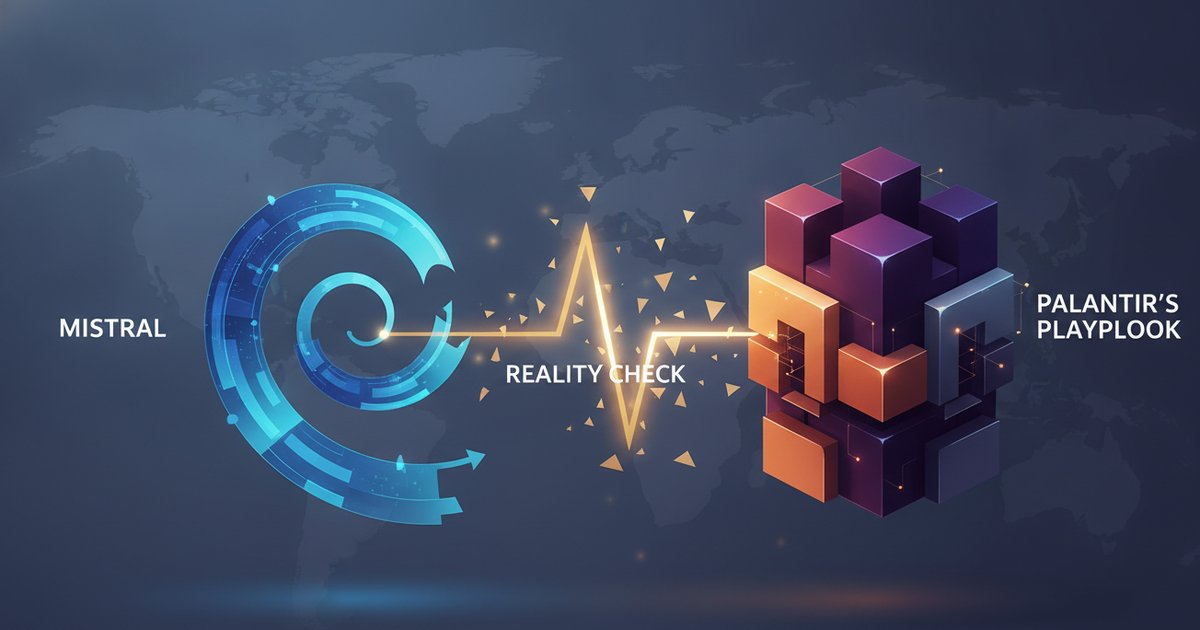
Here is where Mistral diverges sharply from the consumer-AI playbook. Rather than pouring resources into winning the mass-market chatbot war, the company is following what looks a great deal like Palantir’s model, per TechCrunch: forward-deployed engineers who embed directly inside governments and large enterprises, helping them adopt and tailor AI to their specific workflows, data, and constraints.
This is a fundamentally different business than selling API tokens or monthly subscriptions. Forward-deployed engineering is high-touch, high-margin over time, and — crucially — sticky. Once your engineers have wired a model into a ministry’s document pipeline or a bank’s risk systems, you are not easily displaced. Palantir spent two decades proving that this approach, unglamorous as it is, produces enormous enterprise value and defensible relationships.
Wrapped around this is Mistral’s sovereign-AI positioning. For European institutions wary of routing sensitive data through American providers — and increasingly conscious of the geopolitics of technological dependence — a credible European lab offering on-premise, controllable, tailorable models is a compelling proposition. Mistral is selling not just capability but autonomy. That framing turns regulatory anxiety, often seen as Europe’s weakness, into a commercial asset.
The company has also moved to build out the layers around the model itself, with acquisitions extending into infrastructure and into physics AI — the application of models to physical and scientific domains rather than purely linguistic ones. The logic is coherent: if your customers are governments and industrial enterprises, owning more of the stack and expanding into real-world simulation and engineering problems deepens the moat.
The reality check
None of this makes Mistral a lock. Several hard constraints deserve honest treatment.
First, consumer brand. In the mind of the average user, AI means ChatGPT. Mistral’s Le Chat has a fraction of that mindshare, and brand recognition compounds — it drives developer adoption, talent, and default-choice behavior. By choosing the enterprise-and-government route, Mistral is partly conceding the consumer arena. That’s a defensible strategic choice, but it does mean the company will remain relatively invisible to the public even if it succeeds commercially.
Second, the war chest. A reported ~$3.5 billion raise is enormous by European standards and modest by frontier-lab standards. American leaders are operating with capital commitments an order of magnitude larger, and training costs for successive model generations keep climbing. Mistral cannot win a pure spending war. Its bet has to be that being good enough at the frontier, combined with deployment excellence and sovereign positioning, beats being marginally better but generic.
Third, execution and differentiation risk. Forward-deployed models are operationally demanding — they scale with headcount, not just code, and margins can erode if implementations sprawl. And the technical gap between the best open and proprietary models keeps narrowing, which cuts both ways: it helps Mistral stay competitive, but it also means its models are not uniquely irreplaceable. The company’s defensibility rests more on relationships and trust than on any permanent technical lead.
The India read
For India — a country with genuine sovereign-AI ambitions, world-class engineering talent, and a stated desire not to be a pure consumer of foreign models — Mistral is arguably the most instructive case study available. It answers a question Indian policymakers and founders keep circling: what does a credible non-US AI champion actually look like?
The first lesson is that you do not need to win the consumer chatbot war to be strategically significant. India’s temptation is to chase a homegrown ChatGPT with mass appeal. Mistral suggests a more pragmatic route: build strong foundational models, then win through deployment inside institutions that matter — government departments, public-sector banks, healthcare systems, defense, and large domestic enterprises.
The second lesson is the forward-deployed, enterprise-first path itself. India has a deep bench of systems-integration and services talent — the same skills that make forward-deployed engineering work. Rather than viewing that as a legacy of the outsourcing era, it could be reframed as a structural advantage in an AI economy where the hard part is increasingly integration, not just model training.
The third lesson is about positioning. Mistral turned sovereignty from a slogan into a sales pitch. India’s data-localization instincts, its digital-public-infrastructure success, and its geopolitical desire for strategic autonomy could combine into a similar proposition — models built in India, hosted in India, controllable by Indian institutions. That is a real market, and a domestic champion that owns it would matter more than one chasing global consumer share it will never capture.
The caution, of course, is the same one that applies to Mistral: capital and talent are necessary but not sufficient. Sovereign ambition without commercial discipline produces expensive prestige projects. What Mistral is demonstrating — provisionally, and with plenty left to prove — is that the two can be reconciled. Build for the institutions that will pay, embed deeply, and let the revenue, not the hype, do the talking. It is not the loudest strategy in AI. It may turn out to be one of the smartest.
