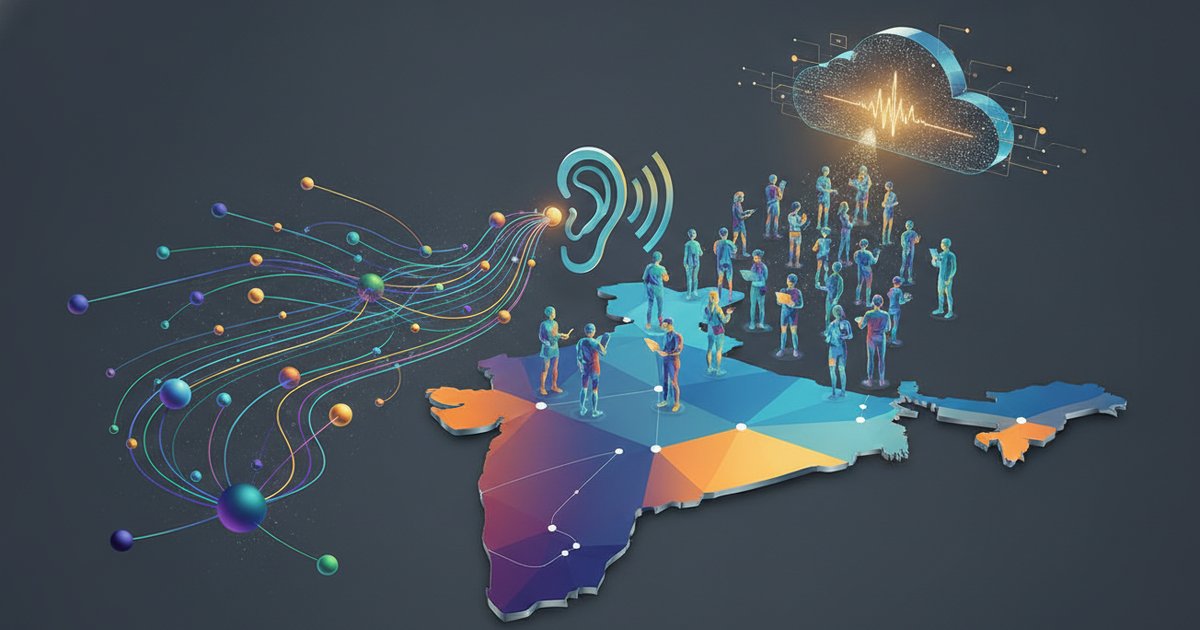
In much of India, the barrier to learning online has never really been curiosity. It has been the keyboard. Typing in English — or navigating a text-heavy interface at all — filters out hundreds of millions of people who are perfectly capable of learning, but not on the terms most edtech products quietly assume. That is the wager behind a new pre-seed raise: that if you let learners simply talk, the addressable market gets dramatically larger.
YoLearn.ai is building for exactly that thesis, and its recent funding round puts a small but pointed bet on it. What follows is a look at the raise, why a voice-first approach fits the Indian context, the guardrails responsible builders should hold themselves to, and what it all signals about the country’s underserved learning market.
The raise
According to Indian Startup Times (July 1, 2026), YoLearn.ai raised $500,000 in pre-seed funding to expand its voice-first AI tutoring platform. The report’s finer details — including the full investor line-up, target user segments, and geographic scope — remain limited and single-sourced, so treat the specifics as provisional until confirmed by the company or its backers.
What is clear is the design choice at the centre of the pitch. Rather than treating voice as a bolt-on feature to a text-based tutor, YoLearn.ai is framing conversation as the primary interface: a learner speaks, the AI responds, and the interaction resembles a spoken lesson more than a chatbot exchange. It is an early bet on conversational learning as the default mode, not the accessibility option.
Pre-seed cheques of this size do not build category leaders on their own. But they do buy a young team the runway to prove a narrow hypothesis — in this case, that voice-led tutoring can retain and genuinely teach users who would otherwise bounce off a typing-first product. The interesting question is not the round size; it is whether the interface bet holds up at scale.

Why voice-first fits India
The strategic logic is straightforward once you look at who is not already served by mainstream edtech. Voice-led interfaces are widely seen as a key unlock for expanding digital access among India’s non-English-first and lower-literacy users — a genuine tailwind for any vernacular learning product. Speaking is universal in a way that typing is not; a learner who hesitates to compose an English sentence on a cramped smartphone keyboard will happily ask a question aloud.
Three advantages stack up here:
- Lower literacy and typing barriers. Voice removes the need to read dense menus or type queries, letting comprehension — not keyboard fluency — set the pace of learning.
- Vernacular and accessibility potential. A voice-native system can, in principle, meet learners in the language they actually think in, and serve users with visual or motor constraints who find text interfaces punishing.
- Reach beyond the metros. The next wave of internet users skews toward smaller towns and first-generation digital adopters, for whom an English-first, text-first app is a wall rather than a door.
None of this is guaranteed by the interface alone. Voice recognition still struggles with accents, code-switching, and noisy environments — realities of Indian daily life rather than edge cases. But the direction of travel is sound: if the goal is the next hundreds of millions of learners, voice is the more honest interface than the keyboard.

The guardrails
Voice-first AI tutoring inherits every risk of generative AI and adds a few of its own, precisely because it feels so natural and trustworthy. The intimacy of a spoken conversation can mask the fact that the system does not actually know anything — it predicts. Responsible builders should treat a few guardrails as non-negotiable.
- Accuracy and age-appropriate content. A tutor that confidently teaches a wrong fact is worse than no tutor, because it is believed. Voice products need rigorous grounding, subject-matter review, and content filters calibrated to the age of the learner — not a generic model piped through a friendly voice.
- Transparency that it is an AI. A conversational, human-sounding tutor must be unambiguous that it is software, not a person. This matters most for children and first-time users, who may otherwise over-trust the system or form misplaced expectations about what it can do.
- Complementing, not replacing, teachers. The most defensible framing for AI tutoring is augmentation: extending practice, patience, and personalised drilling beyond what a stretched teacher can offer one-to-one. Human oversight — from parents, educators, or the platform itself — should remain in the loop, especially for assessment and anything approaching guidance.
These are not abstractions. In a market where an AI tutor may be the only tutor a child has access to, the responsibility to get accuracy and disclosure right is heavier, not lighter. The convenience of scale cannot become an excuse for looser standards.
The India read
Step back and the opportunity is obvious. India has an enormous, chronically underserved learning market: more demand for quality instruction than the supply of good teachers can ever meet, spread across languages, income levels, and regions that mainstream products have historically skipped. That gap is exactly where a well-built voice tutor could do real good — and where a careless one could do real harm.
The interface bet is the part worth watching. If typing filtered the first wave of Indian edtech into an English-comfortable, metro-skewed audience, voice is the most credible candidate to be the interface for the next hundred million. It lowers the entry cost of learning to something close to zero: you need to be able to speak, not to spell.
So what should responsible voice-led edtech AI prioritise? A short list would put accuracy and grounding first, genuine vernacular support second, and radical transparency about the tool’s nature third — with a business model that rewards learning outcomes rather than raw engagement. YoLearn.ai’s $500K round is far too early to judge against any of that. But the direction is the right one to be building in, provided the guardrails are treated as core product, not compliance theatre.
The promise of voice-first tutoring is that it finally matches the tool to the learner instead of the other way around. The test — for YoLearn.ai and everyone chasing the same thesis — is whether that promise is kept for the users who need it most, and who are least equipped to catch it when the AI gets something wrong.
