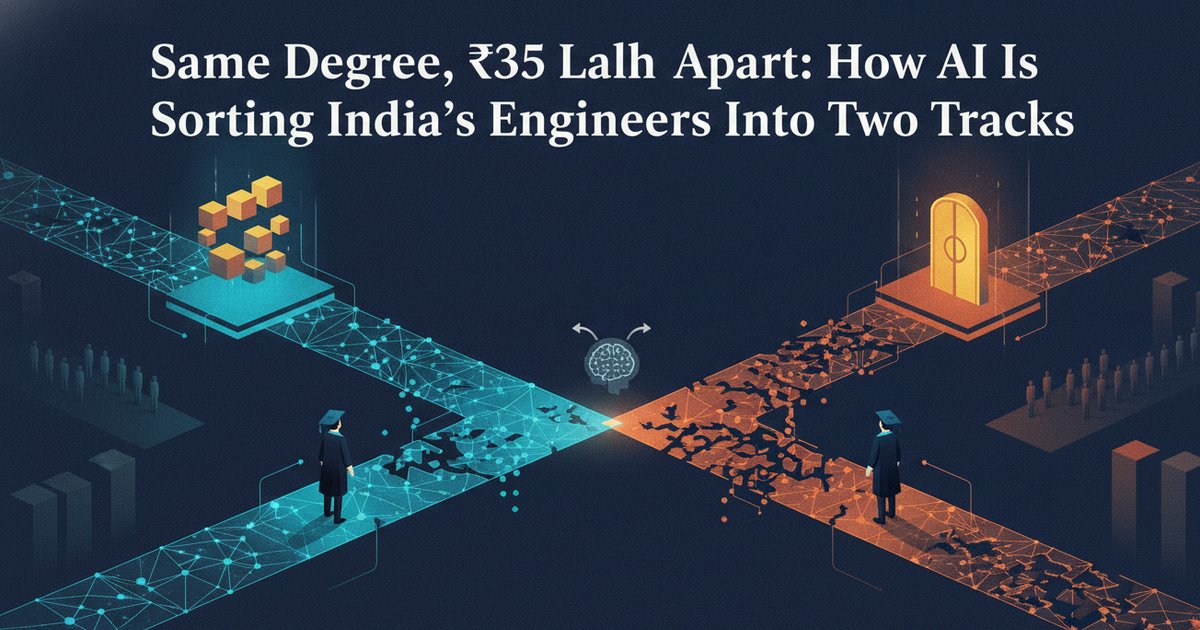
Picture two engineers. Same college, same graduating year, same branch, similar CGPA. One signs an offer that starts near the bottom of the generic IT band. The other walks into an AI/ML role at a product company starting tens of lakhs higher. Nothing about their degrees explains the gap. What separates them is a portfolio of AI work and the skills behind it, and increasingly, an AI screens both of them before a recruiter reads a single line.
This is not a story about robots taking jobs. It is a story about a job market quietly reorganising itself into two tracks, and about how early, and how invisibly, you get sorted onto one of them.
The gap, in numbers
Start with what the money is saying. Market salary guides for 2026 put Indian fresher pay across an enormous range, from roughly ₹3.5 LPA for generic IT roles to ₹40 LPA and above for AI/ML roles at leading product companies, according to a Hyring fresher-salary analysis. Treat those bands as directional rather than gospel, salary numbers swing by city, company and negotiation, but the shape of the curve is the point.
The same analysis suggests AI-aligned candidates frequently earn 30 to 50 percent more than peers with identical academic qualifications, a premium recruiters say is widening each quarter. In other words, the credential that used to set your starting band, your college tier and grades, is no longer the thing doing the sorting. A demonstrated ability to build with AI is.
Zoom out and the divide looks structural, not cyclical. PwC’s 2026 Global AI Jobs Barometer, as cited in coverage by Asanify, finds that ‘professionalised’ roles, where AI handles the routine work and humans bring judgement, are growing roughly twice as fast as the roles AI simply makes easier. Read that carefully. The fast track is not ‘jobs that use AI’. It is jobs that pair AI with human judgement, the ones where you decide what good looks like and the machine does the grinding. The slow track is everything AI can quietly absorb.
That is the two-track market in one sentence: judgement-heavy, professionalised roles expanding fast, commodity execution roles flattening. The ₹35 lakh gap between our two engineers is just the most visible symptom.
Why an AI now screens you first
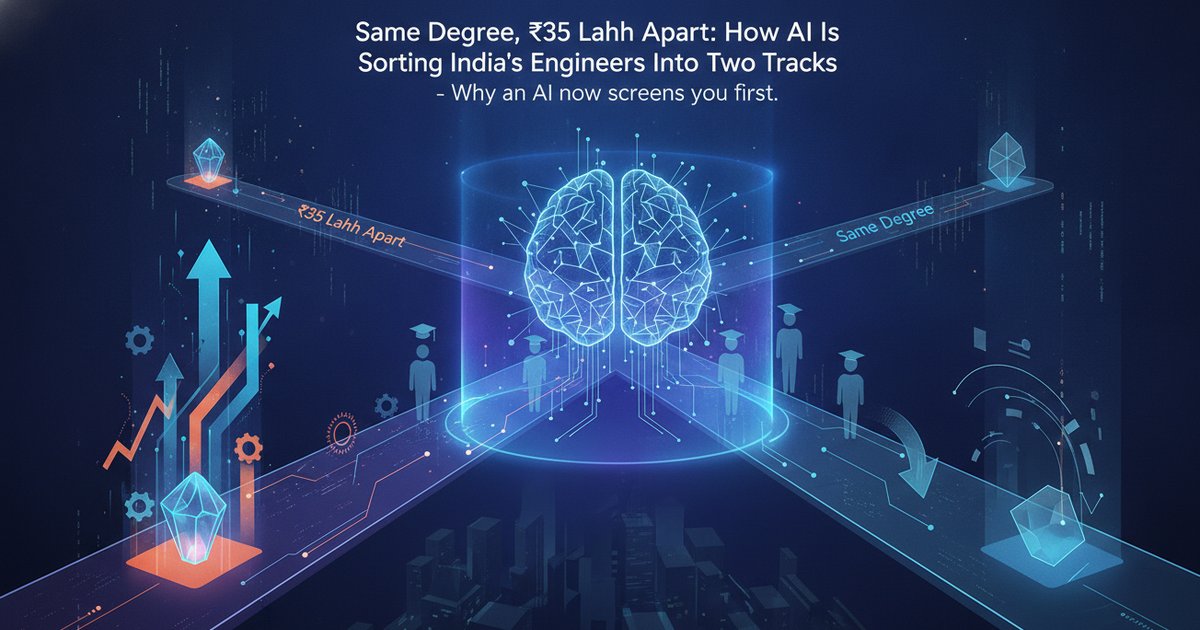
Here is the part most graduates underestimate. By the time a human evaluates you, a machine may have already set your band.
Applicant-screening systems and AI interviewers have moved well past keyword matching. The signals that increasingly carry weight are the ones you can prove: a public GitHub with real commits, projects that actually run, a portfolio that shows what you have shipped. CGPA and college name still open some doors, but they no longer dominate the way they did a decade ago. A strong, verifiable body of work now speaks louder than a transcript, partly because it is harder to fake and easier for an automated system to inspect.
AI interviewers add another layer. They evaluate not just whether your code works but how you got there, the structure of your solution, its efficiency, and crucially whether you handled the edge cases a hurried candidate ignores. These systems are unsentimental. They do not care which institute you attended; they care whether your thinking holds up under examination.
The uncomfortable implication is that the most consequential evaluation of your career often happens before any human is in the loop. Your band, your shortlist, your rejection, much of it can be decided by a model reading your artefacts. Founders and operators reading this should sit with that too: if you are hiring, you are likely already outsourcing your first cut to software, and you should know what it rewards.
The anxiety, and the reality check
None of this lands gently. The anxiety in engineering colleges and early-career WhatsApp groups is real, and it is not irrational.
But the data invites a more honest reading than the doom version. A Perceptyx benchmark of around 23 million employees, again via Asanify, found only about a third feel prepared to use AI tools at work. Sit with that number. The gap between the people who can build with AI and the people who cannot is wide, and that is precisely why the salary premium exists. But the same number is oddly reassuring. If two-thirds of the workforce does not yet feel ready, this is not a closed club for prodigies. It is an open gap, and gaps created by missing skills can be closed by learning skills.
That is the reframe worth holding onto. The PwC finding is not ‘AI eliminates work’. It is that work is being reshaped, with the routine layer automated and the judgement layer made more valuable. Jobs are not vanishing so much as splitting, the rote parts handed to machines, the discerning parts handed to humans who know how to direct them. The threat is not that the work disappears. It is being on the wrong side of that split, doing the part the machine now does better.
The honest takeaway: the divide is real, the premium is real, and the anxiety is understandable. The skills are also learnable, faster than the salary gap might suggest, because the bar most candidates set is still low.
How to land on the right track
If the sorting happens early and an AI does much of it, the strategy follows directly. You win by accumulating demonstrable evidence that you can build with AI and exercise judgement while doing it. Three principles, in order of importance.
Ship real projects, not toy ones. The single highest-leverage move is to build and publish two or three things that actually work. A few that map cleanly to what the market is paying for:
- A retrieval-augmented generation (RAG) system that answers questions over a document set you actually care about, with the messy bits handled, chunking, retrieval quality, and what happens when the model has no good answer.
- An agent that completes a multi-step task end to end, calling tools, recovering from errors, and stopping when it should.
- A working tool that a real person could use, deployed, documented, and honest about its limits.
What matters is not novelty but completeness. A project that runs, handles edge cases, and explains its own tradeoffs tells both an AI screener and a human hiring manager more than any line on a resume.
Build for demonstrable skill, not certificates. Certificates signal that you sat through a course. They rarely prove you can ship. In a market where screeners inspect your actual artefacts, a stack of completion badges is worth far less than one repository that demonstrates you understood the problem and solved it well. By all means take the courses, but treat them as scaffolding for building, not as the deliverable. The deliverable is the work.
Chase the premium where it is concentrated. The clearest salary signal sits around generative AI and agentic systems, the ability to design, build and reason about AI that takes actions rather than just produces text. This is exactly the professionalised, judgement-heavy territory PwC’s barometer says is growing fastest. It is also where the readiness gap is widest, which is another way of saying it is where the opportunity is. If you are deciding where to spend the next six months of effort, spend it here.
The two engineers we started with are not separated by talent or pedigree. They are separated by a few months of deliberate, demonstrable work, and by an early, partly automated sorting they may not have noticed happening. The encouraging part is that the gate is not locked. The market is rewarding a specific, learnable set of skills, and most people have not yet acquired them. Which side of the divide you land on is being decided earlier than ever, but it is still, for now, being decided by what you choose to build.
